


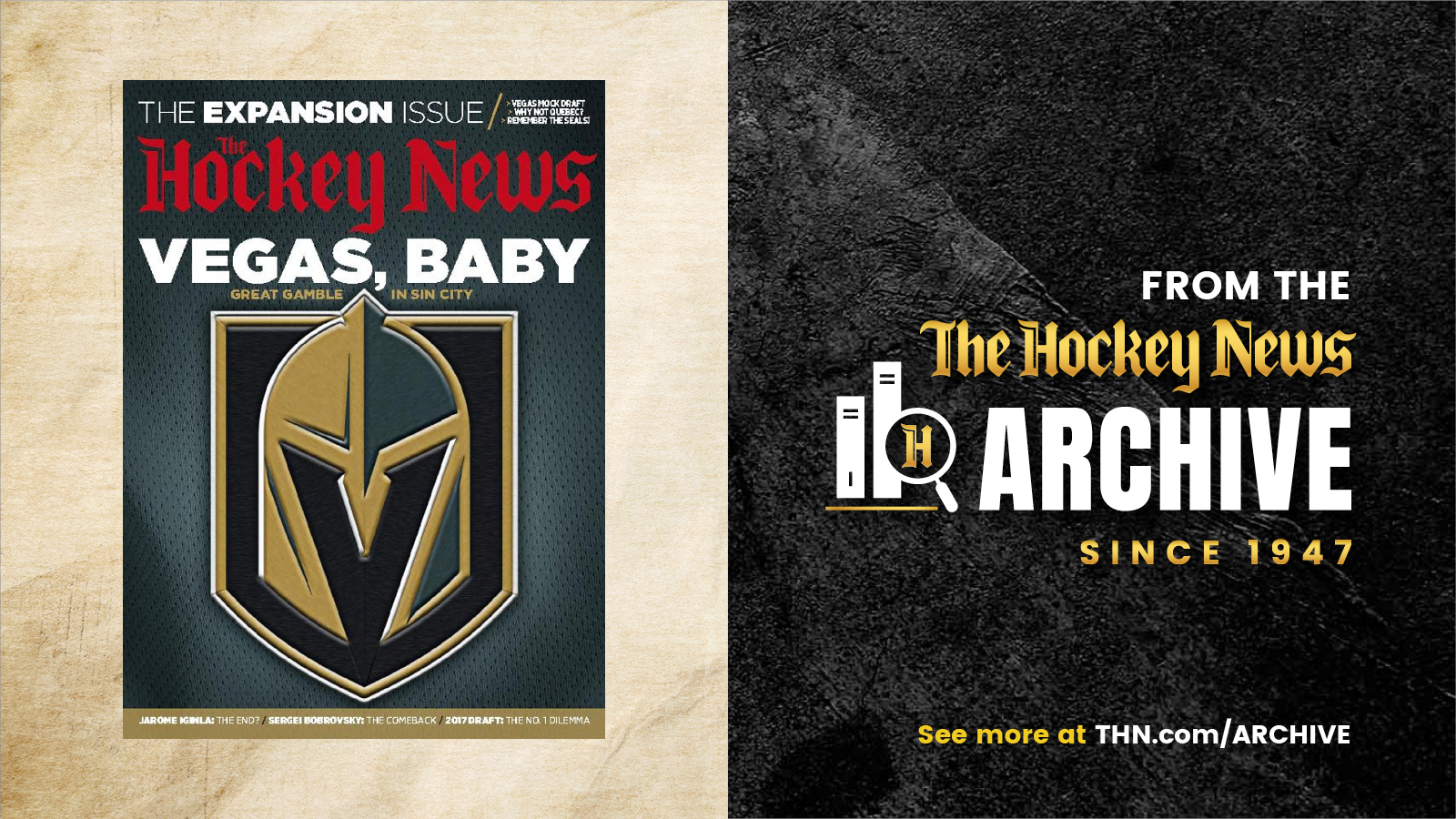
The Vegas Golden Knights came into the NHL with their sights set firmly on the Stanley Cup. And in this THN Archive story from 2017, the Golden Knights laid out their plans.
The Vegas Golden Knights came into the NHL with their sights set firmly on the Stanley Cup. And in this THN Archive story from 2017, the Golden Knights laid out their plans.
In their first year of on-ice opertation in 2017, th Vegas Golden Knights aspired for great things immediately. And in this January, 2017 THN cover story, editor-in-chief Ryan Kennedy profiled the Golden Knights as their management was hard at work right from the get-go:
STARTING FROM SCRATCH
By Ryan Kennedy
David Poile was just a young pup when the Atlanta Flames joined the NHL in 1972, but he learned a valuable lesson right off the hop. Poile, a 23-year-old administrative assistant at the time, was at the expansion draft with Flames GM Cliff Fletcher, where Atlanta and the New York Islanders would get their first players.
After the picks were made, Minnesota North Stars GM Wren Blair came up to Fletcher and offered him a hearty handshake. “Fantastic job, Cliff,” Poile recalled Blair saying with enthusiasm. “Now all you have to do is get rid of every single player you picked, and you can get started on building your team.”
Blair had called the expansion draft shots for the North Stars five years earlier in 1967, so his veiled compliment had some credence. Constructing an expansion team from the ground up is a challenge.
The Vegas Golden Knights are the latest franchise to undertake this mission, and it will be exhilarating and daunting. Right now, the Golden Knights have zero players. But according to Poile – who graduated from Atlanta and is, to this day, the only GM the 1998 expansion Nashville Predators have ever had – Vegas already has job No. 1 accomplished. “You don’t begin with the players,” Poile said. “You begin with the staff.”
And the Golden Knights have assembled an impressive crew. They hired George McPhee as GM, and brought in the smart and savvy David Conte from the New Jersey Devils as a special advisor. Assistant GM Kelly McCrimmon came from the WHL powerhouse Brandon Wheat Kings, while Scott Luce, director of amateur scouting, is a long-tenured executive, most recently with the Florida Panthers. At the other end of the spectrum, Vegas nabbed the young and coveted Misha Donskov from Hockey Canada to be its director of hockey operations, and former U.S. National Team Development Program recruiter Peter Ward is the squad’s U.S. amateur scout. Ward had actually left the NTDP to become an agent with Newport Sports, but the chance to work with McPhee (whose son Graham, now an Oilers draft pick, was recruited to the NTDP by Ward) was too good to pass up. McCrimmon estimates that between Aug. 1 and the first week of September, the team added 35 people to the hockey operations department. Now the group must actually build a franchise.
Expansion drafts are tricky. Although Vegas should get a better crop of players to pick from than past teams did, the Knights aren’t getting top-tier NHLers. Coming in by themselves does give them an advantage, as they’re not competing with another new franchise for talent. That can get complex, especially since existing teams are protective of their own assets. Tom Lynn was the Minnesota Wild’s first assistant GM when the team came into the league in 2000-01, and he literally wrote a book on building an expansion team, entitled How to Bake an NHL Franchise from Scratch. The Wild came into the NHL at the same time as the Columbus Blue Jackets, and one of Lynn’s biggest regrets involved the expansion draft. “I wish we had rescued the deal we made with Columbus to game the draft,” Lynn said. “We would have both gotten three or four more players that we wanted.”
Initially, Minnesota and Columbus had talked about working together to maximize the talent both could land. According to that year’s rules, if a team lost a goalie in the draft, for example, it couldn’t lose a defenseman. And if a team lost a defenseman, it couldn’t lose another. So if the Blue Jackets wanted a certain blueliner from Pittsburgh, they could have told the Wild not to take a Penguins goalie ahead of time. If both teams wanted different defensemen from St. Louis, they would make a deal so that one squad got that guy and the other team got their first choice of Chicago blueliners, for example. But Lynn said Columbus GM Doug MacLean got suspicious of his Minnesota counterpart, Doug Risebrough, on the night before the draft and pulled the plug on the plan. The advantage went back to the NHL’s existing teams.
Not that expansion teams are without leverage, of course. Plenty of deals are made that help established squads keep players they want. When Nashville was picking in the 1998 expansion draft, the Los Angeles Kings were worried they would lose one of their two young netminders, Jamie Storr and Stephane Fiset. Poile agreed to take third goalie Frederic Chabot instead, thanks to a deal that saw Nashville get Kimmo Timonen and Jan Vopat from L.A. in exchange for those “future considerations.” Timonen went on to become one of the most vital Predators defensemen ever.
For the most part, Vegas will attempt to make the best of the lot it’s presented with. The Knights brass expects a wide range of players to draw from, including older guys, players who haven’t reached their potential, expiring contracts, bad contracts – the whole gamut. “The game today revolves around speed, hockey sense and skill level,” McCrimmon said. “But there are no absolutes. There may be players not as strong in those areas that we take because you need a mix.”
Since Vegas will be choosing one player from all 30 NHL teams, it will have a surplus heading into the season. The Knights are still figuring out what their plans will be for an AHL team (they could send players to another franchise’s affiliate until they get their own), but that will also be part of the pipeline. The expansion draft is just the first of two major building events. “Hopefully,” McCrimmon said, “the best player we draft is in Round 1 on Friday night at the entry draft.”
Starting off with an ace prospect is crucial. Minnesota took Marian Gaborik with its first selection, third overall in 2000. Columbus went fourth and got Rostislav Klesla. This may seem simplistic, but Gaborik had Minnesota playing in the Western Conference final three years later. Columbus didn’t make the post-season until 2009.
When the Predators were preparing to join the league for 1998-99, Poile was so convinced of the importance of having a center to build around that he traded a second-round pick to San Jose to move up one spot to No. 2 in the draft. It wasn’t high enough to land Vincent Lecavalier, who went first to Tampa Bay (and then was compared to the greatest basketball player of all-time by the team’s owner, Art Williams). But the Preds did get David Legwand, who would play for the franchise for more than a decade and lead them in scoring in 2002-03.
Vegas will choose no worse than sixth in its first entry draft. The Golden Knights will get the same odds as the third-worst team in the NHL, then will be slated to pick third in all other rounds. So there is a chance Vegas wins the lottery and selects top-ranked Nolan Patrick first overall. That would be especially great for McCrimmon, who used to coach Patrick with the Wheat Kings
And while that first selection is huge, remember the Knights go into the summer with no pipeline whatsoever, so each pick they make brings more importance than it might to a flush team like Washington or St. Louis. That’s why Luce put a big emphasis on hiring scouts with vast knowledge of their individual territories. “The heart and the lifeline are those regional scouts,” Luce said. “We wanted scouts with high character who are low maintenance and hardworking. They get along with others and contribute at meetings.”
Ward’s turf includes the United States League, and his built-in advantage is that the current NTDP draft crop were his last recruiting class, so he has seen topend kids like Scott Reedy and Grant Mismash play for years already.
While it may seem as though stocking up on picks for your first couple drafts would be prudent, none of the hockey minds interviewed believed quantity always trumps quality. “We felt that being in the top 120 was key,” Lynn said. “You’d rather have a fourth-rounder than three sevenths.”
And though the Knights come into the draft with no prospects, it’s hard not to go best player available, even if that means Vegas selects six centers and no goalies. Overall, Vegas must remember success requires patience. “I never put a timeline on it,” Poile said. “That’s impossible to do. You just do your best to improve your team year over year.”
Owner Bill Foley may have broken that commandment when he said the Golden Knights would win the Cup within six years, but that’s just Sin City bluster. He wouldn’t be the first owner to break an unwritten rule with enthusiasm. “Oh, one other tip?” Lynn said. “Don’t call your first pick the Michael Jordan of hockey.”