


By Owen Cameron, The Hockey News intern
Like most professional sports, the NHL is a copycat league, and where teams share some of the most similarities is their power play.
Several formations have been used over the years, including the umbrella, overload, spread and the 1-3-1, which is the formation teams are primarily using now.
The 1-3-1 isolates a point man, two players in line with the half wall, a bumper in the middle and a net-front player.
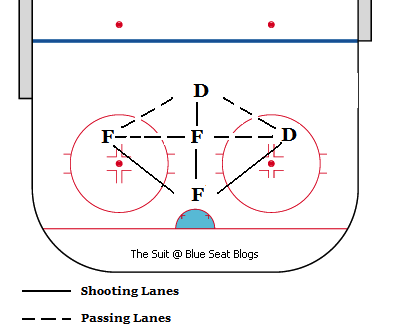
A team that benefited from this formation early on was the Washington Capitals in the 2014-15 season, during which they had the best power play that year, at a 25.3 percent success rate. All-time goals leader Alex Ovechkin potted a career-high 25 goals on the power play that year. One thing that made the 1-3-1 so lethal that year was how Washington changed the way it created offense.
Mike Green was a lethal option at the point with his all-world slapshot, and to the left of him was Ovechkin. They played what I call a push-pull power play. They force bodies to one spot on the ice, showing that one player is a threat (push) before moving the puck to another spot on the ice instead of taking the initial shot (pull). That method is what the Caps have been doing for years. You may ask yourself, “Why is Ovechkin always so open for a one-timer?” It’s because he gets schemed open like an NFL wide receiver.
The Tampa Bay Lightning have also made effective use of the 1-3-1. What makes the Lightning such a threat is they have one of the best bumper players in the world in Brayden Point, who has reached the 30-point mark on the power play four times in his nine-year playing career.
The bumper player is the middle forward who stays between the two players playing on the halfwall. The bumper player makes slight movements around the slot, trying to be an easy option for his teammates to pass to. Point knows where his players are at all times, making it so teams must worry just as much about him as they do his teammates, who happen to be some of the best players on the planet.
Point demonstrates how important the bumper player is when it comes to creating that push-pull method. He draws in the opposition, which creates gaps elsewhere. Point is an elite scorer from the bumper as well; he led the NHL in goals in high-danger areas this past season, according to NHL Edge. Not to mention, he was tied for third the season before and first the season before that one.
Point’s teammate, Nikita Kucherov, is one of the best NHL players on the power play. Since 2012-13, Kucherov is tied for first in power-play points with Connor McDavid at 364.
What makes Kucherov so lethal is the fact that he can make any pass, and he can score on any shot.
A lot of the creation comes from Kucherov on the half wall, and he seems to have a favorite target in Point.
The most recent version of that 2014-15 Capitals power play happens to be the best power play of all-time, the 2023-24 Edmonton Oilers.
This team scored in an insane 32.4 percent of their power plays, the highest rate since tracking began in 1977-78.
Evan Bouchard served as the Oilers' version of Mike Green, while Leon Draisaitl served as their Ovechkin most of the time. I would like to say that Connor McDavid is the Nicklas Backstrom of the Oilers, but McDavid is his own player and can transcend a power play himself, which is also why this unit was so lethal all year round.
The Oilers loved to force opposing penalty-killers to collapse so they could open up a lane for Bouchard, who would let off his well-known ‘Bouch Bomb.’ By forcing teams to collapse, it opened up Bouchard, but when teams didn’t clog the middle, Draisaitl was the marksman on this unit, moving around the left faceoff circle waiting for Bouchard and McDavid to get the puck on his tape. This team created nightmares for PK coaches around the NHL because of how they were able to work it low to high and even high to low while staying in the dominant 1-3-1.
 Leon Draisaitl, Connor McDavid and Evan Bouchard (Walter Tychnowicz-Imagn Images)
One of the reasons teams have converted to the 1-3-1 on the man advantage over the years is simply how good the players are now. The main shots that come from the formation are one-timers, which have become more popular, and almost every player has an effective one. With stick technology getting better as well as the players, it wouldn’t be surprising if this formation is the go-to choice for a long time, simply due to the amount of high-velocity shots players can create, as seen in the Edmonton and Washington examples.
Maybe in a few years, things can change, but in 2025, the 1-3-1 remains unbeaten.
Get the latest news and trending stories by following The Hockey News on Google News and by subscribing to The Hockey News newsletter here. And share your thoughts by commenting below the article on THN.com.
