




Sep 9, 2025 8:26 PM
Updated Sep 10, 2025 9:46 PM
Geoff Seagram turned 88 years old in January 2025, but he still remembers the joy of getting a new Canadian-made wooden hockey stick for Christmas when he was a kid.
But in his case, the delight was greater than it would have been for most other boys his age, because he wouldn’t just get one hockey stick – he’d get a dozen.
Geoff’s family owned and operated Hespeler St. Marys Wood Specialties. Based in what is now Cambridge, Ontario, Hespeler St. Marys was one of the largest and most prominent hockey stick manufacturing companies in the world for decades. That company emerged from the ashes of numerous predecessor companies, and it survives today, after more transformations and ownership changes, as Roustan Sports Ltd. Now located in Brantford, Ontario, Roustan Sports Ltd. is the last manufacturer of wooden hockey sticks in Canada and is also the world’s oldest surviving hockey-related business, with roots dating back to 1847 – a full 20 years before Confederation.
In truth, the story of Roustan Sports Ltd. parallels the story of Canada itself. It’s the story of opportunity, of ingenuity and innovation, of overcoming adversity, of taking pride in our achievements, and of making a positive difference in the world. That’s our history, and that’s Canada in a nutshell.
It was also very much the Seagram story. Hespeler St. Marys Wood Specialties was based in the town of Hespeler, Ontario, which is now part of the city of Cambridge. It was a subsidiary of Canada Barrels and Kegs, also known as Canbar, which was the Seagram family’s main business concern after selling the internationally famous distillery that they had built up and made famous in the nearby town of Waterloo.
Geoff, the great-grandson of pioneer distiller Joseph Emm Seagram, remembers that Hespeler St. Marys was important to the family business despite nominally being only a subsidiary.
“It was a fairly large part,” he said in an interview. “I think my dad was very proud of the fact that they made hockey sticks and that certain NHL players played with them . . . and I think all the grandsons and everybody used to get hockey sticks that we were really happy to have.”
Geoff, a retired pediatric surgeon, attended boarding school in Toronto as a teen and still enjoys the memory of returning to school after the holiday period every year.
“We played hockey at Upper Canada College,” he said, remembering the prep school league that pitted his team against Ridley College, Trinity College School, and St. Andrew’s College, as well as against other teams in Toronto like De La Salle College and St. Michael’s College School. “I have to tell you,” he added, laughing. “I was the envy of the kids at Upper Canada because I got a dozen hockey sticks for Christmas.”
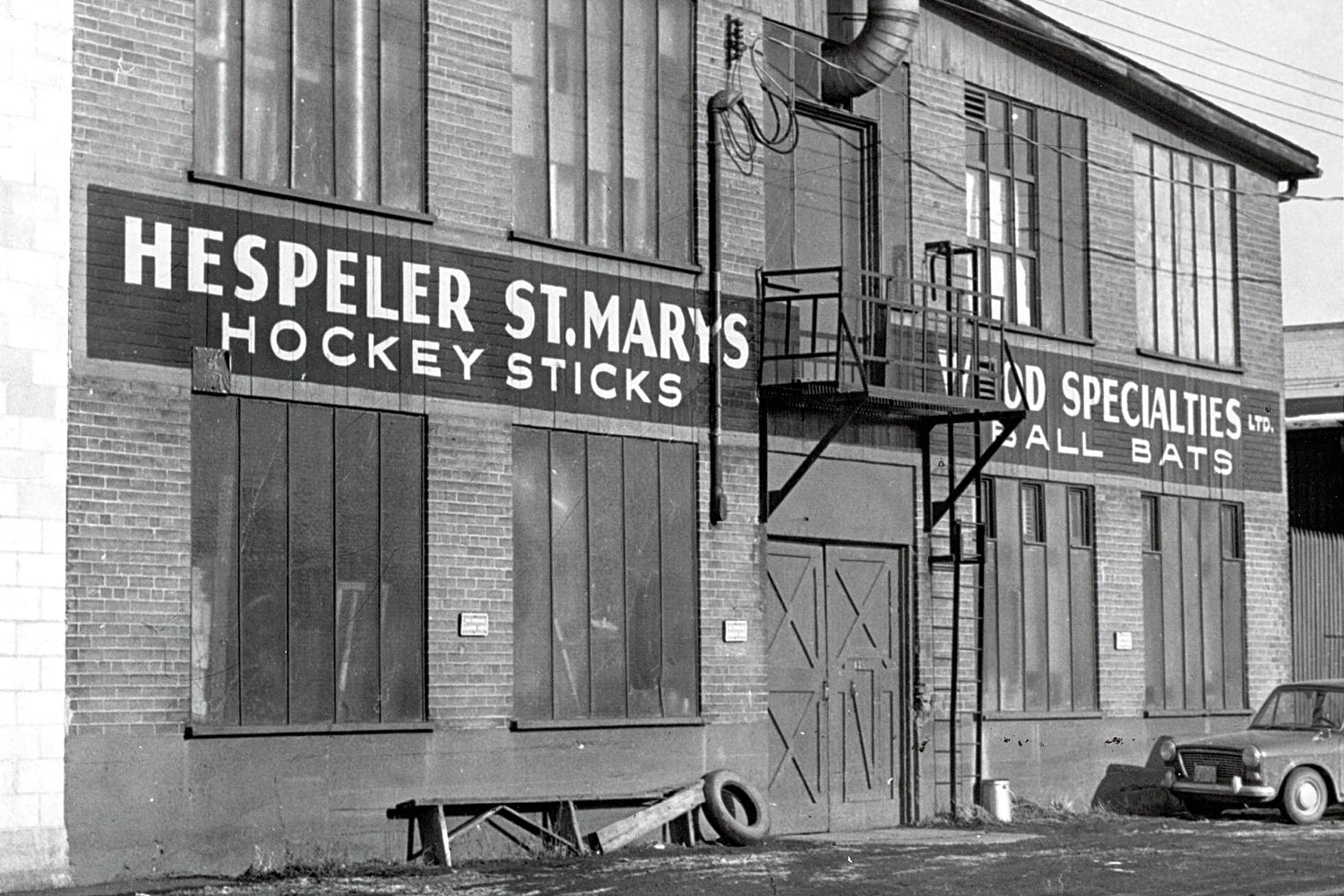 (Heritage Sticks Archives)
It was Geoff’s grandfather, Edward Frowde Seagram, who created Hespeler St. Marys Wood Specialties. He spearheaded the purchase and amalgamation of four separate hockey stick manufacturers at the height of the Great Depression, cementing the family’s involvement with a game they had been playing and excelling at since before the turn of the century. In fact, Edward Seagram has been credited as the person who introduced hockey to the twin cities of Berlin (now Kitchener) and Waterloo. He played high-level hockey and even brought a short-lived professional team to Waterloo early in the 20th century.
This series of articles is about hockey sticks and the men like Ed Seagram who owned and operated the businesses that have created those sticks. Most of them are gone now, and we remember them. The ones who aren’t gone are out of the stick business, with one exception. That’s W. Graeme Roustan, the owner of Roustan Sports Ltd., The Hockey News, and other hockey enterprises, and the former chairman of Bauer Hockey. As Canadian manufacturers of wooden hockey sticks go, he is literally the last man standing. He’s keeping the made-in-Canada tradition alive.
Hockey sticks, according to the late hockey historian Bill Fitsell, are “an integral part of the history of the game. The stick is the one solid thing we have that tells us about the development and history of the game. Sticks tell a story.” (1)
He was right. And this is our story, beginning with two entrepreneurs in a southwestern Ontario community called Ayr.
Jonathon Jackson is a hockey historian based in Guelph, Ontario.
Follow along as we post new chapters of Hockey's Oldest Business – Since 1847 on TheHockeyNews.com.
Read the next chapter: Chapter 1 – Ayr
(1) Bruce Deachman, “What is a piece of hockey history worth? Hastings man looks to sell 19th-century stick,” Ottawa Citizen, December 9, 2020.
1
Comments

Powered by RoundtableBuilt on infrastructure designed for real-time media. Learn more at RTB.io.© Roundtable 2026. By using this site you agree to the Terms of Use and Privacy Policy