


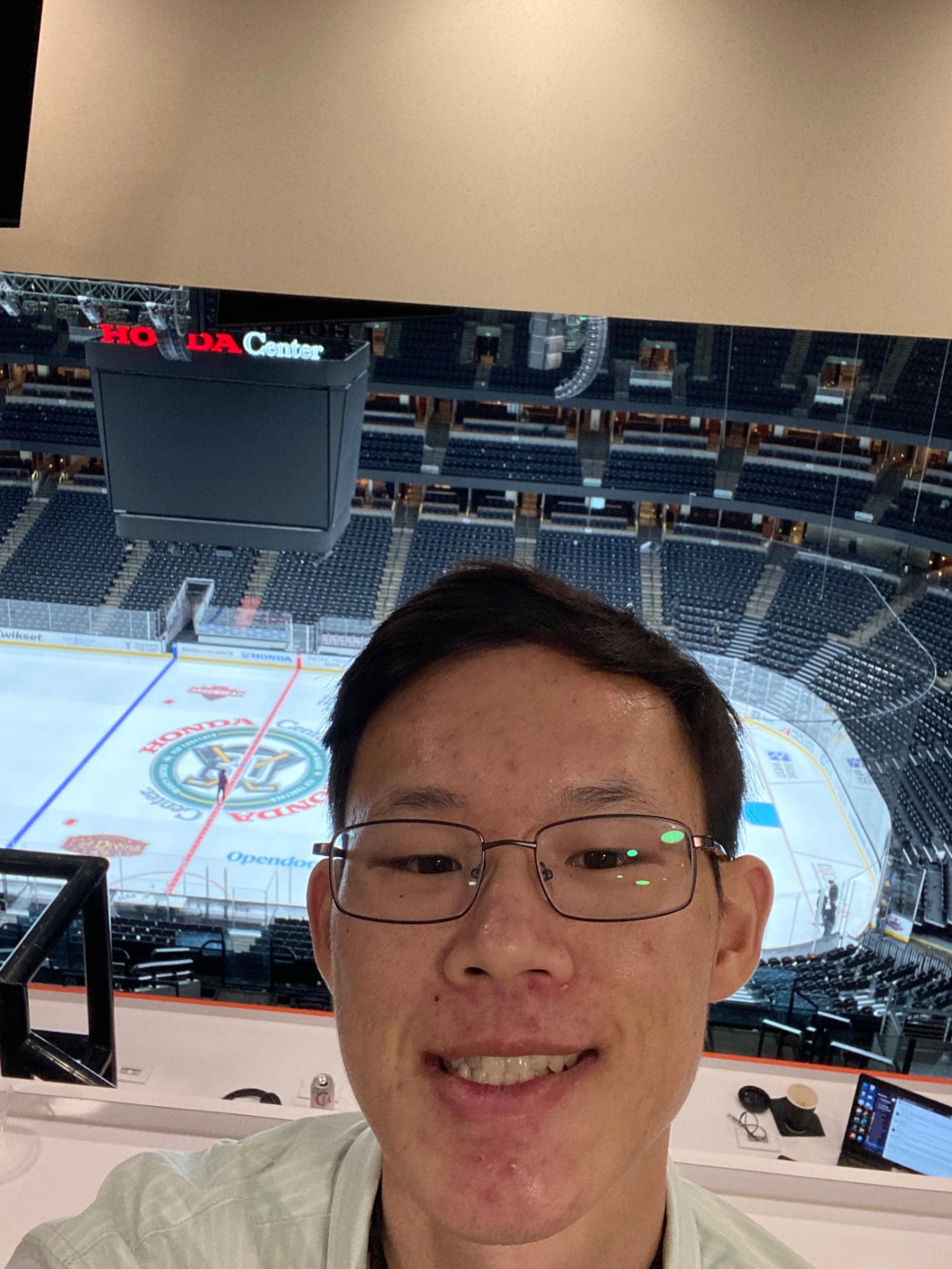

Nov 20, 2025 2:58 PM
Hockey Fights Cancer Night has impacted Ducks goaltender Lukáš Dostál in many different ways.
Hockey Fights Cancer Night holds a different meaning for each person. For Alex Killorn, it's a night to remember his grandparents, three of whom passed away from pancreatic, colon and breast cancer. For Jacob Trouba, it's a night to honor his grandfather, who also passed away from cancer. For goaltender Lukáš Dostál, this night is special for many different reasons.
It was through Hockey Fights Cancer Night that Dostál met Patrick 'Paddy' O'Donnell, a young goaltender from the Carlsbad area who had played youth hockey in San Diego and then spent his high school years playing in the Anaheim Ducks High School Hockey League (ADHSHL). O'Donnell began playing hockey almost as soon as he could walk. The O'Donnell family, consisting of father Hugh, mother Anne, sons Sean, Kevin, Matt and daughter Annie, along with Paddy, often skated at the now-closed Ice-Plex in Escondido while the O’Donnell children were growing up.
"All my brothers expressed interest in playing goalie," Annie said. "My dad was a goalie––and still was for a long time. But, according to my dad, Paddy was the only one who had the temperament to play goal, whereas my brothers get pissed off about a lot of things, easily hold a grudge. Paddy was really good about just kind of, 'Yeah, you get upset about things, but onto the next thing.’ Kind of have that emotional maturity. So once he expressed interest, my dad said, ‘Okay,’ and he was sold ever since. He got his pads (when) he was seven, eight years old. He was young. He was goalie for his mite team, so he’s been a goalie for a long time.”
Paddy played his AAA hockey in San Diego for the Jr. Gulls before joining Pacific Ridge School’s team during the 2017-18 season. He would play parts of three seasons for Pacific Ridge, backstopping them to the ADHSHL Championship in 2020. He also earned a North American Prospects Hockey League (NAPHL) All-Star selection for his performance and was selected as the tournament MVP.
 Photo courtesy of Annie O'Donnell
Following his high school career, Paddy committed to the University of Utah with the intention of playing club hockey and majoring in game design. The COVID-19 pandemic, which had begun just mere months before, limited Paddy’s collegiate hockey options.
“He liked the idea of playing club hockey while still being able to have a life and be a student,” Annie said. “So he went to visit Utah, and this was well before they had the Mammoth there now. He just fell in love with the city. Loved the outdoors, the aspect of it and the fact that they did have a DI and a DII club program, and a women's program as well. He loved the fact that it was in the city, but still had the culture of Salt Lake City. Great food. He's a big foodie, so different cuisine was very important to him. He just knew that's where he wanted to be. He ended up going there, pledged a fraternity. First, he made the DII team starting out, and then he was called up to the Division I program as well. So he was playing on both teams, playing games for both. So there's some times where they would decide, ‘Is Paddy traveling? Where is he going?’ And he practiced with both teams, too. So they'd have early morning practices, he'd do both. I don't know how that kid wasn’t exhausted, quite honestly. But it was so fun because he truly loved it.”
In August 2022, O'Donnell was diagnosed with glioblastoma. Glioblastoma is a brain tumor and the most aggressive and common type of cancer that originates in the brain. O'Donnell was days away from beginning his junior year at the University of Utah when he was diagnosed.
"It was kind of out of nowhere," Annie said. "Over the summer, he started to notice some difficulty gripping his left hand. He got a job as a busboy for the summer, and he was trying to pick up glasses, but he wasn't able to. The last thing you think about is a brain tumor. We're thinking, 'Oh, maybe it's something nerve-wise.' So we got him into physical therapy to kind of work that out. And it seemed to be good. And then one day, he comes home from working with his goalie coach, and he had called me, and he says, 'What are we doing for dinner?' I was like, 'I'm not too sure,' and it just kind of went silent for a bit. Part of me was like, 'You good, bud?' He's like, 'Yeah, yeah.' So I kind of knew something was up. He comes in, he's like, 'I feel really weird. My face is numb, I don't really know what's going on.'
After taking some time to see if Paddy's symptoms would subside, it was determined that he had suffered a stroke. Slurred speech followed by a seizure prompted a trip to the hospital, where Paddy remained for a week.
"We had no idea," Annie said. "We didn't think he was going to wake up. So the fact that he woke up later the day after is still a miracle to this day. But we were kind of under the impression that benign tumors happen; they’re common. We were not led to believe that this was anything, because he had all the blood tests, spinal taps. They ruled out cancer––no worries. And then they went in and did a biopsy. We got the results on my mom's birthday, shit timing. We had no idea. It was a complete blindside there.
“But our mentality and Paddy’s mentality were always that he wanted to fight, he wanted to do anything and everything. (The doctors) gave him six months. Funnily enough, my parents did not tell me or my other brothers that it was six months until he hit a year. And I'm kind of glad they didn't, just because I feel like that would have made things a lot worse, in that sense. And I like that I didn't know for the longest time because once I'm like, ‘Hey, we're at a year. Let's go.’”
A few months after his diagnosis, Paddy was invited by San Diego Gulls goaltending coach Jeff Glass to be part of their Hockey Fights Cancer Night. Paddy read out the Gulls' starting lineup, took part in the ceremonial puck drop and was acknowledged with a Hockey Fights Cancer community award during the game. Afterwards, Paddy spoke with the Gulls goaltenders, one of whom was Dostál.
 Photo courtesy of Annie O'Donnell
"He was basically almost the same age as me," Dostál said. "You are so fortunate to be able to play hockey, right? He was growing up playing hockey, too, and suddenly, he got to know that he has brain cancer that's basically untreatable. Suddenly, your life absolutely changes, and it's just so sad because you can be in the position where you can play the game that he loves as well, but he's not so fortunate. He gets sick, and half of hockey is just basically taken from him."
“The goalie coach down there, Jeff Glass, knows a friend of ours, Geoff Leibl,” Annie said. “His son played with Paddy on one of the Jr. Gulls teams, and we've just remained family friends since. Once news of this diagnosis got around in the community, he said, ‘Hey, would love to get something going with the Gulls with Paddy. I don't know what they could do for him, but a little something where he could go down, shadow, go to a practice or something.’ During that, he went down to Poway down to The Rinks down there, and the goalie at the time down there was Lukáš Dostál, a very young Lukáš Dostál. So (Paddy) was able to sit in on a few video sessions, go down for practices, hang with the team a bit. But he and Lukáš really hit it off in those video sessions where Lukáš would stop and kind of tell him what's going on and why he would look for certain things. Paddy has always been a student of the game. Being a goalie is like a majority of his personality, so he was eating it up. He loved it.
“I think the hardest part was once everything happened, it was hard with just the left side being paralyzed. Getting on the ice just wasn't really possible for him. He was able to get on the ice with help a couple of times, which was great. But as far as fully independently being a goalie or playing in a game again, he knew it wasn't going to happen for him. So that part was hard. Especially since when he had his seizure, he was days away from going to Utah hockey camp, their preseason bonding experience that they do in Idaho. Those moments for him it really was kind of what started the whole friendship, really the foundation of it.
“That was before the very nice Hockey Fights Cancer Night they put on for Paddy, where he was able to go into the locker room, recite the lineup, which was always fun. They invited us to a couple of games before and the stairs going up to that top, I don't think they've updated it since the 70s. (Paddy) had a brace on his leg at the time, but he was marching his way up to sit up with Jeff Glass, because that's where the coaches would sit. Their press box is up against the wall, and he would sit there and watch and take notes. He ate it up. He loved it.”
“We actually had a lot in common,” Dostál said. “When I talked to Annie, for him, it was basically kind of the gateway, whenever he can talk to me about hockey and about everything like that. That was what we would talk about the most, hockey, the different techniques, the way the goalies play and everything. I just really wanted to be there for him. The first time I saw him in San Diego, I’m never a big fan of cameras and stuff. I just felt it was about him, but then I was included in the cameras and everything, but I wanted to be more personal. So that's why I ask Glasser, ‘Hey, I would like to get in touch with him after that night in San Diego. I really wanted to stay in touch with him on, I don't want to say daily basis, but just see how he's doing and everything because I wanted him to feel that he's part of the team and that he's my friend and I wasn't doing it just for the cameras.”
 Photo courtesy of Annie O'Donnell
Following that Hockey Fights Cancer Night in 2022, Paddy and Dostál did indeed continue to keep in touch. The first time they met again after that game, Paddy was three weeks post-brain operation. The two of them had sushi while accompanied by Annie, on her mother’s suggestion. The conversation never angled towards Paddy’s treatment, his medicine or anything related to his condition. It was strictly goaltending discussions.
“That really was remarkable,” Annie said. Lukáš was this way (with) every interaction. He never brought up Paddy being sick. He asked him, ‘Hey, how you doing? How you feeling?’ But he never asked about the hospital. He never asked about treatment, about medicine, nothing. It was not about Paddy being sick, and I think Paddy really appreciated that. Because he loves his friends, and his friends were great to him, but it's hard when you see your friend going through something. It's hard to ignore what's in front of you. Lukáš was really good about being able to do that, and they just talked goalie stuff the entire time, which was fun for me. I got some insight into how goalies think a little bit more. You could definitely tell it was just such a healing experience for Paddy to have that. He kind of had the game stripped away from him, so to feel like he still has that connection really meant a lot, that he could just be a goalie again for that lunch.”
Once Dostál began to receive call-ups to the Ducks and eventually became a full-time NHLer, it was difficult for him to make visits down south to see Paddy, especially with such few days off. But that didn’t deter the Czech goaltender from continuing to keep in touch with his new friend via texts or calls.
“When I went down there, it was around lunchtime when we had a day off and I just tried to grab him whatever he wanted,” Dostál said. “We just hang out and talk, and I wish I could have done it more often.”
“It was so cool to just see anything around revolving Lukáš,” Annie said. “Because Paddy was like, ‘That's my friend’ and just lit up. It made him so happy to see him doing well.”
Thanks to a family friend who had Ducks season tickets behind one of the nets, Annie was able to take Paddy to several Ducks games over the past couple of seasons. The deciding factor for Paddy on whether he would go to the game with Annie would always be if Dostál was starting.
“Something he would always do was try and make Lukáš laugh after the national anthem when he's kind of in the zone before he puts his mask on,” Annie said. “Sometimes, you would see him just making faces, and you see Lukáš let out a smile. It's funny to see because they're so in the zone, but there's moments where he knows that Paddy’s there and he just smiles or laughs."
 Photo courtesy of Annie O'Donnell
A memorable Ducks game with Paddy for Annie came in 2023, after Dostál had been named one of the three stars and pointed at Paddy after giving away the Three Stars stick. Paddy had expected to meet up with Dostál after the game, but the netminder had gotten caught up with postgame media duties. A disappointed Paddy was reassured by his sister that he would be able to connect with his friend another time. Later that night, Dostál messaged Annie, apologizing profusely for being unable to meet with Paddy after the game.
“He said, ‘Hey, I would love to come down if you have time tomorrow,’” Annie said. “(Paddy) had bi-monthly MRIs at that point, just to kind of see the tumor progression because this cancer was so fast that you had to have regular scans just to make sure everything’s stable. Stable became your favorite word throughout this time. I said, ‘Yeah, his MRI is at 4. I can drive him up to Orange County after, before, whatever works for you.’ He's like, ‘I'll come down to Carlsbad.’ So the morning after, I think they had the day off, he came down to Carlsbad and took Paddy to lunch before his MRI. Paddy was always kind of nervous before his MRIs, but it was that gesture that just meant a lot. It meant the world to Paddy and it meant a lot to us, just because the days leading up, you never know. Because we've had scans where it just kind of rocks your world and some scans where you're breathing just a sigh of relief for a couple months.”
Paddy was able to return to Utah for a semester in 2024. By this time, he had to wear an Optune device on his head, which helps slow brain tumor growth. He lived with his best friend and longtime teammate, Ethan Kuhrt, and though his left side was paralyzed due to his stroke, it never stopped him from continuing to live his life. At Paddy’s celebration of life, Kuhrt told a story about how Paddy walked a mile and a half from his apartment to mass and back on Easter Sunday because his friend was working and wasn’t able to drive him.
“That was Patty,” Annie said. “He did what he wanted to do, and he wasn't going to let something like brain cancer stop him. We say that he went back to school. People be like, ‘What? What do you mean he's back at school by himself? What?’ A lot of cancer patients are able to put the Optune device on by themselves, but because Paddy was paralyzed on the left side, it made things a little bit more difficult as far as independence goes. But he did lots of brain injury clinic stuff and just learning. Physical therapy, occupational therapy, speech (therapy). I didn't notice too much for speech, actually, as far as the stroke goes, but just kind of learning how to live with just operating on the right side. And you see him amidst stroke patients who are a lot older, but I think a lot of people saw this 23, at the time, 20, 21, 22-year-old kid in here working so hard to just learn how to live independently one day. He's pretty incredible.”
 Photo courtesy of Annie O'Donnell
When Paddy was diagnosed in 2022, Annie moved back home to help her parents care for her brother. She pointed out how much her parents had sacrificed so that her brothers could play travel hockey. No family vacations were taken and retirement was put off so that all five children could have the chance to attend college.
“I tell people that's one of the hardest parts,” Annie said. “Seeing your sibling battle is really hard, but seeing your parents have a kid have cancer is excruciating. It's those moments where you're just like, ‘How is this fair? What kind of hand (is this)? Where is God in this?’ But my parents never felt that way. They believe God is good. ‘If you're good, good will come back to you.’ They still believe that, despite having to deal with the loss of a child. They're pretty remarkable people. I can't say enough great things about my parents.”
The beginning of 2025 is when Paddy’s health began to decline. He spent five weeks and the entire month of March in the hospital. All the while, Annie kept Dostál in the loop, with the netminder sending along a pair of his custom Vans from the Ducks x Vans collaboration. Paddy was the first person to receive a pair.
“As soon as I got Paddy home, we took him out for walks in the wheelchair and put the shoes on," Annie said. "That was a big thing, getting the full fit. It's like, ‘Hey, let's get ready for the day. That’s important.’ The hope was to get him back to a game, but we weren't able to make that happen, just with travel time, the drive up from North County. Then, sitting there and going back, it just wasn't in the cards. And Lukáš, on Easter Sunday, two days before he flew back home for the summer, came down and hung out with us on Easter. You're trying to pack up your life for the summer. That was very touching and meant a lot to us and meant a lot to Paddy. And that was the last time they saw each other. I was praying that it wasn't going to be, but they just hung out and they watched playoff hockey. It was fun to sit there, Lukáš was talking about some of it, just little tidbits from him and they would just talk shop.
“I would keep him posted. They both had birthdays in July and I had informed him when we made the decision to go into hospice. I told him about that, but he was trying not to be on his phone too much. And I was able to––which I'm very grateful for––tell Paddy about Lukáš’ contract. He just smiled really big, he was really proud. He said, ‘How much?’ I told him the amount and he was like, ‘He could have gotten more. Why didn't he get more money?" I was like, ‘Oh, you gotta ask him that, not me.’ I knew the hockey community talks, so the morning he passed, I did message Lukáš immediately. I would have felt awful if he had found out from somebody else and not us. He sent a really nice message. He was shocked because he didn't reply to my message about him going into hospice. My last thing I wanted was for him to be out of the blue, so I don't know if that did happen. Kept him in the loop as much as I could.”
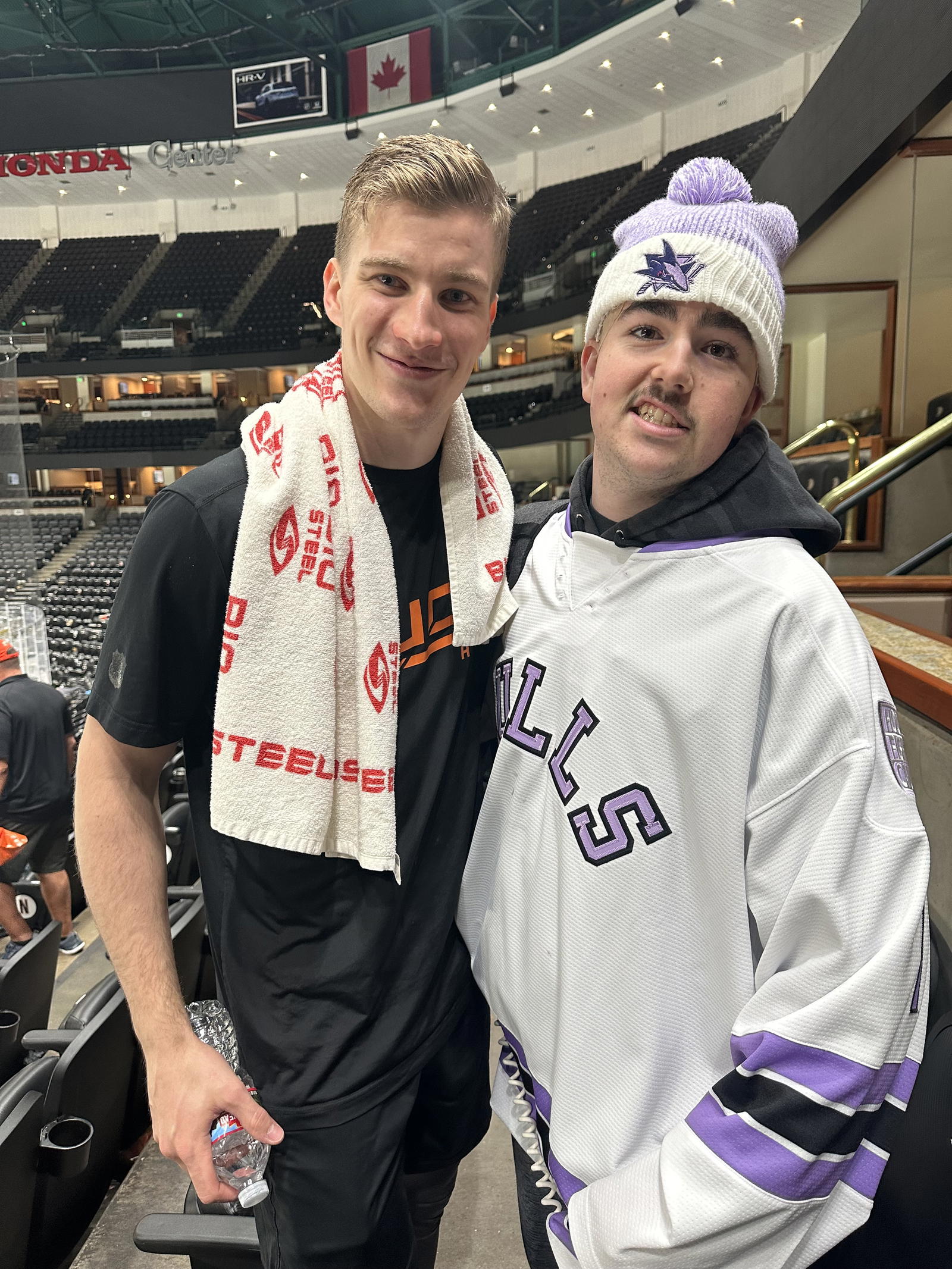 Photo courtesy of Annie O'Donnell
“Right before I left, Paddy was right after chemo treatment and he wasn’t in the best shape, unfortunately, so it was kind of sad to see because some days when I saw him, he was happy, smiling, getting better,” Dostál said. “And suddenly, it hit him again, and he needed to do chemo or some experimental treatments and it took a hit on his body. So when I saw him last time, he wasn't in the best shape, but I still was so glad that I could see him and see his family again.
“The spirit he had watching all our games, he was very important support for me, and I was trying to support him back. It’s just so sad what happened to him, but I really believe he's in a better place now and he's playing hockey and he's happy there.”
“The fact that he was able to 1) Get back on the ice, 2) Go back to school is almost unheard of,” Annie said. “The average prognosis for glioblastoma is 19 months since diagnosis. So the fact that Paddy lived for three years, he's in the 3% of people with diagnosis. There’s some days where it just feels really cruel and unfair for what happened. You think about those metrics and you just think, ‘How incredible,' how hard he fought, the fact that he was able to do anything and everything. He had so much trust in his doctors and in us to make the right decisions for him and to provide the information. He was able to make decisions as well, up until he wasn't able to make decisions for himself. To this day, it’s still really inspiring and eye-opening.”
Another reason why Dostál connected so well with Paddy is because Dostál lost his grandmother to pancreatic cancer when he was a teenager. Since fifth grade, Dostál’s grandmother would cook homemade meals for him because his father didn’t want him to eat the school food.
“My dad didn’t want me to eat the crap in the school,” Dostál said with a grin. “He was just like, ‘Hey, you're gonna eat at home, you're going to have real food.’ It was always old-school cooking, so a lot of meat, a lot of fat there. She was very close to me. I miss her every day.”
Even before her diagnosis, Dostál said that his grandmother had tumors in her head that affected her motor system, causing her to lose her balance from time to time. During the spring of 2019, Dostál had moved to Finland to play for Ilves and had just signed his entry-level contract with the Ducks. His grandmother had been complaining about pain in her stomach, but because of the tumors in her head, the doctors weren’t sure what the cause of the pain was. Two months before World Juniors in Ostrava and Třinec in the Czech Republic, Dostál’s grandmother was diagnosed with pancreatic cancer.
“It was a hard diagnosis because her family, they have a couple of doctors there and they said that five to 10% of people survive,” Dostál said. “So, suddenly the hope (is gone). You still have hope, but with all the tumors and everything, with the health issues that she had throughout her life, you knew that chances are probably very slim. So for me, it was a very hard moment when I saw her all healthy (when I’m) leaving to Finland. Right before the World Juniors, because it was in Czech, I had a chance to see her. And suddenly, she went from the point A to absolutely low. Obviously, her pancreas didn't work well. She got hepatitis, her skin was yellow. Suddenly, I saw I saw her there and I was like, ‘Wow, that's almost unbelievable what cancer can really do to you, all those chemos and everything.’
“And then the doctor said, ‘We probably cannot even do the surgery due to those tumors and everything and the condition she was (in), she might just pass away on the table. So we all decided that she's going to go home, and literally the last day before they wanted to release her home, she broke her hip in the restroom because (of) the motoric center. So they did the surgery for that. She survived that, and then we got her home and then COVID started. I was in Finland at the time and I couldn't leave the country. I could, but then I wouldn't be able to return. And then she unfortunately they passed away.”
“Being a Ducks fan, I had known of who he was, and I was appreciative of his kindness to my brother,” Annie said. “He opened up a lot about the loss of his grandmother and how that impacted him while he was away at juniors.”
“It’s hard,” Dostál said. “But I was able to process it. I didn’t really have any other option. It was hard. It was hard.”
Sudarshan ‘Sudsie’ Maharaj has been part of the Ducks organization for over a decade. Dostál has known him since being drafted by the Ducks in 2018, more than seven years ago. Like Dostál’s grandmother, Maharaj was diagnosed with pancreatic cancer in 2023. After 11 rounds of chemotherapy, he was declared cancer-free.

“Every day is a gift, right?” Dostál said. “He went through the battle. He was very fortunate they found it early, but it still took such a hit to his body. But he survived all that and he’s a cancer survivor and warrior. Just unbelievable that he can be here with us.”
Dostál has learned many things from Maharaj over the years, but the lessons he’s gotten the most out of have been about things off the ice.
“Just always be a good person," Dostál said. "Always be positive. Smile every day. Work hard. I learned a lot, more of the life lessons, the advice he gives you (on) how to be a good human being.”
The jersey that Dostál gifted to Paddy on that Hockey Fights Cancer Night in 2022 was worn by Paddy at every Ducks game he went to after that. It went to college with Paddy, it hung in his room when he was back from school, it was in his hospital room and it was still there when Paddy was moved downstairs to the room where he would spend the final months of his life.
“It was a reminder for him,” Annie said. “Where this really solidified it for me was when he brought it back to school. Going back to school with a device on your head, you're not able to drive, you have so little independence. But that was his goal, getting back to school, being a normal kid, trying to live his life as normally as he could. Seeing that jersey really reminded him that he had such a strong support system. Even if he was away and even the times he felt alone, he never was alone.
“And Lukáš was such a huge part of why Paddy felt that way. As his sister, I'm forever in debt to him for that. And you hate the idea of your brother feeling alone, even though I can be smothering––and I am smothering as a big sister––and remind him that he's loved and tell him all these things, he's so strong. But I think looking at that jersey and seeing that, he knew he was strong. He knew he was loved and he knew how divinely supported he was for people that were not obligated to love him, like our family.”
After the national anthem concludes before each Ducks game, Dostál does a motion similar to the Catholic hand gesture and then points to the sky. When asked about it, Dostál said that he’s keeping people like Paddy and his grandmother in his mind.
“Just people that I love that passed away. I kind of pray for them.”
6
Comments

Powered by RoundtableBuilt on infrastructure designed for real-time media. Learn more at RTB.io.© Roundtable 2026. By using this site you agree to the Terms of Use and Privacy Policy