



Sep 23, 2025 6:13 PM
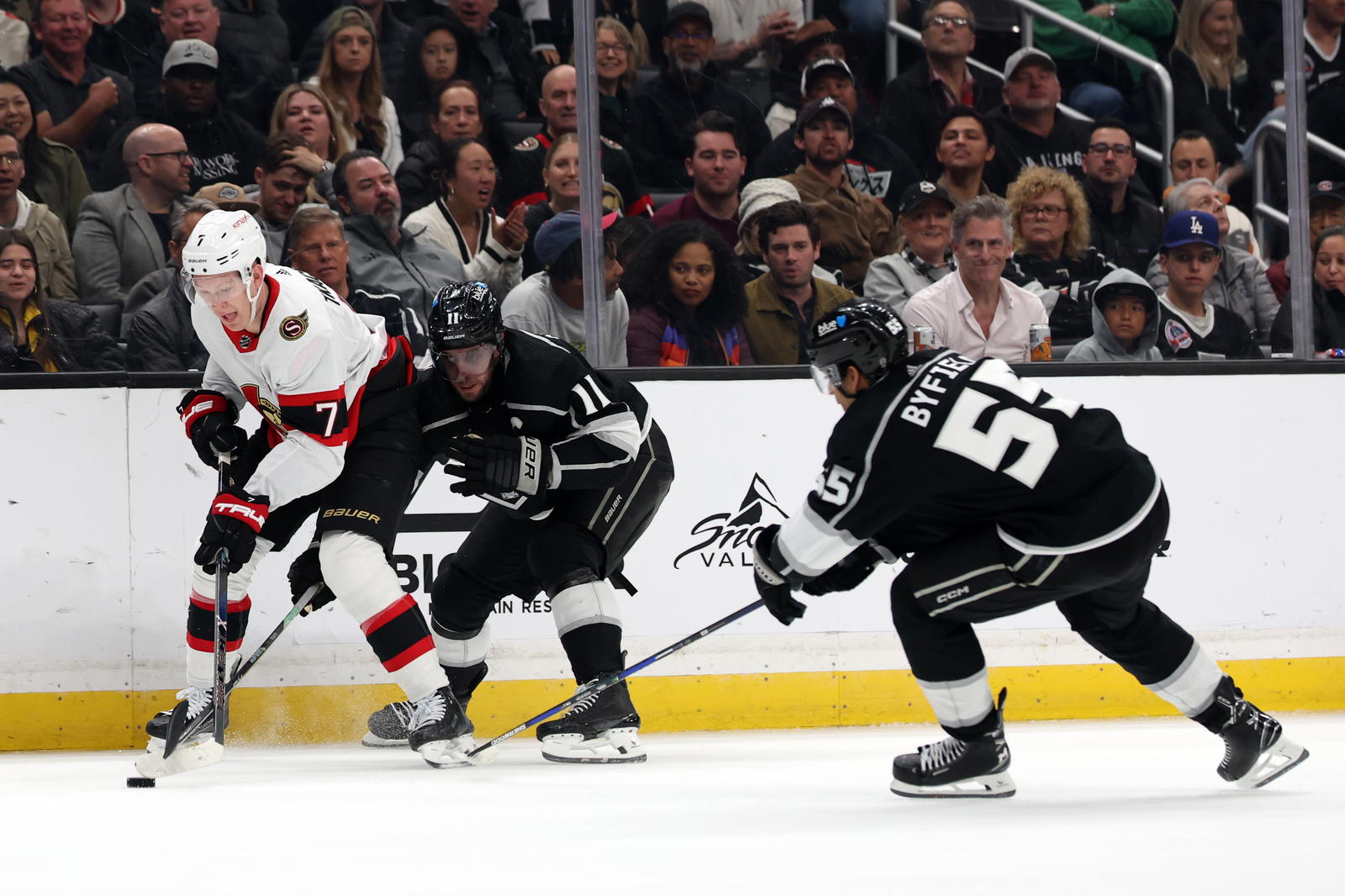 Credit © Kiyoshi Mio-Imagn Images
EL SEGUNDO, CA — For the first time in twenty years, the Los Angeles Kings' next season will be without the presence of Anze Kopitar. The Slovenian lock for the Hall of Fame has been everything a franchise could ask for in a first-line center: a two-time Selke Trophy winner, consistent point producer, two-time Stanley Cup champion, and captain. With Kopitar announcing that the 2025–26 season will be his last, the Kings are going to be at a crossroads. Can Quinton Byfield, the 2020 second-overall pick and top center hopeful, step into those massive skates?
Can Byfield truly step into those massive shoes, or are the shoes a little too big? In all fairness, it's an arduous task for any center to come into. For the young centerman, some boxes get checked off, while others remain unfulfilled.
Byfield's first few years in the NHL were plagued by injuries, illness, and an interrupted developmental track. This bumpy road left many questioning whether he would reach the ceiling expected of a No. 2 overall pick, sparking an intense and ongoing Tim Stutzle vs. Byfield debate. In the past two seasons, however, Byfield has carved out a distinct identity as a reliable two-way center with offensive upside, projected towards a promising future in LA.
His skating, particularly for a 6-foot-5 player, with the ability to handle the puck like a 5-foot-9 forward, stands out as elite. He no longer resembles a raw project that has undergone fumbled development into the league; he looks like a player rounding into form.
Last year, his point production was right on track with the season prior, when he was on the top line with Kopitar and Adrian Kempe. This past season Byfield took on full-time center duties. During of which, he showed that he can drive a line, create offense through vision and puck protection, and be tasked with shutting down top competition. The fact that Team Canada extended him an Olympic camp invite underscores how he's now viewed in the broader hockey world: not just as a developing talent, but as a potential top-tier center.
What made Kopitar a household name across the league wasn't the point totals; it was his ability to shut down the opposition's best on a night-in, night-out basis. Byfield is trending towards filling that same mold. His length allows him to disrupt passing lanes, and his anticipation makes him a penalty-kill asset, which saw full-time deployment last season as a shorthanded threat. Jim Hiller trusted him in heavier defensive situations from the second half of the previous season onwards, a sign that his game is maturing. If Kopitar's legacy is Selke-caliber hockey, Byfield is quietly walking that path, maybe not to the same tier, but making strides with the upside of being more physically imposing and more fleet of foot than Kopitar ever was.
 Kopitar and Byfield top center matchups from last season via NaturalStatTrick
One of the most important aspects is that Byfield is only 23, knocking on the door of entering the prime years where forwards typically break out. With Kopitar departing, ice time and responsibility will flow directly to him. Unlike the vast majority of Kings' prospects, Byfield has had the benefit of apprenticeship under Kopitar and Phillip Danault, two of the league's better defensive centers. That mentorship, combined with his natural talent, positions him well to take the mantle.
Concerns
Byfield has shown significant growth, but he has not yet demonstrated the ability to consistently finish plays and rack up points at a level expected of a true No. 1 center. Most top three picks at center that get the baton as the team's number one start much earlier, as Byfield has dealt with early career setbacks to injury, illness, and blockage up the roster chart. Production-wise, Kopitar at the same age was already putting up 70-point seasons as the 'guy' in LA. Byfield has yet to hit that stride, and in a league where elite centers are expected to produce offensively, his development curve remains behind.
Flashes of Byfield's brilliance have too often been followed by stretches of quiet play. Even during his most encouraging portions of last season, Byfield hasn't put together the type of dominant 20–30 game runs that signal an emerging star. While he scored five goals in five straight games last season, he would only score six in his following 16 games. Many, including myself, would argue that while his toolkit is undeniable, he hasn't proven he can carry a line game in and game out, especially against top Western Conference matchups like Connor McDavid, Nathan MacKinnon, or Jack Eichel.
 Even strength metrics from last season don't exactly scream high-end center, though he was partnered with Tanner Jeannot and young Alex Laferriere for large stretches of the season
It's also fair to question whether the Kings are putting too much weight on Byfield's shoulders without the support below him. The former fifth overall pick, Alex Turcotte, is looking to be either a top six fixture as a complementary winger or a depth center, coupled with the element of no other elite center prospects in the pipeline. Los Angeles' organizational plan practically demands that Byfield become Kopitar's heir in a hurry. That pressure may be necessary, but it is a guise for poor asset management of the past, and an ill-timed retooling under a separate administration. These factors could expose shortcomings if Byfield's offensive game never fully blossoms. The Kings may need to look externally, via trade or free agency, to find a true 1C or a high-end 2C, if Byfield grows into a top center himself or, at worst, an elite 2C.
As a reminder, due to the market for talent and the surrounding aspects of the franchise, the team fell flat on its face in the last free agency period, whiffing on any high-caliber players. Things could drastically change by next offseason, but it is an element to keep in mind with Kopitar's salary coming off the books.
The answer to the Byfield question has implications that extend beyond just one player; it reveals an organizational weakness. If he becomes the number one with ease next season, being given the gift of Kempe at the wing, pots 70+ points, the Kings' future looks stable. Byfield would anchor the top line, Danault would handle defensive matchups, and a young core of Alex Laferriere and Brandt Clarke would grow into their own, complementing the attack. But if he cannot make that leap, the Kings risk entering a new era with a glaring void at their most important position.
 The trio of Laferriere, Fiala and Byfield showed elite potential. Once together, they became one of the best lines in the league.
In the NHL, Stanley Cup contenders always have a legitimate first-line center, elite, and in his prime. For the Kings, the difference between relevance and another cycle of mediocrity may not hinge on the fact that he needs to be the next Kopitar, but whether or not he can just be an elite center in this league. That checks off a significant box for the franchise, maintaining relevancy.
So, is Quinton Byfield ready to ascend the throne? He's on track, having seen his defensive play mature, his confidence rise each season, and his elite skating give him a solid foundation. The skeptical view is that he still lacks the scoring punch and consistency required to be a true successor.
What's undeniable is that the moment is coming, whether he's ready or not. With Kopitar's retirement just next season, the Kings have no choice but to hand Byfield the keys. The ace in the hole is that Byfield has yet to be geared with a bonafide threat like Kempe on the wing, for a full season.
The 2025–26 season may not just define his career; it could determine the trajectory of the Kings for the next decade.
2
Comments

Powered by RoundtableAn AI/DeFi-powered Enterprise Media Operating System. Learn more at Roundtable.io.© Roundtable 2026. By using this site you agree to the Terms of Use and Privacy Policy