



Nov 13, 2025 5:24 PM
In Anaheim, it appears that the kids ARE alright.
On Nov. 13, the Ducks sit atop the Pacific Division and are second in the Western Conference. While media outlets around the league pegged the Ducks as a possible playoff contender, few could have predicted this kind of early season success.
Currently holding the third-best record in the league, the Ducks have been led by their young superstar in the making, 20-year-old Swedish forward Leo Carlsson. Carlsson scored his 100th NHL point on Tuesday to extend his point streak to 11 games. He is the youngest Ducks player to reach 100 NHL points. Carlsson was also named one of the NHL’s Three Stars of the Week for this past week.
“He seems to be looking like he wants to take that next step and be one of the top players,” head coach Joel Quenneville said. “His speed has been unbelievable in the middle of the ice. Has the puck a lot, wants the puck, makes plays. Plays all-important minutes for us and seems to be getting better every night, so it's a great sign at this stage of his career. He's making a big improvement on an early basis, on a regular basis to start the year. So, we're very happy with him.”
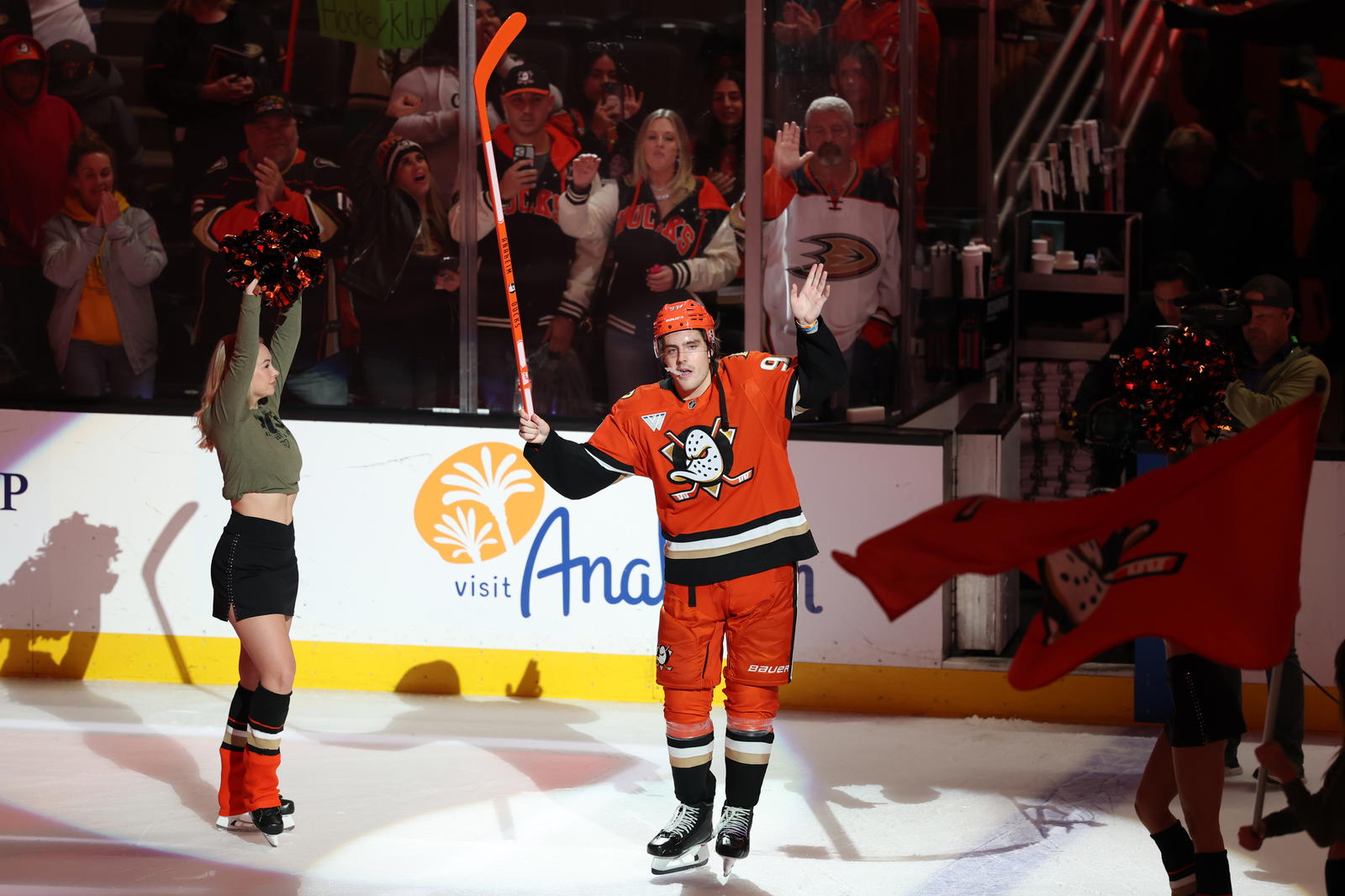 Nov 9, 2025; Anaheim, California, USA; Anaheim Ducks center Leo Carlsson (91) waves to fans as he is named Second Star of the Game against the Winnipeg Jets at Honda Center. Mandatory Credit: Kiyoshi Mio-Imagn Images
Carlsson is not the only Anaheim youngster who has been making waves this season. 21-year-old Cutter Gauthier is tied for fourth in the NHL in goals scored (11) alongside a handful of players, which includes the aforementioned Carlsson. Gauthier recently had an eight-game point streak snapped, but scored his first career NHL hat trick on Nov. 4, a four-point outing. He is currently tied with Nathan MacKinnon for first in shots on goal (74) and has been a lethal weapon on the Ducks power play after being elevated to the top unit following Mikael Granlund’s injury.
For as dangerous a weapon as his shot is, Gauthier focused on improving his speed this offseason in an effort to become more of an offensive dual threat.
“I feel like halfway through (last season), I kind of realized that I'm a pretty fast player and I'm able to beat guys wide with my speed,” Gauthier said. “I just wanted to really emphasize that this summer, being really good laterally, not just straight-line speed and crossovers and stuff like that. I'm looking to use my speed as much as I can and try to force defenseman back to create lanes for my team, my linemates and try to get some breakaways, too. I think speed kills and the more I focus on that, it'll pay off.”
“I think the shot is excellent, but I think his speed is what makes the shot effective,” Olen Zellweger said. “ Lots of guys have pretty great shots, but he's able to get open. He's able to use it off the rush. He obviously shoots a ton, so they're bound to go in. He’s shooting a lot. He's got a great shot, but he's able to use it because his speed's so effective. In practice, going against him, you know how fast he is. He’s a really fast skater and makes it hard on their defensemen.”
“Just knowing that you have an extra half a second to make a play instead of rushing it,” Gauthier said in the difference between last season and this season. “I think last year, I’d try to rush to get the shot off really quickly and I didn't realize how much time I had. That’s why (I was) probably whiffing a lot of pucks. Now, I know I have maybe an extra half a second to make a play, whether it's a pass or a shot and, ultimately, get all of it on it.”
Gauthier’s most consistent linemates have been 22-year-old Mason McTavish and 19-year-old Beckett Sennecke. Anaheim’s ‘Kid Line’ has contributed 42 combined points through 16 games and holds a 61.5 expected goals percentage, per Moneypuck. McTavish has been developing his offensive toolbox this season, adding another layer of playmaking and doing well to hold onto pucks down low and along the boards in the offensive zone.
At times, Sennecke has certainly looked like a 19-year-old playing his first set of games at the top level, but he has also been ironing out some of the bad habits that players can get away with in juniors, but are punished in the NHL. His long reach has aided him with takeaways and created rush opportunities for himself and his teammates. It’s likely that he will remain with the Ducks for the rest of the season.
Jackson LaCombe holds down the backend, fresh off a breakout sophomore season and an eight-year contract extension that he signed just over a month ago. Though it’s been veteran Jacob Trouba leading the charge offensively so far this season, LaCombe averages over 25 minutes a game and is trusted in all situations by Quenneville as the No. 1 defenseman.
“Last year, I kind of started to play more minutes,” LaCombe said. “I'm prepared to play whatever situation or opportunity there is. I'm just doing my best to come in in shape. I’m ready to play those bigger minutes.”
With captain Radko Gudas out injured, Trouba has been the lone veteran on the blue line. The rest of the defense has been comprised of Zellweger (22), Drew Helleson (24), Pavel Mintyukov (21), Ian Moore (23) and LaCombe (24). It’s a lot of youth back there playing big minutes, and they haven’t looked out of sorts, for the most part.

LaCombe and Trouba have been the big minute eaters, but Helleson and Zellweger are both averaging close to 20 minutes per game, too. Mintyukov and Moore have also been entrusted with killing penalties from time to time, a responsibility that the previous coaching regime would not have given to them.
“I've been really impressed with his patience with the puck,” Alex Killorn said of fellow Harvard graduate Moore. “A lot of young guys, especially when they come into the league, the game's really fast and they don't want to hold onto the puck too long. They kind of want to get it out of their hands. I think with him, he has the ability to kind of slow things down and he's got so much confidence with the puck that he's able to hold onto it for a second and plays develop because of that. And he ends up making a great play, whether it's a breakout pass or getting a puck through to the net, it's been pretty impressive.”
“The more reps you get and the more time you get with a group, you get more comfortable and you see things over and over, certain situations on the ice,” Moore said. “You also get to know guys better. I feel last year was a great opportunity to just kind of see what it's like and get to meet some guys. And then this year, just kind of sticking to that same thing and just the more time I'm with this group and out there, I think I'm getting more comfortable with certain situations and the group, too. They've been awesome. Just kind of carrying me along for this last stretch here.”
 Nov 6, 2025; Dallas, Texas, USA; Anaheim Ducks defenseman Ian Moore (74) skates off the ice after scoring a goal against Dallas Stars goaltender Jake Oettinger (29) during the second period at the American Airlines Center. Mandatory Credit: Jerome Miron-Imagn Images
The last line of defense has arguably been the Ducks’ biggest constant for the past decade. John Gibson’s departure via trade to the Detroit Red Wings this past summer signaled a change in goaltending hierarchy and after setting career highs in games played and wins for the second consecutive season, Lukáš Dostál was officially granted the starting goaltender job. His five-year contract extension—which came barely three weeks after Gibson was traded—confirmed Dostál’s long-term future.
All Dostál has done to start the season is post an 8-4-1 record with a 2.69 GAA and .908 SV%. His calm demeanor in net has kept the Ducks in every single one of their games thus far, even the losses. His combination of sound positioning and superb rebound control has been complemented by an altered defensive scheme, which now features a zone/pressure system versus man-to-man.
“When you have a goalie who's able to keep you in games (and) make big saves, it gives the team a lot of confidence,” Killorn said.
“He’s been awesome,” Gauthier said. “Having a great year last year, playing a lot of games and knowing that he's going to play a lot this year, still having that same mindset of giving it his best. He’s coming to the rink every single day with a smile on his face and just being a great teammate all-around. I'm super happy for him. I love joking around with him on and off the ice, giving him extra shootout moves or whatever the case is. Super happy for him. He puts the time in and he's really dialed with his craft, so it goes to show the performances he makes on the ice.”
“He’s unbelievable,” Moore said. “You see the saves he makes. Away from that, he’s been helpful for me in getting adjusted. He’s pretty light. He’s certainly focused and dialed in, but he gives us a sense of confidence playing in front of him, which is huge. Just the way he carries himself, little taps or things he says during the game. They’re small, but they go a long way in giving off a sense of confidence for the group. It starts with him and his demeanor in games. You just see by the way he prepares and the way he takes care of himself, there’s no surprise he’s having a great start.”
“He’s a battler,” Quenneville said. “You can see that he's growing every single night in the net and handling the puck well, making some nice plays with the puck as well. But we’ve given up some dangerous chances that he's made some big, timely saves (on) in the last few games. So, it looks like we went on to have easy victories, they were not. They were a lot closer, and goaltending was great.”
While they are the focus of this piece, it hasn’t only been the youth contributing for Anaheim. Troy Terry and offseason addition Chris Kreider have combined with Carlsson for a super-powered top line. The aforementioned Trouba has been playing some of his best hockey and Granlund, who should be back soon, was an offensive fulcrum prior to his injury.
But the youngsters are leading the charge and putting the league on notice. Just how high can these young Ducks fly?
Related articles:
Comments

Powered by RoundtableBuilt on infrastructure designed for real-time media. Learn more at RTB.io.© Roundtable 2026. By using this site you agree to the Terms of Use and Privacy Policy