


Megan DeRuchie-The Hockey News


Dec 4, 2025 9:01 PM
In the early months of Rick Tocchet’s tenure behind the Philadelphia Flyers’ bench, the on-ice systems weren’t the only things being installed.
The other project has been more culture-focused: figuring out how this particular group of players communicates, learns, and responds to direction.
Tocchet isn’t trying to force a one-size-fits-all standard. Instead, he has been calibrating in real time, deliberately studying personalities to be able to get to know his players on a real individual level.
Leadership by Committee
Tocchet openly admits he prefers to give the locker room space to police itself.
“Sometimes leaders can do their own thing on the bench,” he said. “Sometimes a coach has to stay out of it. They can correct themselves. [Travis Konecny] does it a lot, [Garnet Hathaway] will say something. Some of the quiet guys, like, they’ll say something—I love when quiet guys do it because it really wakes up the guys, like, ‘Oh my god, he said it?’ And he’s probably right!”
 Travis Konecny (11). (Megan DeRuchie-The Hockey News)
There’s an important distinction here: this isn’t a “let the players handle everything” philosophy, nor is it a romanticized ideal of a self-regulating team. It’s more practical. When players challenge each other mid-shift or mid-game, those corrections carry a different weight. Peer-to-peer communication hits faster, requires less translation, and eliminates the lag between instruction and execution.
But Tocchet also recognizes the flip side.
“We’re a little quieter of a team when it comes to barking orders on the ice,” he said. “And that’s one thing we have to get better at—have more command on the ice.”
This team can be reserved. They don’t automatically default to vocal leadership. That means the Flyers aren’t just learning systems—they’re learning to externalize them.
Coaching the Individual, Not the Position
Three months into the job, Tocchet is still cataloging how each player processes information. It’s a more nuanced operation than many realize. NHL teams review video, dissect systems, deliver clips, run meetings, and give constant reminders from the bench. That flow of information can be helpful—but for some players, it can be overwhelming and even a bit detrimental to how they play.
Tocchet’s early experience with Matvei Michkov is a perfect example.
“Don’t give him too much,” he said. “I think, earlier on, [assistant coaches] Yogi [Svejkovsky] would talk to him, then Jay [Varady], then me—we’re giving so much information that I think we could frustrate him a little bit.”
 Matvei Michkov (39). (Megan DeRuchie-The Hockey News)
This isn’t a criticism of Michkov; it’s the opposite. Some players thrive when given a long grocery list of adjustments. Michkov, as Tocchet describes, sharpens better when the list is short.
“The last few weeks, we’ve really dialed in how to do it,” Tocchet continued. “Now, it’s like, okay, one coach has him for the day; hey, let’s give him a break and not talk systems, talk about something else.”
The temptation with talented players—especially young ones—is to pour information into every available space. But Tocchet’s staff recognized they were crossing into “over-correction.” They simplified, and the results are showing.
“I think he seems to be grasping it more these last three weeks than he did in the first three,” Tocchet said. “And I think that’s where we as coaches have adjusted. Sometimes we over-coach.”
Different Players, Different Wiring
Tocchet’s contrast of Trevor Zegras and Michkov illustrates how drastically two high-skill players can differ in temperament.
“Trevor you can dig in on,” he said. “He can take it. You can bark at him about D-zone coverage or whatever, and next day, he’s like, ‘Tocc, show me.’ He’s one of those guys. I love that about him. He doesn’t pout and he takes it.”
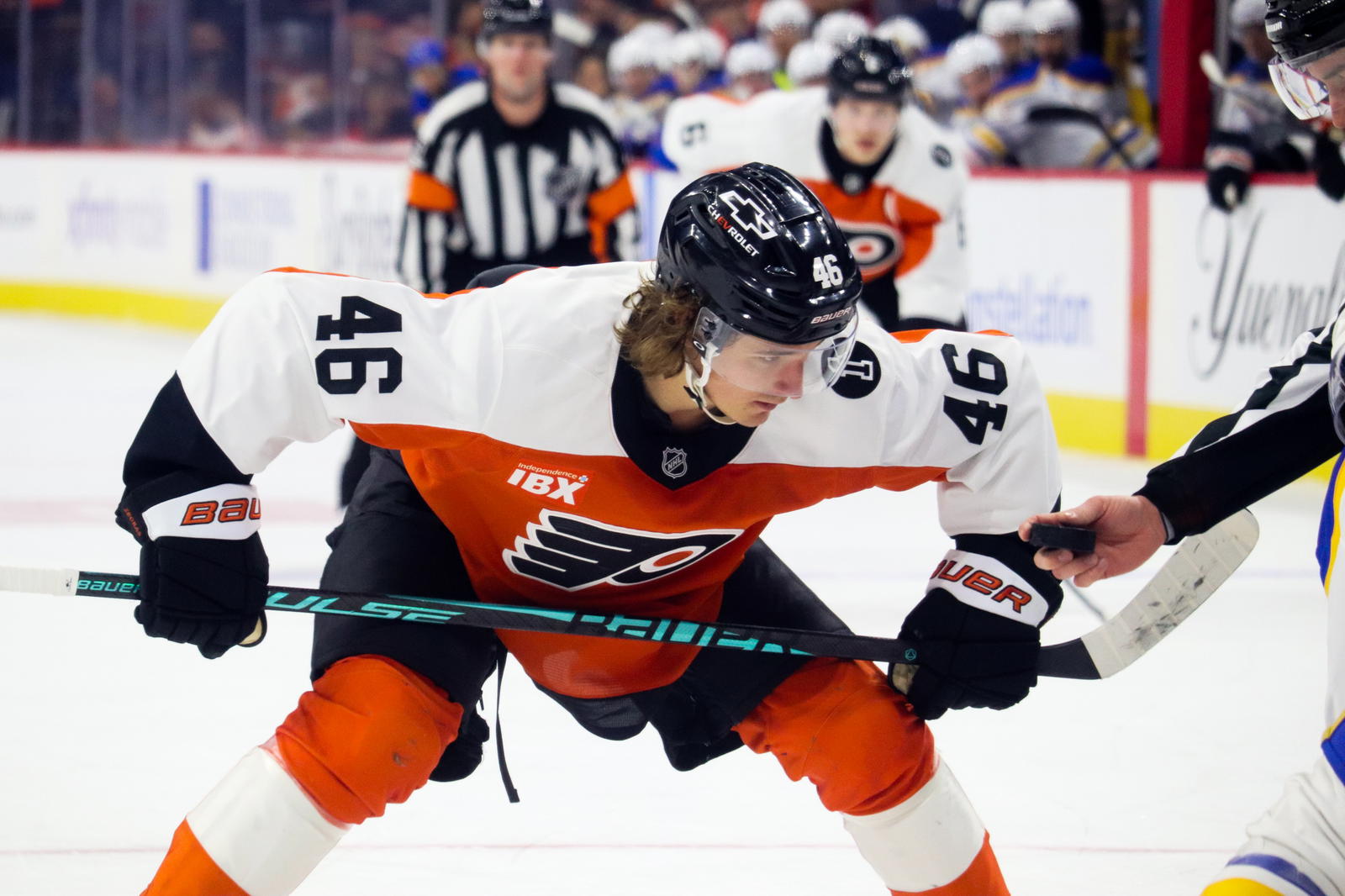 Trevor Zegras (46). (Megan DeRuchie-The Hockey News)
Some players absorb intensity like a sponge. For Zegras, sharp criticism doesn’t feel like pressure—it feels like clarity. Michkov, meanwhile, processes intensity differently. His growth trajectory improves when the environment is clean, narrow, and consistent—one voice per day, one focal point at a time. It means he learns through depth, not breadth.
Understanding these differences—then building small daily habits around them—is where coaching becomes more than diagramming routes on a whiteboard. It becomes interpersonal.
Internal Accountability Is Becoming Structural
Tocchet wants leaders correcting teammates before the coaching staff has to. He wants quieter players to feel empowered to jump in, even if it momentarily surprises the room, and he wants the staff to resist its own impulse to over-explain.
These threads all connect. If the team becomes more vocal on the ice, coaches don’t need to micromanage. If the staff becomes more precise in how it delivers information, players gain confidence and clarity. If players start driving solutions among themselves, leaders multiply instead of bottlenecking.
The emerging picture is a team learning not just what to do, but how to talk about what they’re doing.

The Bottom Line
The Flyers aren’t just adjusting systems, as has become a frequently touched-on topic in Tocchet's tenure so far. They’re adjusting tone, structure, and information flow, and Tocchet’s willingness to tailor his messaging to individual personalities, allow players to self-direct, and rein in the staff’s instinct to over-coach has already made a visible impact.
The team is still learning how to be louder, more directive, more authoritative on the ice. But they’re also learning when quiet is strategic rather than passive, when a single voice is better than three, and when a coach stepping back actually pushes players forward.
1
Comments

Powered by RoundtableBuilt on infrastructure designed for real-time media. Learn more at RTB.io.© Roundtable 2026. By using this site you agree to the Terms of Use and Privacy Policy