




If a report surfaces linking an NHL team to Quinn Hughes, the first reaction is usually some version of: well, of course they’re interested. He’s a franchise-caliber defenseman—one of the best puck-moving blueliners in the world, a minutes-eater, a transition engine, and the kind of modern defenseman you don’t trade unless the return alters the architecture of your organization.
So yes, the Philadelphia Flyers are reportedly among the teams that have at least checked in. Interest alone is not newsworthy; due diligence is routine. What is worth examining, however, is what a Hughes-level acquisition would require in terms of cost, cap structure, defensive identity, and long-term planning—and whether the Flyers have the assets to make such a negotiation more than a theoretical exercise.
The short answer: they do. But the longer answer is more complicated.
Why Any Team—Flyers Included—Would Inquire
The Flyers are building around a young core with multiple timelines braided together. Some players (Owen Tippett, Travis Konecny, Sam Ersson, Cam York) are entering their prime years. Others (Matvei Michkov, Nikita Grebenkin, Oliver Bonk) are at the start of theirs. A defenseman like Hughes fits into both timelines because he’s 25 years old, elite right now, and still ascending.
His value profile is unusually clean:
- He logs No. 1 defenseman minutes.
- He drives play in transition better than almost any defenseman in the league.
- He can single-handedly tilt shot share, zone exit efficiency, and offensive-zone retrieval rates.
- He’s locked into a cost-controlled contract relative to his value.
There are maybe three or four defensemen in the NHL who shift a team’s ceiling as dramatically as Hughes. That is why teams ask—knowing full well the price isn’t just high; it’s structural.
What the Flyers Would Have to Include
This is the part where the conversation has to leave the realm of fan hypotheticals and enter the territory of organizational logic. If a team trades Quinn Hughes, it isn’t for a bundle of “interesting” pieces. It’s for cornerstone assets that replace Hughes’ function and secure future value.
For the Flyers, that means two categories: young roster defensemen who can play major minutes and premium draft capital.
A. The Defenseman Going Back: Cam York or Jamie Drysdale
Any realistic framework begins with one of these names. Not because either player is Hughes—no one truly is—but because they represent a role and trajectory that at least maps onto Vancouver’s needs.
Cam York
York is the closest stylistic parallel the Flyers have to Hughes. He plays a high-volume transition game, logs large minutes against quality competition, and has matured into a defender who can run a power play while also carrying defensive responsibility. York is 24, cost-controlled, and already capable of handling top-pair deployment.
If Vancouver insists on replacing the left-side puck-moving role directly, York is the logical request.
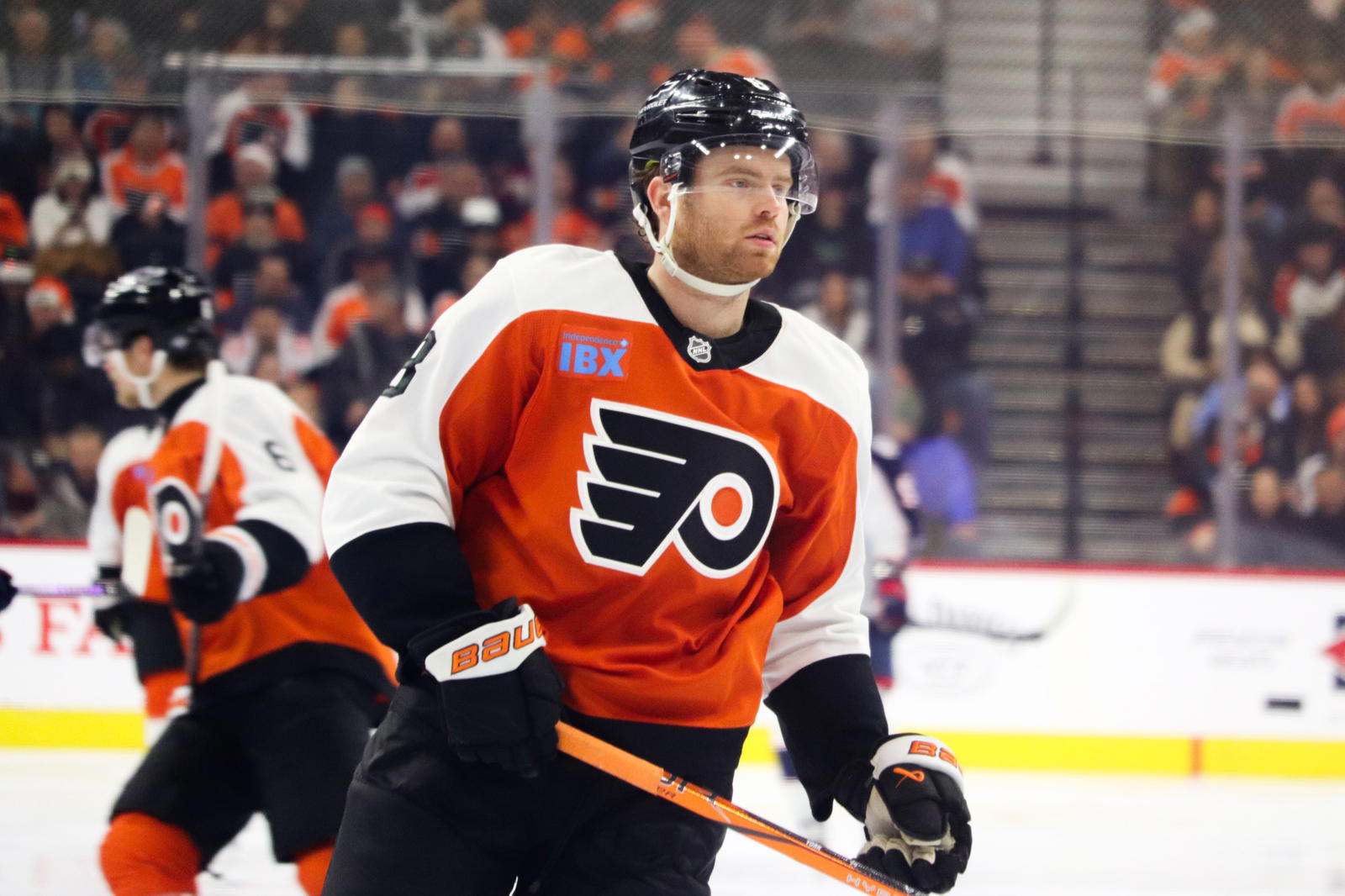 Cam York (8). (Megan DeRuchie-The Hockey News)
Jamie Drysdale
Drysdale is a different kind of piece: a right-shot puck mover who projects as a long-term top-four defenseman with significant upside. His development has been disrupted by injuries and inconsistency, but he's been enjoying an impressive season so far, and his ceiling remains high. Plus, right-shot defensemen with skating and deception carry outsized value.
If Vancouver prefers a different handedness or sees Drysdale as a better long-term fit beside their existing left-side defensemen, he becomes the centerpiece.
In almost any scenario, one of those players is non-negotiable. It’s not a commentary on their talent—both are excellent young defensemen—it’s simply the physics of the trade market.

B. Draft Capital: First-Rounders, Possibly Multiple
This is where Philadelphia’s current asset profile becomes relevant. The Flyers have a surplus of draft picks in their arsenal that would be appealing to any team entering discussions with Danny Briere. That flexibility is rare, and it is exactly the kind of capital teams draw from when attempting to land elite players.
A Hughes package likely requires:
- One of the Flyers’ own first-round picks
- At least one additional first-rounder or equivalent
- Possibly a high second-round pick to balance the structure
Teams do not trade players like Hughes without extracting future certainty. Philadelphia has more of that currency than many teams in the league.
C. Additional Young Pieces (Depending on Structure)
Depending on Vancouver’s intended direction, there could be asks around:
- Bobby Brink
- Noah Cates
- A- or B+ level prospects (e.g., Denver Barkey, Oliver Bonk, Alex Bump)
This isn’t to say all would be included—only that teams ask for needle-moving complementary pieces when dealing with franchise players.
Cap and Construction: The Other Half of the Equation
Acquiring Hughes is not simply about assets; it’s about structure.
A. Hughes’ Contract Slot
Hughes’ $7.85M cap hit runs through 2027. It is an excellent number for his value, but it still requires planning. The Flyers are in a manageable cap situation, but long-term commitments to Tippett, eventual deals for the likes of Michkov and Trevor Zegras, and internal raises mean the team would need to map the financial timeline carefully.
B. Depth Ripple Effect
Adding Hughes has the power to push:
- York or Drysdale out (depending on which is moved)
- Sanheim potentially into a second-pairing role
- Andrae and Zamula into sheltered or developmental slots
This is not inherently negative. In fact, this is how competitive teams stack blue lines: elite players absorb heavy lifting, and young depth grows without being overextended. But it does change the distribution of usage and minutes.
 Egor Zamula (5). (Megan DeRuchie-The Hockey News)
Are the Flyers in a Position to Make This Kind of Move?
This is the central organizational question—not “could they?” but “should they at this stage?”
Arguments for making such a deal:
- Hughes’ age fits the core's emerging window.
- The Flyers have deep draft capital.
- They have NHL-ready replacement defensemen.
- Their rebuild is out of the subtracting stage; adding a top-five defenseman accelerates it responsibly.
Arguments against:
- Trading York or Drysdale removes a cost-controlled defenseman at a premium position.
- Future first-rounders carry significant value in a still-developing roster cycle.
- The Flyers have multiple young players whose peak timelines aren’t fully known; consolidating too early is risky.
There is no wrong analysis here. It depends entirely on how the Flyers internally evaluate their timeline—and how strongly they believe Hughes changes the trajectory.
The Bottom Line: Interest Is Expected; Execution Is Enormous
The Flyers having interest in Quinn Hughes is wholly unsurprising. Every team does. What matters is that the Flyers have three ingredients necessary to even be part of the conversation:
- Impact roster players who fill the role Vancouver would lose
- Premium draft capital
- A cap structure that can realistically absorb Hughes long-term
That does not make a trade likely—it simply makes it plausible, which is more than can be said for a lot of teams when a superstar becomes even theoretically available.
If such discussions ever moved past the exploratory stage, the Flyers wouldn’t be negotiating from fantasy—they’d be negotiating from actual leverage, actual assets, and actual roster construction logic, which could potentially put them in a better position than most to land Hughes if Vancouver is willing to listen to offers.