


Ohio University's storied hockey program is an ACHA powerhouse. Explore Bird Arena's history and the logical evolution to NCAA Division III for this passionate program.
The pool of eligible players for NCAA Division I hockey swelled last fall with the addition of CHL players. Despite the increase, the number of teams at the Division I level has dropped to 63, with American International College joining the Division II ranks. Restoring The Rink examines programs that have gone defunct and their viability in today’s market.
History:
The Ohio University Bobcats are a unique story in terms of college hockey both the club levels. Historic Bird Arena was constructed in 1956, and legendary Head Coach John McComb joined the following year.
According to the University of Ohio, McComb helped found the Central Collegiate Hockey Association (CCHA), a college hockey conference still around today. The legendary Bobcat bench boss ran the program for 18 years, notching 176 wins in that span. McComb's dedication helped cement the Bobcats' programs as one of the premier programs in the midwest through increased funding, even when the team left the CCHA following the 1972-73 Season.
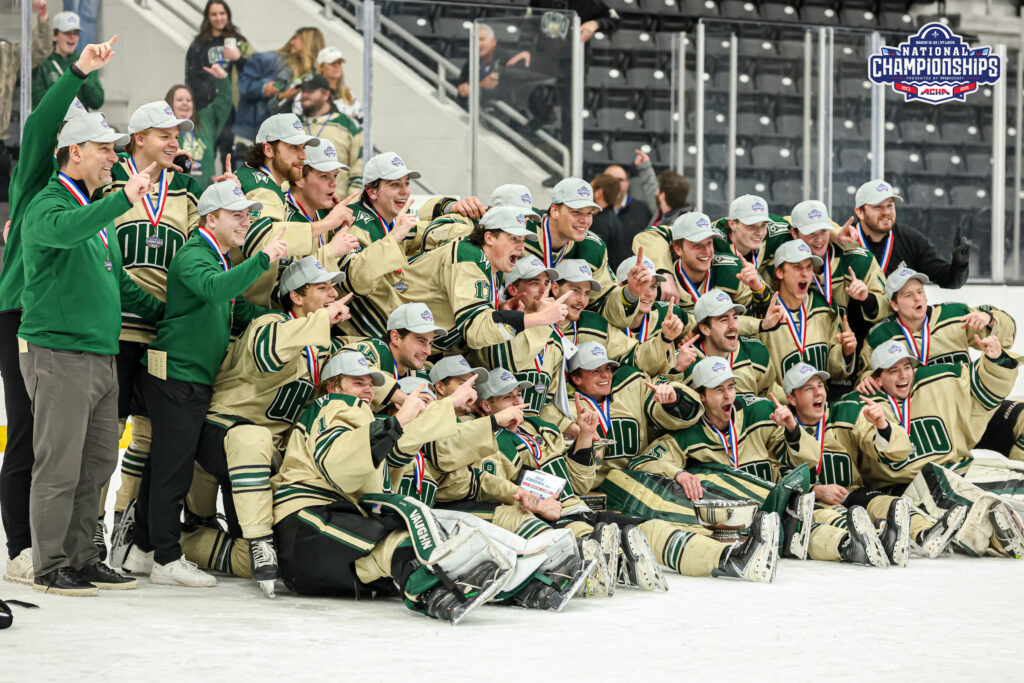
Since the club's inception in 1958, Ohio University has won over 65% of its games at both the ACHA (club) and NCAA levels. Their most recent success was a 2025-26 ACHA DI National Championship less than two weeks ago. This Marks the Bobcats' fifth ACHA title.
 Feb 10, 2026; Milan, Italy; Gwyneth Philips (33) of the United States warms up before playing against Canada in women's ice hockey group A play during the Milano Cortina 2026 Olympic Winter Games at Milano Santagiulia Ice Hockey Arena. Mandatory Credit: Geoff Burke-Imagn Images
Hockey Impact:
Bird Arena has been a staple of Athens, OH since its inception in 1956. The Athens Youth Hockey Association and many learn to skate programs conducted with the Columbus Blue Jackets based at Bird Arena. These programs most likely helped the development of goaltender Gwyneth Philips. The Athen,s OH native recently won a Gold Medal for Team USA at the 2026 Milano Cortina Olympics. Phillips is also in her second season with the PWHL Ottawa Charge.
Market Viability:
Capacity at Bird Arena is 1,200 per Ohio University, making NCAA Division I Hockey not feasible given attendance constraints. However, what absolutely could and should be explored is moving the Bobcats to NCAA Division III. Division III school buildings hold significantly less than their Division I counterparts. Let's explore Milwaukee School of Engineering's Kern Center, an NCAA Division III Hockey Program with similar spectator accommodations. The MSOE Raiders draw great crowds while boasting a well versed technical and communications staff that assists with game broadcasts. Given Ohio University's student population is ten times that of MSOE (29,000 to 2,900) the budget for going DIII may be there. As the market for Division III Hockey expands due to the trickling down of talent, it would be logical for one of the most storied club hockey programs to explore Division III.
