


Perry Nelson-Imagn Images


Dec 6, 2025 11:38 PM
Updated Dec 6, 2025 11:40 PM
This season marks 20 years since the NHL introduced the shootout. In that time, it’s made many memorable moments. But have rule changes reduced its relevance?
By Jared Clinton, Features Writer
Usually, Anniversaries are met with a little flourish. Maybe a card. Maybe some cake. Flowers, at the very least. If nothing else, though, you expect a modicum of acknowledgement that you’ve reached a milestone, especially when it’s one of those big, round numbers.
But when it comes to the 20th anniversary of the shootout in the NHL, the whole thing came and went without much fuss. So, if not the NHL, let us be the ones to take a moment to recognize it has been two decades since the league adopted the shootout. In fact, when the puck dropped on the 2025-26 season, it had been almost 20 years to the day since the first time fans got to see a shootout in NHL action.
The very first NHL shootout came in the ‘Battle of Ontario’ Oct. 5, 2005, the opening night of 2005-06. The shooter-goalie matchup? It was one with Hall of Fame proportions: the Ottawa Senators’ Daniel Alfredsson had the puck on his stick, with Ed Belfour guarding the crease for the Toronto Maple Leafs. The result? A simple but effective attempt by Alfredsson. His tally, combined with the goaltending of Dominik Hasek, helped the Senators etch their name in the record book as winners of the NHL’s first official shootout.
Since then – and prior to the start of this season – an additional 2,485 games have been decided by way of shootout. That’s a hair more than 10 percent of all regular-season games the past 20 years. And those shootouts have taken on all shapes and sizes, from two-round sweeps and back-and-forth affairs to out-and-out marathons. The longest shootout, which took place Dec. 16, 2014, went 20 rounds, with Florida eventually defeating Washington when Nick Bjugstad netted the winner.
And though the central conceit of the shootout has always been to produce clear-cut winners and losers, it has also delivered iconic moments. Within months of the shootout’s introduction, in a Nov. 26, 2005 outing that saw the Washington Capitals and New York Rangers deadlocked after regulation and overtime, Blueshirts defenseman Marek Malik stepped up to take his turn in the then-record 15th round of the shootout. Staring down Washington’s Olie Kolzig, Malik wound down the ice, tucked the puck back between his own legs and found twine, sending the Madison Square Garden crowd into a frenzy.

Moments like those – or Pavel Datsyuk’s chip shot, Patrick Kane’s deft dekes or more obscure efforts such as Linus Omark’s spinning start – are seared into the minds of hockey fans. The shootout, in its own way, has shone a brighter spotlight on the dazzling displays of high-end skill that elite-level talents possess. “As a fan, I love the shootout,” said Dallas Stars goaltender Jake Oettinger. “Whenever I went to Wild games (as a kid) and it went to a shootout, it was like winning the lottery.”
Not everyone is as enamored by the shootout, however. Among those who make their living on big-league ice, the perception of the shootout is somewhat mixed.
Seattle Kraken captain Jordan Eberle is one of the most frequent participants in the player-goalie tete-a-tete. He entered 2025-26 with 87 career shootout attempts, 18th-most in league history. Even before he arrived in the big leagues, Eberle had carved out a reputation as a smooth operator in the skills competition, notably for his heroics in the World Junior Championship. Most remember his game-tying goal against Russia in the 2009 WJC semifinal but forget he also scored the shootout-winner.
Much like one of his breakaway attempts, though, Eberle zigs where you expect him to zag. “I’m not a huge fan of the shootout,” he said.
In part, his dislike stems from changes made over the past two decades. Before the NHL removed the mandate ahead of the 2014-15 season, the ice would be dry-scraped before each shootout. The fresh surface, he said, provided for the slick puckhandling that once made the shootout a must-see event. But when that went away, so did much of Eberle’s enjoyment.
He also feels the conditions surrounding the shootout have changed. “When the shootout came, OT was 4-on-4, and I don’t know the percentage on those games ending, but it was a lot lower than it is now,” he said.
 Vasily Podkolzin and Spencer Knight (Perry Nelson-Imagn Images)
It’s true. There has been a marked change in the number of games ending in extra time since the shift to 3-on-3 overtime. In the first 10 seasons of the shootout’s NHL existence, during which overtime was four-a-side, nearly 57 percent of all contests that went past regulation needed a shootout to find a winner. But the move to 3-on-3 in 2015-16 resulted in an almost immediate uptick in sudden-death outcomes. Prior to this season, exactly two thirds of all games that have gone to overtime since 2015-16 have ended in the extra frame.
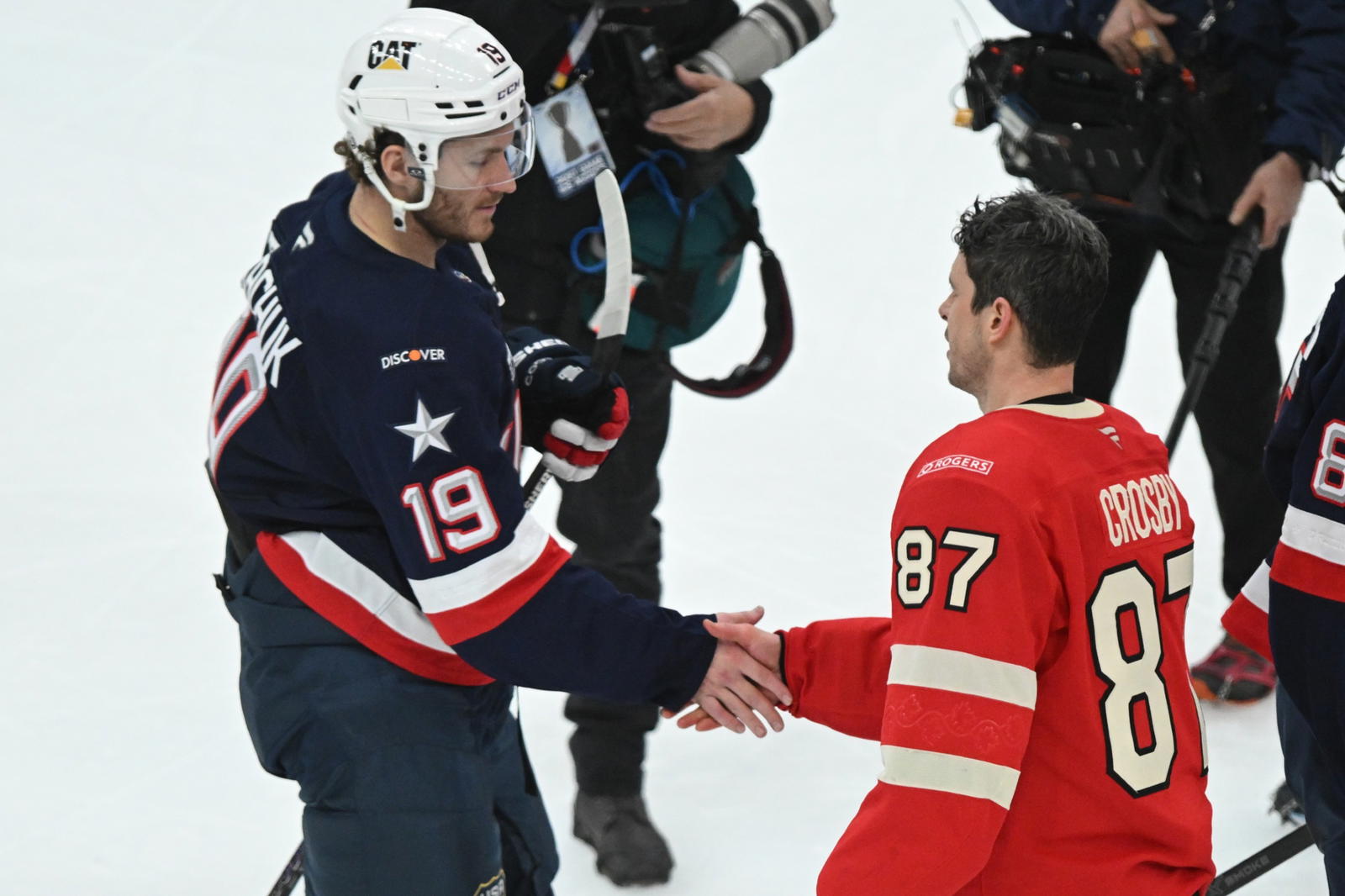
And in the eyes of some, the success of 3-on-3 is cause to embrace longer overtimes and even further reduce the likelihood that games are decided by shootout. “There should be a change,” said Senators goaltender Linus Ullmark. “We’ve already changed the offensive game a lot in general, with 3-on-3 and overtime. My two cents, we should add five more minutes of overtime, like at the 4 Nations. Because it comes down more to play.”
There’s another reason, though, why Eberle, Ullmark and several others throughout the league would like to see overtime extended: being on the wrong side of the result can be tough on the psyche. “It’s funny how you can play a really good game – and I’ve been in this spot – and you’re the last guy to shoot and you miss, how crappy you feel,” Eberle said.
That’s a sentiment that Ullmark echoes. “From the perspective of a goaltender, you can go out and play the best game of your life and have a shutout – and the other goalie can play phenomenal as well – then you go out there and let in three (shootout goals), and you feel like the worst goalie ever,” Ullmark said. “That’s just how it is, plain and simple. And I think a lot of other goalies feel the same way.”
A lot? Perhaps that’s the case – and you can be sure no netminder enjoys feeling like the goat in a losing effort – but the league’s masked men are not a monolith. Ask avowed shootout fan Oettinger, and he’ll tell you there’s a thrill to the all-or-nothing dynamic. “Some people think it’s stupid, but I think it’s fun,” he said. “As a goalie, you’re in the spotlight and get to decide the game.”

And while the shootout has its detractors, step into any arena or tune into any game in which a shootout is taking place and you can feel the building living and dying with every attempt. In some respects, it is the game distilled down to its purest form: shooter versus goaltender, head-to-head, with victory or defeat hanging in the balance. “It’s why we play the game,” said Detroit Red Wings right winger Alex DeBrincat. “You get that pressure of the game on your stick, just you and the goalie. It’s a different experience than you get anywhere else.”

This is an excerpt of a feature that appeared in The Hockey News' Prospects Unlimited issue. We profile plenty of top prospects such as Macklin Celebrini, Connor Bedard, Zeev Buium and Marco Kasper.
Elsewhere in the issue, we take a look at each NHL team's prospect pool, and we explore several PWHL teams, as well as features on the AHL, ECHL and the NCAA.
You can get it in print for free when you subscribe to The Hockey News at THN.com/Free today. All subscriptions include complete access to more than 76 years of articles at The Hockey News Archive.
5
Comments

Powered by RoundtableBuilt on infrastructure designed for real-time media. Learn more at RTB.io.© Roundtable 2026. By using this site you agree to the Terms of Use and Privacy Policy