


Waterloo Public Library

Sep 16, 2025 10:29 PM
Updated Sep 17, 2025 9:14 PM
Waterloo Wood Products was a short-lived corporate entity, but it’s important to the story of Roustan Sports Ltd.
It’s the name of a holding company that the Seagram family of Waterloo used to purchase four local wooden hockey stick manufacturers in southwestern Ontario and consolidate them into one business – namely, Roustan Sports, which still proudly operates in Ontario and still makes wooden hockey sticks.
That said, the process really began even before the Seagrams adopted that name.
Another corporate identity, Canada Barrels and Kegs, provided the impetus and the security. It was a Waterloo cooperage that had a fascinating history, starting as an outgrowth of what would become the Seagram empire and continuing after it was reincorporated into that empire nearly 50 years later. It was separated again, this time permanently, when the family sold the distillery. It was also the last industrial plant to operate in Waterloo’s core, an area now known as Uptown Waterloo, and its closure and demolition truly marked the end of an era locally and in the history of Canadian business.
Karl (also spelled Carl, later known as Charles) Mueller was born in December 1836 in Baden-Baden, Germany. As a child, he and his family immigrated to North America, settling first in Buffalo before moving across the border into Canada West. They lived in Vineland, in Bridgeport (now part of Kitchener), and finally in Waterloo.
 Undated photo of the cooperage’s founder, Charles Mueller. (Ellis Little Local History Room, Waterloo Public Library)
Mueller began working for Jacob Hespeler as a teenager; according to one story, he marked the end of every week by carrying a 30-pound bag of flour as he walked home to Bridgeport. (1) Soon after, he took a job with William Hespeler and George Randall at their grist mill, which operated a distillery as a sideline. (2)
Mueller built barrels for Granite Mills’ distillery until 1872, when he felt he had learned enough about the trade to start his own business, which he named the Charles Mueller Company. Because Granite Mills was the precursor to Joseph E. Seagram and Sons, Mueller can be regarded as perhaps the first spinoff from the distillery that would soon be world-famous.
He built a home and his business on a half-acre lot on Queen (now Regina) Street South in Waterloo, near the corner of Erb Street East, very close to the current site of Waterloo’s city hall. He started out with three employees in a building on the property, producing three barrels a day, and quick and lasting success resulted in several expansions over the next 30 years. Mueller also found in 1882 that he had been extremely fortunate in establishing himself where he had, because the Grand Trunk Railway opened a branch line to Waterloo in that year, with its station and yard adjoining his property. (3)
Mueller’s only son, John Charles Mueller, was born in February 1875 in Waterloo. Known as J. Charles, he began working at the cooperage when he was 19 years old. He worked to bring it into a more modern era; when he joined the company, everything was still being done by hand, and J. Charles reportedly made it a condition of his employment that money be spent to modernize the cooperage. Sources vary, but the Muellers’ first machine-made barrel was produced sometime between 1898 and 1903. (4)
 Undated photo of the original cooperage in Waterloo. (Ellis Little Local History Room, Waterloo Public Library)
Both Muellers were civic-minded. J. Charles became a member of Waterloo’s Board of Trade in 1902 and then joined the town council as an alderman in 1905. J. Charles was also one of the founders of a Lutheran seminary in Waterloo, donating the land on which it was established. That seminary has evolved into what was once Waterloo College and is now Wilfrid Laurier University. But his altruism was matched by his political savvy.
The railway’s presence next to the cooperage, a blessing on one hand, had boxed the Muellers in, and there was no room left to expand on their original property. In 1905, J. Charles maneuvered to obtain a new, larger site elsewhere in Waterloo, and he got it for free. He reported that he had been approached by representatives from the neighboring town of Berlin (now Kitchener), including the mayor and two councillors, who wanted the Mueller Company to relocate and would provide it with free land and an exemption from property taxes.
The Waterloo Board of Trade brought the matter to the town council, recommending the passage of a bylaw that would give the Mueller Company the same deal that had been offered by Berlin. J. Charles did not take part in the council debate and claimed that any interest he had in the issue was only as an employee, because, conveniently, he worked for his father and therefore was “not the proprietor” of the barrel works. (5)
Waterloo ratepayers overwhelmingly approved the bylaw that gifted the Mueller Company with three acres on Erb Street West. It was less than a mile away from their existing cooperage, and it was an ideal location near the Seagram operation, with access to not only the GTR but also the recently built branch line that was operated by the Canadian Pacific Railway.
The Muellers built a much larger, steam-powered cooperage in 1906, helping to establish a heavily industrial area in Waterloo that centered around the distillery. The two-storey brick building was accompanied by two separate warehouses and a dry kiln, and there was enough room on the site for both railways to install spur lines. (6) The old cooperage buildings continued to serve various industrial uses over the ensuing decades; the Muellers’ historic 65-foot smokestack was the last remnant before it was demolished in 1993 to accommodate the move of Waterloo’s cenotaph to a nearby location.
Although he had already been running the company in practice if not in name for many years, J. Charles officially took ownership of it in 1914, and it was incorporated as the Charles Mueller Company Ltd.
An expansion of the plant increased daily production to 1,000 barrels, supplying the local distilleries and breweries, and also supplying wineries in what is now the Niagara Region. Barrels were also being exported to the U.S., Britain and Europe. Reportedly, the company operated three separate machine lines, each producing a different type and size of barrel for Mueller’s various customers.
J. Charles Mueller owned and operated the largest cooperage in Canada, and it appeared that he would thrive for many years to come. Unfortunately, fate had other plans. In October 1916, he contracted a cold and, despite being ill, went on a hunting trip to Mildmay, a town about 60 miles northwest of Waterloo. Perhaps he had thought the trip would do him some good, but instead the cold turned into pneumonia. J. Charles quickly went downhill and died in Mildmay on October 20. He was only 41 years old.
Who would run the Mueller Company now that its owner and driving force was gone?
His father was about to reach his 70th birthday, had been retired for years, and was almost certainly not equipped to run a modern cooperage that was so significantly different from the one he had handed over to his son. J. Charles’ children were too young to step in.
Leo Henhoeffer, who had been working for the company as its bookkeeper since 1907 and as secretary-treasurer since 1914, took on the managerial role and kept the business going on the family’s behalf.
In July 1920, it was reported that the cooperage had been sold to interests in Chicago. (7) If that did in fact happen, the firm returned to local ownership very quickly.
Edward Frowde Seagram, president of the nearby Seagram distillery, undoubtedly liked the idea of bringing the barrel business back in-house, but rather than completely fold his new purchase into the Seagram corporate structure, he incorporated it as a separate company.
The establishment of Canada Barrels and Kegs Ltd. took place in December 1920 and was announced the following month, with a capitalization of $500,000. The directors included Ed Seagram as president and his brothers Thomas Seagram and Norman Seagram as vice-presidents. Leo Henhoeffer’s future was secured when he agreed to stay on in his existing capacities. (8)
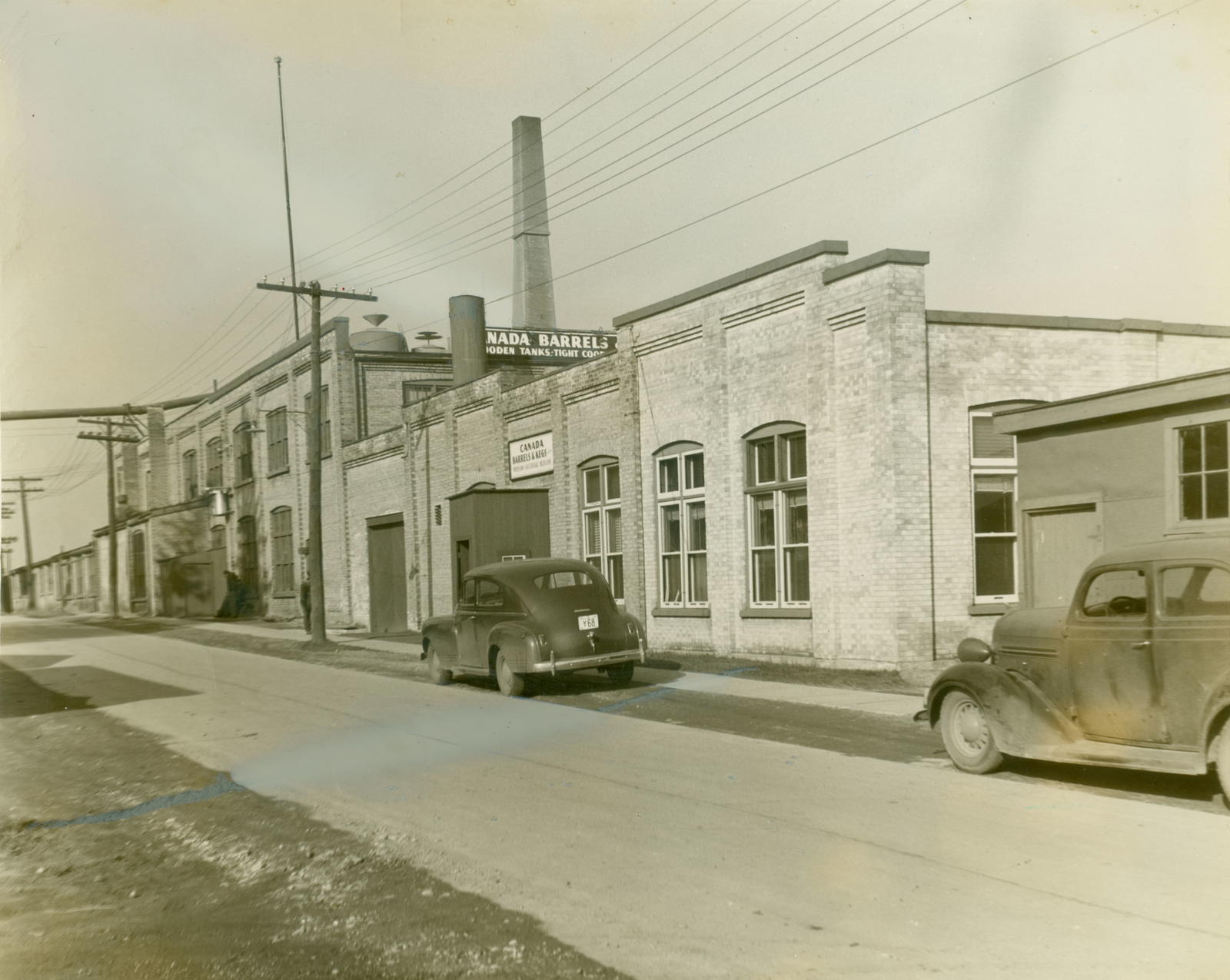 Undated photo of cooperage, originally owned by the Mueller family and later by the Seagram family. (Ellis Little Local History Room, Waterloo Public Library)
Charles Mueller was 93 years old and the oldest citizen of Waterloo when he passed away in January 1930. He had learned his trade at the distillery that would be made famous by the Seagram family, and then he and his son oversaw the construction of untold millions of barrels that carried Seagram products from the distillery to the marketplace. He lived long enough to see his thriving cooperage expand to even greater heights under new ownership, becoming the base of the Seagrams’ industrial activities in Waterloo and area after they divested themselves of the distillery in 1926.
Canada Barrels and Kegs continued to manufacture products for not only the distillery but also breweries in the Kitchener-Waterloo area and elsewhere. It diversified into wooden and plastic storage tanks and containers that were used to hold food, paint, chemicals and other consumer products. The company was later renamed Canbar Products, and it had other subsidiaries, such as Canbar Lumber and Canbar Marine, which built fiberglass boats. Eventually, the company that had started on a half-acre piece of land and then moved to a three-acre site grew into 150,000 square feet of building space on 22 acres.
The company’s leadership was remarkably stable over the years. After Ed Seagram’s sudden death in February 1937, the presidency passed to his brother Tom Seagram, who held it until his own death at age 77 in October 1965. Leo Henhoeffer was 72 and still serving as managing director when he passed away in March 1963. Tom Seagram Jr. took over as managing director, and the presidency passed to J.E. Frowde Seagram, Ed’s son. He retained that position until 1974, when the family sold Canbar to a firm based in Weston. Even then, Frowde remained involved, holding a minority interest in the company and serving as chairman of the board of directors. (9)
Waterloo’s old industrial heart died off suddenly with the closures of an office furniture factory, the Labatt brewery and the Seagram distillery, all within easy skating distance of Canbar and all between January 1990 and December 1992.
Canbar’s fate in Waterloo was sealed in 1990 when, after years of negotiation and threats of expropriation, it surrendered part of its property to the city for the construction of an arena and recreation centre.
Pressured to sell the rest of its land and move so that the area could be further redeveloped, Canbar eventually departed to Breslau, a small community just east of Kitchener.
Canbar continues to exist today and, after some further ownership changes, is still manufacturing barrels and tanks in Campbellville, Ontario, near Milton. What had been the Canbar complex in Waterloo was finally demolished in 2000. A luxury high-rise apartment complex called The Barrel Yards now occupies most of the former site.
It's not just Canbar that has physically disappeared from Waterloo. Precious elements of the company’s history were mysteriously but irretrievably lost in 1979 after the death of Frowde Seagram in November of that year.
According to an unofficial history of the cooperage, Seagram had for some unknown reason directed that following his passing, “the entire collection of company documents, many thousands of pages in total,” was to be destroyed. “The documents, many vital to the telling of the Canbar story, were removed from the company vault... and burned in the plant incinerator under tight security.” (10)
Geoff Seagram, the son of Frowde Seagram, had never heard this story before and could not explain why his father would have given such an order.
“I didn’t know that. That’s interesting,” he said in an interview. “I don’t know why that was – maybe a little skulduggery. Isn’t that funny? My father didn’t tell me everything. There wasn’t a lot of transparency in those days.”
And yet, were it not for Canbar and especially for Frowde’s father, it’s quite likely that Roustan Sports Ltd. would not be making hockey sticks in Canada today.
It was Ed Seagram who used Canada Barrels and Kegs to create a conglomerate called Hespeler St. Marys Wood Specialties, and it was his family’s stewardship of the hockey stick business that carried it through the uncertain times of the Great Depression and the Second World War, making it a viable company that continues to survive in its current incarnation. Roustan Sports owes the Seagrams everything, and we’ll learn more about them in the next chapters of our story.
Chapter 5B – The Muellers' Connection To Hockey
It’s not believed that either Charles Mueller, founder of the Mueller Cooperage, or his son, J. Charles Mueller, were actively involved in the sport of hockey.
But one of J. Charles’ two sons ended up making history when he pulled a “Canada” sweater over his goaltending equipment and became the first hockey player from Waterloo County to win an Olympic gold medal.
Norbert Edward Mueller, whose nickname was 'Stuffy,' was born on February 14, 1906, in Waterloo and was only 10 years old at the time of his father’s untimely death, so he did not have the opportunity to follow J. Charles into the family business before it was sold in 1920 to the Seagram family.
Stuffy became a scholar instead, not to mention a goaltender of note.
He made his competitive debut with the Kitchener junior team at age 14, then helped them to the Ontario Hockey Association and Eastern Canadian championships and a berth in the Memorial Cup final in 1923.
He later attended school in Toronto, where he played for teams at St. Andrew’s College and at the University of Toronto. As a member of the Varsity Grads, comprised mainly of former U of T players who wanted to stay and continue to play together after graduation, he won the OHA and Canadian Amateur Hockey Association senior titles in 1927 – the J. Ross Robertson Cup and the Allan Cup.
The Varsity Grads, as CAHA champions, were nominated to represent Canada in the 1928 Winter Olympics in St. Moritz, Switzerland. They won all three of their games by a combined score of 38-0, and Mueller was in net for Canada’s second game, a 14-0 triumph over Great Britain. That contest was played four days after his 22nd birthday. Joe Sullivan was Canada’s goalie in the other two games.
The Grads then undertook a successful goodwill tour of Europe, playing exhibition games in Davos, Vienna, Berlin, Paris and London. They returned to Canada in late March 1928, and Mueller spoke to the Kitchener Daily Record newspaper after arriving home in Waterloo.
“While the European teams have plenty of speed, they do not seem to know the finer points of the game, and certainly have not the scoring punch that characterizes Canadian hockey,” he said.
Mueller continued to play amateur hockey in Toronto after the Olympic triumph and won his third OHA championship and his second Allan Cup while playing with the National Sea Fleas team in 1932. The Sea Fleas swept the best-of-three final series 2-0, with Mueller blanking Fort William 1-0 in overtime in the deciding game, played in the Montreal Forum.
According to the Toronto Daily Star, Mueller had been “a master” in how he handled his opponents: “he refused to make the first move on attacking plays and fully deserved the shutout which marked the victorious bid for the Allan Cup.”
Still only 26 years old, Mueller could have jumped to the NHL in the wake of that triumph.
The New York Rangers took notice of his abilities and added his name to their reserve list. They offered Mueller a contract – $2,500 to sign and another $2,500 to play, reportedly – but he turned them down, perhaps costing himself the chance to add a Stanley Cup to his list of honors. The Rangers signed another amateur, Andy Aitkenhead, instead, and he immediately took them to the title in the spring of 1933 as a 28-year-old rookie.
It appears that Mueller had rejected at least one other professional team prior to snubbing the Rangers, content to remain in the amateur ranks while raising a family and building a career in Toronto. That said, he did not remain with the Sea Fleas after a falling out with their coach/manager – future Toronto Maple Leafs owner Harold Ballard – and missed their trip to the 1933 world championship tournament in Prague, Czechoslovakia.
Norbert 'Stuffy' Mueller worked as a stockbroker and then in the insurance business in Toronto before his untimely death from a heart attack at age 50 in July 1956.
His place in hockey history is admittedly an obscure one but given his father’s and grandfather’s roles in the creation of what is now Roustan Sports Ltd., he deserves mention as an interesting supporting character in our story.
Jonathon Jackson is a hockey historian based in Guelph, Ontario.
Follow along as we post new chapters of Hockey's Oldest Business – Since 1847 on TheHockeyNews.com.
Read the previous chapter: Chapter 4 – Hespeler
Read the next chapter: Chapter 6 – The Seagrams, Part 1
(1) Fred Shinn, “How They Rolled Those Barrels,” Waterloo Chronicle, March 20, 1968.
(2) Unknown author, Rolling Out the Barrels: Cooperage in Waterloo 1853-1987, p. 8.
(3) Rolling Out the Barrels, pp. 9-10.
(4) “Waterloo’s Citizens,” Berlin Daily Telegraph, November 10, 1905; Rolling Out the Barrels, p. 10.
(5) “Closing Letters On The Bylaw,” Berlin Daily Telegraph, November 18, 1905.
(6) “The Mueller Cooperage Plant,” Berlin Daily Telegraph, May 2, 1906.
(7) “Waterloo,” Ontario Journal, July 21, 1920.
(8) “Old Company Under New Name,” Kitchener Daily Record, January 8, 1921.
(9) Henry Koch, “Waterloo’s Canbar Ltd. sold to Weston company,” Kitchener-Waterloo Record, October 25, 1974.
(10) Rolling Out the Barrels, p. 14.
1
Comments

Powered by RoundtableBuilt on infrastructure designed for real-time media. Learn more at RTB.io.© Roundtable 2026. By using this site you agree to the Terms of Use and Privacy Policy