


May 9, 2025 1:11 AM
Updated Jun 18, 2025 2:55 PM
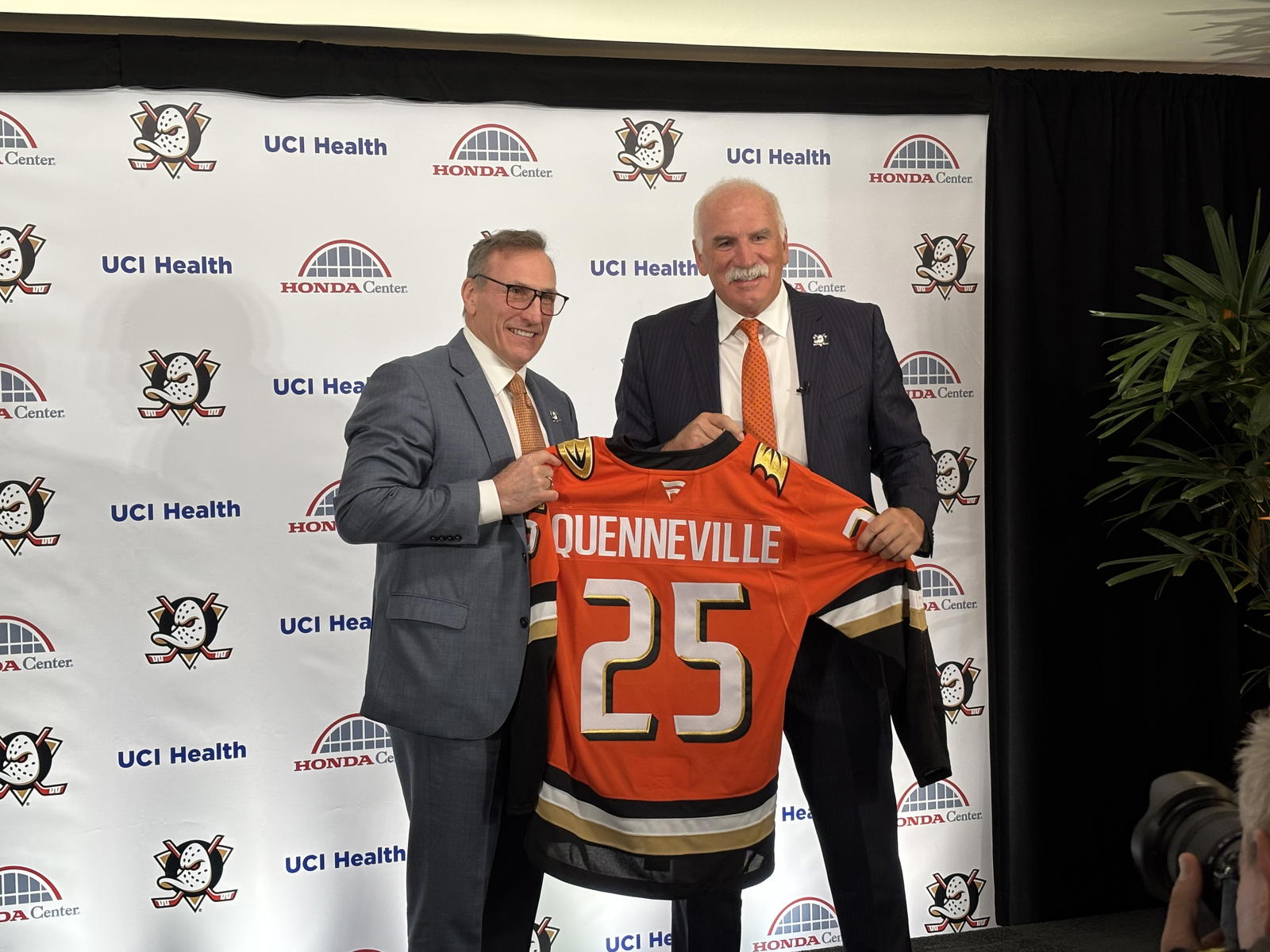 May 8, 2025; Anaheim, California, USA; Anaheim Ducks general manager Pat Verbeek and Joel Quenneville pose with a Ducks jersey after Quenneville was named the 12th head coach in franchise history. Mandatory Credit: Derek Lee-The Hockey News
On Thursday morning, the Ducks named Joel Quenneville the 12th head coach in franchise history. Quenneville last coached in the NHL in 2021 with the Florida Panthers, resigning from his position following a meeting with NHL commissioner Gary Bettman about his involvement in the Chicago Blackhawks' sexual abuse case from 2010. Quenneville had been ineligible to seek employment in the NHL up until July 2024, when he was reinstated by the league.
“Over the last two weeks, we conducted interviews with many outstanding coaching candidates, while simultaneously conducting a comprehensive review of what took place while Joel was head coach of the Blackhawks in 2010," Ducks general manager Pat Verbeek said in the team's press release following Quenneville's hiring. "We spoke with dozens of individuals, including advocates for positive change in hockey and leadership of the NHL, which last July officially cleared Joel to seek employment in the league. Our findings are consistent with Joel’s account that he was not fully aware of the severity of what transpired in 2010. It is clear that Joel deeply regrets not following up with more questions at the time, has demonstrated meaningful personal growth and accountability, and has earned the opportunity to return to coaching."
On Thursday afternoon, a news conference was held for local media with Verbeek and Quenneville. Ducks players Ryan Strome, Frank Vatrano and Troy Terry were in attendance, as well as Ducks CEO Michael Schulman and Ducks Club President Aaaron Teats.
Below is a full transcript of the news conference. Questions and answers have been lightly edited for clarity and length.
Pat Verbeek Opening Statement
Good afternoon, everybody. Let me first start by saying I'd like to thank the Samueli family, Michael Schulman and Aaron Teats for their support in the backing of this process. And I'd like to welcome Joel’s wife, Elizabeth, better known as Boo, and his daughter, Anna. And the Ducks in attendance: Ryan Strome, Frank Vatrano, and Troy Terry.
Today is a great day for the Ducks. Naming Joel Quenneville as our head coach represents the next phase of our team development. Our goal is to make the playoffs, and I believe Joel is the guy to take us there. To give you a little perspective, the first time he joined Chicago, he had a young and very talented and very raw team. And when Joel and I got together, I believe that (the Ducks) provide very similar circumstances and we see the same similarities. When Joel went to Florida, he had just a touch older team, but he had a team that was on the precipice of being a perennial contender. Joel will be instrumental, in my opinion, in helping us get to our ultimate goal, which is a Stanley Cup.
Before we continue, I'd like to review the steps that we've taken together to get here. This was a thorough and meticulous process. What happened to Kyle Beach in 2010 was both shocking and unacceptable. As an organization, we approach this with the utmost care and due diligence. Our executive team, myself included, spoke with many individuals about Joel and his role in what transpired in 2010. We spoke with NHL leadership, which, last July, officially cleared Joel to be able to come back into the NHL. We spoke with advocates for positive change in hockey and those in and around Joel, who worked with Joel, amongst others. And finally, we spoke with Kyle Beach, whose courage and character throughout this continue to inspire us all. While the specifics of those conversations will remain private, out of respect for the process, I want to emphasize that those conversations, along with the time spent with Joel, and through our thorough review of this matter, led us to this decision today. Joel acknowledged that his response in 2010 was inadequate. He recognizes the failure to ask further questions, not following up and taking action were serious mistakes. Nearly four years away from the game, he has demonstrated sincere remorse and has bettered himself by participating in a number of programs focused on education and personal growth and improving his understanding of abuse prevention and response. Joel has paid a price and has faced the consequences. And after careful deliberation and consultation with so many, we believe he's taken the necessary steps to return to the game as the head coach of the Anaheim Ducks.
Regarding the coaching search, I've interviewed a number of successful coaches. It was encouraging to see the number of strong candidates that viewed this as a great opportunity. On a personal note, I've known Joel since I was 18 years old. We were teammates in New Jersey and then again in Hartford. I know Joel is a man of character. We have a long history, and I know who Joel is as a person. He's the second-winningest coach in NHL history, including four Stanley Cups––three as head coach, one as an assistant. He knows how to win, he knows how to get the best of his players. His coaching resume speaks for itself. We feel he's the right coach to lead us to our ultimate goal, the Stanley Cup. I know Joel will earn the trust of our fans, partners, staff, and the surrounding hockey community. I believe that we are getting the best version of Joel Quenneville, not only as a person, but as a coach. So it is with great pleasure, Joel, and my honor, to formally introduce Joel Quenneville as the next head coach of the Anaheim Ducks.
Joel Quenneville Opening Statement
I want to begin by expressing my gratitude to the Samueli family, Mike Schulman, Aaron Teats and Pat Verbeek for believing in me and trusting me to lead the Ducks. I'm humbled, I'm excited to be here today. I want to thank my family––my wife is here along with my daughter, Anna, along with (my son and daughter) Dylan and Lily, who are not here today, for your support and for being here as well. I want to thank Gary Bettman, Bill Daly, Kim Davis, Colin Campbell and the NHL for their help and guidance.
Before I talk about how excited I am to be here, I'd like to say a few words about what happened in 2010. As Pat said, what happened to Kyle Beach was horrific and inexcusable. I was sick to my stomach when I learned what had taken place. Had I known what had happened, I would have taken swift action. I own my mistakes, while I believe wholeheartedly, the issue was handled by management. I take full responsibility for not following up and asking more questions. That's entirely on me. Over nearly four years, I've taken time to reflect, to listen to experts and advocates and educate myself on the realities of abuse, trauma and how to be a better leader. I hope others can learn from my inaction. I've spoken to Kyle more than once, including this morning. I've apologized to him and expressed how much I regret not following up and taking action. I had to be more aggressive at that time. I fully understand and accept those who question my return to the league. I know words aren't enough. I will demonstrate (through) my actions that I am a man of character. We will be a team this community can be proud of, both on and off the ice. This is my promise.
I am so excited to be back in the NHL and the Ducks are the team I wanted to restart my career with. Great ownership, great management, one of the most exciting young cores in the NHL. We have current players, veteran, young, and even more that will play in the NHL in the near future. One of our top priorities will be to ensure player and staff well-being, and we will make this a safe place both on and on off the ice. That includes here in Anaheim and San Diego. Rest assured, you will be welcome here, and your safety will be a priority from top to bottom. I am humbled and deeply grateful for the opportunity to return to the game I love, and I can't wait to get started.
As you mentioned, you have spoken with Kyle Beach on more than one occasion for clearing. In those conversations, and I can respect if you want to keep him private, did you feel like you needed to get his blessing before returning to the game, and do you feel like this is an opportunity for redemption for you?
I've spoken to Kyle (for) many conversations. They're all productive conversations. We won't get into the details of our conversations, but like most of the conversations, at the end of the day, I thought that today's was like the other ones––all conversations, good talks. That's how he's been. It's been a healthy process for both of us and we're happy with where we’re at today.
Given your obvious credentials, there will be many who feel like you are deserving of a second chance here or another opportunity to coach in the NHL. There will be many who feel like you never deserve another chance, whether with Anaheim or another team. What would you say to those who don't feel like you deserve this opportunity?
It's understandable. I understand people who feel that way. As a team and as an organization, myself, I think we want to make sure that we're going to do everything we can and I'm gonna do everything we can to change that in those people's minds by how we act, by our actions in the community, on and off the ice, that we're gonna be aware of what we learned and how we got educated over these years, and we look and apply those lessons.
Pat, can you tell us what it is about Joel that made it so important to hire him for this job and overlook or get around all the other stuff that we've been talking about here?
Well, I think the easy answer to that, obviously, is coaching pedigree and winning; that's the easy one. I think when I really boiled it down, the decision, what really made it feel right was, as I alluded to when he took over Chicago, how young that team, how raw that team and how talented they were. I feel we're in that same predicament as the same team that he took over. And I watched––because I was scouting at that particular time––that team grow and I watched it develop, I was impressed with how the young kids really took big steps to improve and to become impact players.
To the end of your question, going through this process, this particular process that we talked about, I feel comfortable with what we were able to find out and what we discovered. Gave our entire organization the comfort that we needed to be able to move forward and take this team as far as winning and becoming a winning organization to the next level.
Joel, how have you changed as a person since 2021 in the broadest terms, not even just hockey, in general?
Since the first day I returned from the commissioner's office. I met a man that day who’s here today as a friend of mine, Chris Jensen. And he started on the education of the process over the four years and every day, that it's a new day. And I'm gonna learn more and better myself, and learn how to handle situations that we went through. What survivors have gone through, how they heal and he's here today, Chris––thank you for coming––Jensen. He's in front here and has been a friend over those four years. We had several dinners, several lunches, and that education was led by him in a lot of ways. There's a number of people, I’ve got a list here, I'd like to at least say that I spent some time with and had been influential over the four years and helped me improve as a person, and I'm sure it's going to make me, hopefully, a better coach and as a better person as well. If you want to hear those names right now and the people, it's a long list, but I can talk later about those.
Joel, Pat alluded to the similarities between the Blackhawks when you took over and this roster. Can you kind of expand on that off of what you know about this roster and the personnel?
It's been a long time since I went to an NHL game, but the first game I went to in almost four years was Anaheim at Tampa Bay recently. And I hadn't seen Tampa in a long time, but I certainly hadn't seen much of Anaheim. And I watched the game, I was thoroughly impressed at the pace of the game and the skill and the speed that Anaheim had. They're all young kids, and it was a great game to watch. They lost in overtime, but I was surprised and I was impressed. Everywhere I go in hockey lately, everybody says a place to go, everybody's saying Anaheim. ‘They’ve got what you had in Chicago.’ And I'm sitting there, well, I know as the most fortunate coach walking in that day in Chicago, but I certainly feel that this team is on the right track of being there, and you’ve got a lot of them kids that have got some speed, got some skill. We've got some ingredients that we feel that we can make them better as well, but these are competitive kids that we want to make sure that we grow an identity earlier on in the season, and fulfilling that on a day-to-day basis is going to be what we're all about.
Pat, this one’s for you: What are some of the traits that led you to believe that Joel's the guy that can kickstart this team?
Well, I think it probably happened the second time that we met. The first time we met was over dinner and we had long discussions about other things. The next day, we talked about hockey. We went over video and I was impressed with the details, the little details of how to play better in defense, how to control the puck, how to become a puck possession team. And I think those things, until you really get into it on a day-to-day basis with coaches and you sit down and talk, you never know the coach's methods of how they go about teaching, and I was impressed with that. Obviously, you can look back on what Pat Kane did. You can look back on Duncan Keith, you could look back on (Brent) Seabrook and Jonathan Toews, Corey Crawford, you can look at all those impact young players––and they had a few more. Those guys became stars, and that was what really helped me decide Joel was the right guy for the job.
You mentioned that you have the list there. I think it would be good for everyone to hear here, just out loud, who you've worked with over this time to tell yourself sort of what you've learned from those organizations with those advocates over the time.
Thank you, and thank you all for being here. Chris Jensen will lead that list. Kim Davis at the NHL. Sharyl Garza, who is a lawyer in this area with sexual abuse and assault victims. Hockey 4 Youth is a group that we worked with, started when I met them at the Carnegie Institute. We launched a Windsor program two years ago, Moe Hasham leads the Windsor program that we're proud to be a part of. Christine Lang, behavioral psychologist, spent a lot of time with her. AHL coaches and all the GMs, NHL coaches and all the GMs. The Respect Group, U.S. SafeSport, Bryant McBride, ex-NHL executive; Carnegie Initiative, Brock McGillis, former Windsor Spitfire like myself. Antonio Blake, Brian Burke, Connor Scott Zieky Foundation for mental health and substance abuse for adolescents is very close and near and dear to my family. I’ve got to give my son Dylan some credit for a lot of this stuff.
For Pat and Joel, going forward, I think there's plenty of fans that have opinions about what's going on here, but one way to reach out maybe would be to set up some sort of connection with local advocacy groups for sexual abuse survivors or sexual assault survivors. Is there any plans within the organization or for Joel to do that?
Yes, there is, actually, and we certainly can probably elaborate on that. We haven’t made all of the connections just yet, but yeah, absolutely, that is our plans for Joel, myself to kind of become really involved in that aspect of I think that, yes.
Pat, you laid out reasons why you hired Joel, and as you mentioned, you talked to several different candidates. You could have gone in another direction if you wanted to, and maybe not, for lack of words, court what came around Joel. You could have done that with the opposite of Joel. Did you have concerns about the blowback that may come with hiring Joel?
I thought about that for a long time. What I kept coming back to is the process that we went through, a comprehensive review. And when I was comfortable with that, I was able to take it to ownership, and we were able to present all of that. And I think once we were comfortable with that, the hockey part of it was really easy. Yes, I think it would have been easy to kind of push that aside, but it's my job to find the best coach for our team, and I believe that I have found the best coach for this team.
Pat, when you spoke after you let (Greg Cronin) go, you spoke about how there is a culture of accountability being built here and continuing to be built in Anaheim. How does Joel fit into that culture?
Well, I think it's going to build upon that foundation that's already been laid by Greg Cronin. I believe a really good foundation has been laid. Certainly, Joel is gonna build upon that, and that's what I'm excited about.
Joel, you've spoken about how you've taken steps to become a better leader over the last three years. What specifically have you done in that regard?
Well, some of the people I spoke about, mentioned their names, of learning to be a better person. Basically, the life lessons that I learned about what survivors go through. Every walk, every step. No matter who the person was that was spending time and educating me. Across the board, I got good life lessons of how to apply them going forward, and that's an everyday thing. And surrounded by a lot of good people here in Anaheim, we want to be part of the community. It’s important to us how we are on and off the ice, how we're involved in the community and sharing our message and applying what I've learned. If I could help anybody in the community, and part of my other process was hopefully, coaches learned from what I went through and my inactions, they can learn from that as well.
Joel, with your resumé, you could have simply sat back and rested on it, frankly. So what made you want to get back in and this and put yourself back out in there and do what you've done?
Well, this is a team I wanted to go to. This is a great opportunity to be back in the game, a game I love. I'll get back to the similarities when we were in Chicago, but there's a lot of things that you like about this place, there's a lot of things you love about it. We're probably going to end up at the love. We’re really looking forward to moving into Anaheim, being a part of the community Seeing the guys gather over the course of the summer into the fall. I'm looking forward to touching base with a number of the guys, nice to see some friendly faces over here. And at the same time, this is an opportunity that this is where we wanted to go. This is the only team that was appealing at that level, but it's amazing how many people were saying, ‘This is the place to go’ and now that I'm here, it feels even better.
Did any other teams reach out to you, any overtures to you and what's your energy level in terms of getting back to this grind here?
As far as reaching out teams, I'm not getting into that process, but I feel very fortunate in the trust that the Samueli family has placed in our family. Thank you. It’s a special place, the time of the franchise is where they're at and where they are today, this time. It just reminds me of Chicago a lot and some of Florida as well, so I've been fortunate to be in some really nice places that were in that stage of their franchise growth. Excited to be a part of it.
There's some leftover staff on the coaching staff from last season. Is the plan to bring an entirely coaching staff for Joel?
Joel and I will probably meet tomorrow and discuss all of that and come up with a plan and then we'll go from there.
2
Comments

Powered by RoundtableBuilt on infrastructure designed for real-time media. Learn more at RTB.io.© Roundtable 2026. By using this site you agree to the Terms of Use and Privacy Policy