


Dec 4, 2025 2:49 PM
Updated Dec 4, 2025 6:24 PM
Nathan MacKinnon is far from the first elite competitor to confront illness and nevertheless prevail.
DENVER — Each year, the flu sweeps through workplaces and households alike, leaving countless people bedridden and temporarily unable to meet their professional responsibilities. For most, the consequences are little more than minor disruptions—an inconvenience noted, then quickly forgotten.
For elite athletes, however, the stakes are far higher. A single, ill-timed virus can tilt the balance of a game, alter the arc of a season, and recast a championship narrative entirely. In a world measured by fractions of seconds and razor-thin margins, even a brief bout of illness can become a defining chapter in a career.
True, it was neither the Stanley Cup Final nor an Olympic gold-medal showdown, yet Nathan MacKinnon—who appears intent on revising the record books every time he steps onto the ice—once again demonstrated the depth of his competitive character over the past several days.
BEASTIN WHILE SICK?!
Nathan MacKinnon has, by nearly any measure, achieved the full spectrum of professional triumphs: a Stanley Cup championship, a host of individual accolades, a Four Nations title, a wedding ring, and—should the organizers in Milan manage to align their ambitions—perhaps even an Olympic gold medal in the near future. Yet what has escaped wider notice, particularly among major national networks, is a detail far less glamorous but no less revealing of his competitive stature.
Over the past several games, MacKinnon has been playing while sick. Despite that, he still produced five points during that stretch, including three goals and two assists. And he did it in a league that moves at a pace faster than most people can even process, let alone excel in. Yet even while under the weather, MacKinnon put the team on his back, scoring twice to secure Colorado’s 3–1 win over the Vancouver Canucks on Tuesday.
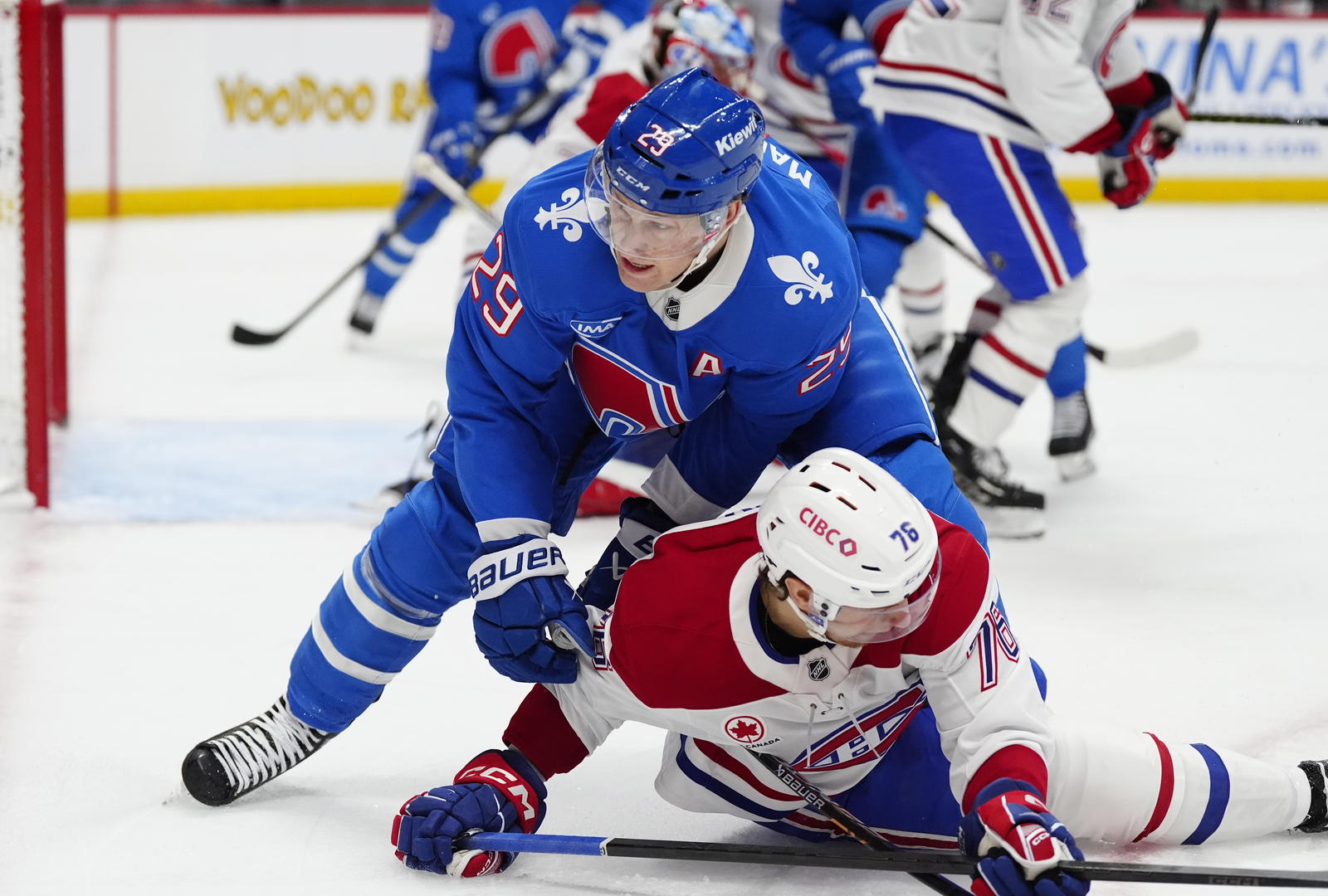 Credit: Ron Chenoy. Nathan MacKinnon takes down Zack Bolduc
MacKinnon, a devoted basketball fan, has long shaped his sports psychology and competitive mindset on legends such as Michael Jordan and Kobe Bryant—both renowned for their relentless drive and ability to perform under pressure. His recent performance while ill serves as a contemporary reflection of this ethos. During the 1998 NBA Finals, Jordan himself battled the flu late in the series, yet in Game 6, he scored 38 points and delivered a now-iconic buzzer-beater to secure his sixth championship with the Chicago Bulls. Similarly, MacKinnon’s recent feats while compromised by illness underscore his capacity to elevate his game under adverse conditions, drawing a compelling parallel to the basketball greats who have inspired him.
MacKinnon Joins Rare Company
And given MacKinnon’s skills at throwing hands when he needs to, we would remiss if we didn’t include a boxing reference in here. The word around the grape vine is that MacKinnon is a fan of three-division world champion Devin Haney, but the fighter we want to mention is former middleweight world champion, Gennadiy “Triple G” Golovkin.
At one point in his career, Golovkin, who hails from Kazakhstan, compiled an extraordinary streak, securing 23 consecutive knockouts between 2008 and 2016—18 of which were world title fights.
Some observers, however, thought the streak might end as early as the 11th fight. Just days before he was set to defend his world title against Gabriel Rosado in New York in January 2013, Golovkin came down with the flu.
 Gennadiy Golovkin's signature jab opens up a nasty cut on Gabe Rosado. Credit: Joe Camporeale Genna
It made no difference. He opened a cut over Rosado’s left eye in the second round, and by the fifth, Rosado was still taking relentless punishment, his face nearly obscured by blood. In the seventh round, Rosado’s corner finally threw in the towel to protect their fighter. Even under the strain of illness, Golovkin dominated a brave Rosado, and his KO streak carried on for five more years. And now he’s on the verge of getting enshrined in the International Boxing Hall of Fame.
And let’s not forget—Golovkin had one of the best ring entrances of all time.
Avs Inspire Through Resilience
And the story goes beyond MacKinnon. Let’s not forget about Gabe Landeskog, who, as we all know, missed more than three years of action following knee surgery but miraculously returned last year in Game 3 of Colorado’s first-round playoff series against the Dallas Stars.
He didn’t register a point in that game, yet he was arguably the best player on the ice that night, alongside Valeri Nichushkin. But the following night, Landeskog joined the club. In only his second professional game after a 1,041-day hiatus, Landeskog reestablished his scoring touch. With 6:50 remaining in the second period, Brock Nelson delivered a precise pass to Landeskog, who stood unguarded in the slot.
Landeskog unleashed a blistering slapshot that eluded Dallas netminder Jake Oettinger, extending the Colorado Avalanche’s lead to 3–0 and sending Ball Arena into a frenzy. The goal marked Landeskog’s first since Game 6 of the 2022 Stanley Cup Final, the very contest that culminated in the Avalanche claiming their third championship in franchise history.
What’s The Slogan This Year?
An illness may have left MacKinnon a bit more fatigued over the past few games, yet it did little to diminish his competitive fire.
“It’s been a grind. Montreal was hell. Tonight was a little better,” he stated. “Just tired. Just tired. Been sitting around the last few days.”
MacKinnon was referring to the November 29 contest in which the Avalanche defeated the Canadiens 7–2—a game in which he tallied three points despite feeling under the weather.
While “Find A Way” may have grown somewhat outdated, a rebrand emphasizing resilience—such as “Keep Fighting” or “Never Back Down”—could serve as fitting replacements.
But one thing is for certain, Nathan MacKinnon is embarking on one of the most memorable NHL seasons in recent memory.
For action-packed issues, access to the entire magazine archive and a free issue, subscribe to The Hockey News at THN.com/free. Get the latest news and trending stories by subscribing to our newsletter here. And share your thoughts by commenting below the article on THN.com or creating your own post in our community forum.

Comments

Powered by RoundtableBuilt on infrastructure designed for real-time media. Learn more at RTB.io.© Roundtable 2026. By using this site you agree to the Terms of Use and Privacy Policy