



Feb 22, 2025 9:48 PM
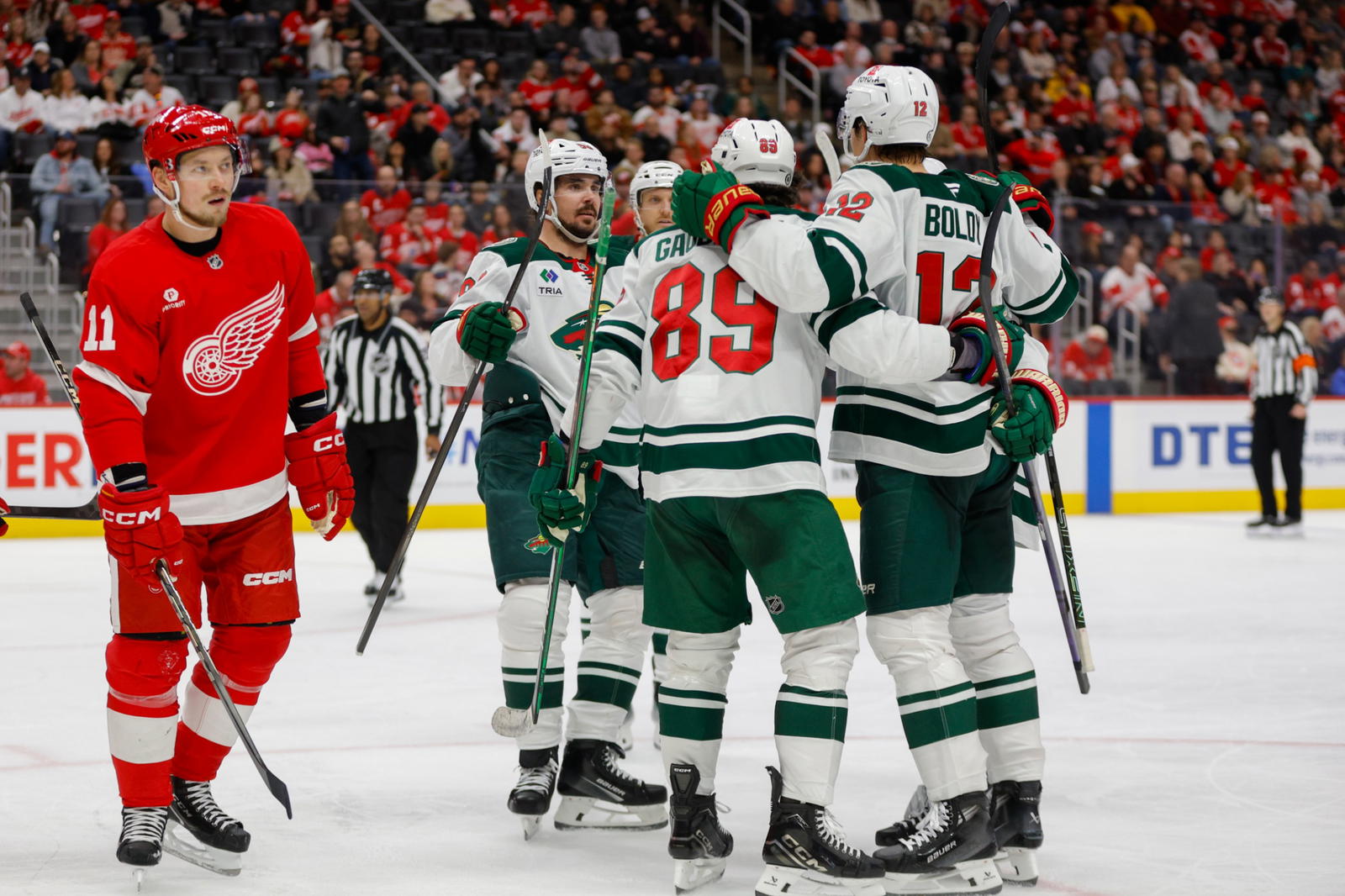
Feb 22, 2025; Detroit, Michigan, USA; The Minnesota Wild celebrate a goal scored in the third period at Little Caesars Arena. (Brian Bradshaw Sevald, Imagn Images)If sloppiness is the norm coming out a prolonged break, the Detroit Red Wings proved unexceptional Saturday afternoon at Little Caesars Arena, squandering a late lead en route to a 4–3 overtime defeat to the visiting Minnesota Wild.
There were moments of decisiveness along the way for the Red Wings. Alex DeBrincat's opening goal not quite eight minutes into the first period offered one: a broken play, before Andrew Copp controlled and found DeBrincat, who struck the back of the net with a cool forehand-backhand move through traffic to send Wild goaltender Marc-André Fleury the wrong way. In the first minute of the third, Detroit executed a power play breakout to textbook perfection, setting up a Lucas Raymond goal that lifted the home team into what seemed a commanding 3–1 advantage.
However, a pervasiveness sloppiness prevented that two-goal lead from ending the game, and Minnesota forced its way to the right side of the choppy affair late. First, Matt Boldy scored with 6:53 during a four-on-four sequence that became five-on-four thanks to a delayed penalty against Vladimir Tarasenko. Then, Marcus Foligno tied the score with 1:31 to play and the Wild net again empty. And, for the coup de grace in overtime, Wild forward Marco Rossi stepped out of the penalty box and straight into a breakaway, where he appeared to fan on his shot attempt only for the puck to slip past Red Wings goaltender Cam Talbot anyway for the winning goal.
In his post-game remarks, Detroit coach Todd McLellan described the afternoon's action as "a real strange game." It wasn't so much about the layoff (14 days between games thanks to the 4 Nations Face-Off break), though of course that was a conditioning factor.
Instead, the irregularities stemmed from the flow of play itself, or lack thereof. The Red Wings' second goal was a power play goal that wasn't a goal then was again, after a DeBrincat shot triggered the goal light only for the officials to realize it hadn't actually gone in but struck the post, only for Dylan Larkin to deposit it anyway. There was also the bizarre sequence that led to Rossi's winner, the four-on-four goal that was actually a five-on-four goal, and a handful of extended replay reviews. The afternoon also featured a more generalized lack of cohesion (likely attributable to the layoff), especially in the early going when neither side appeared very effective in stringing together passes.
A key factor in the Minnesota comeback or Detroit collapse (depending on your perspective) was center depth for the Red Wings. Andrew Copp was injured late in the second and didn't return for the third (McLellan referred to him after the game as "doubtful" for Sunday's game against Anaheim). Then, Dylan Larkin found himself stuck in the box for a matching roughing minor with Joel Eriksson Ek, which stranded him for both of the Wild's third period goals. Larkin's penalty came at 12:43, but because of the game's flow, he didn't actually leave the box until after Foligno's goal at 18:29. To be without both of its top two centers was certainly an impediment to Detroit's attempts at closing out the game.
Nonetheless, there is a clear sense of an opportunity missed for the Red Wings, who appeared to have the game in complete command following Raymond's goal early in the third. "It was a tight game...and it's kind of a sloppy last eight minutes, and they got one, and then they got the last one," said Larkin. "And then in overtime, we got a power play, we got our looks, we gotta score there to put the game away."
Both Larkin and his coach stressed that, despite the peculiar flow of play, Detroit ought to have skated off with the full two points. As Larkin put it, "We had ample opportunities to close that game out, and that's the frustrating part." Meanwhile, McLellan pointed to a pair of power plays—first the delay of game minor that came from Wild coach John Hynes' unsuccessful challenge of Raymond's goal, then Rossi's hooking minor in OT—as moments when his team "could've put the nail in the coffin" but instead failed to convert.
If there was a positive to take from the afternoon from a Detroit perspective (besides the point itself), that came in the form of three individual performances: from DeBrincat and from the two 4 Nations representatives, Larkin and Raymond.
DeBrincat scored, added a primary assist, threw a massive hit on Brock Faber late in the second that roused both teams, and provided the screen (which Hynes challenged unsuccessfully) on Raymond's goal. The diminutive winger was in the middle of most everything good for the Red Wings Saturday afternoon, and McLellan described him affectionately as a "feisty SOB" for his troubles.
Meanwhile, Raymond (21:09) and Larkin (19:55) were the two Detroit forwards by time on ice, despite being the only two players in the lineup who did not benefit from any time off because of their participation in the 4 Nations. Those two received the call-up to international duty because they are greatly impactful players, and for the same reason, McLellan leaned on both heavily once the regular season resumed.
As the head coach pointed out, don't expect that workload to get lighter any time soon, as the Red Wings prepare to host the Ducks Sunday evening. "We're riding the horse right now and we're whipping it," McLellan said. "That's how it's gonna be until the end."
Bookmark The Hockey News Detroit Red Wings team site to stay connected to the latest news, game-day coverage, and player features. Never miss a story by adding us to your Google News favorites.
7
Comments

Powered by RoundtableBuilt on infrastructure designed for real-time media. Learn more at RTB.io.© Roundtable 2026. By using this site you agree to the Terms of Use and Privacy Policy