



Apr 25, 2025 2:24 AM
Updated Apr 25, 2025 2:31 AM
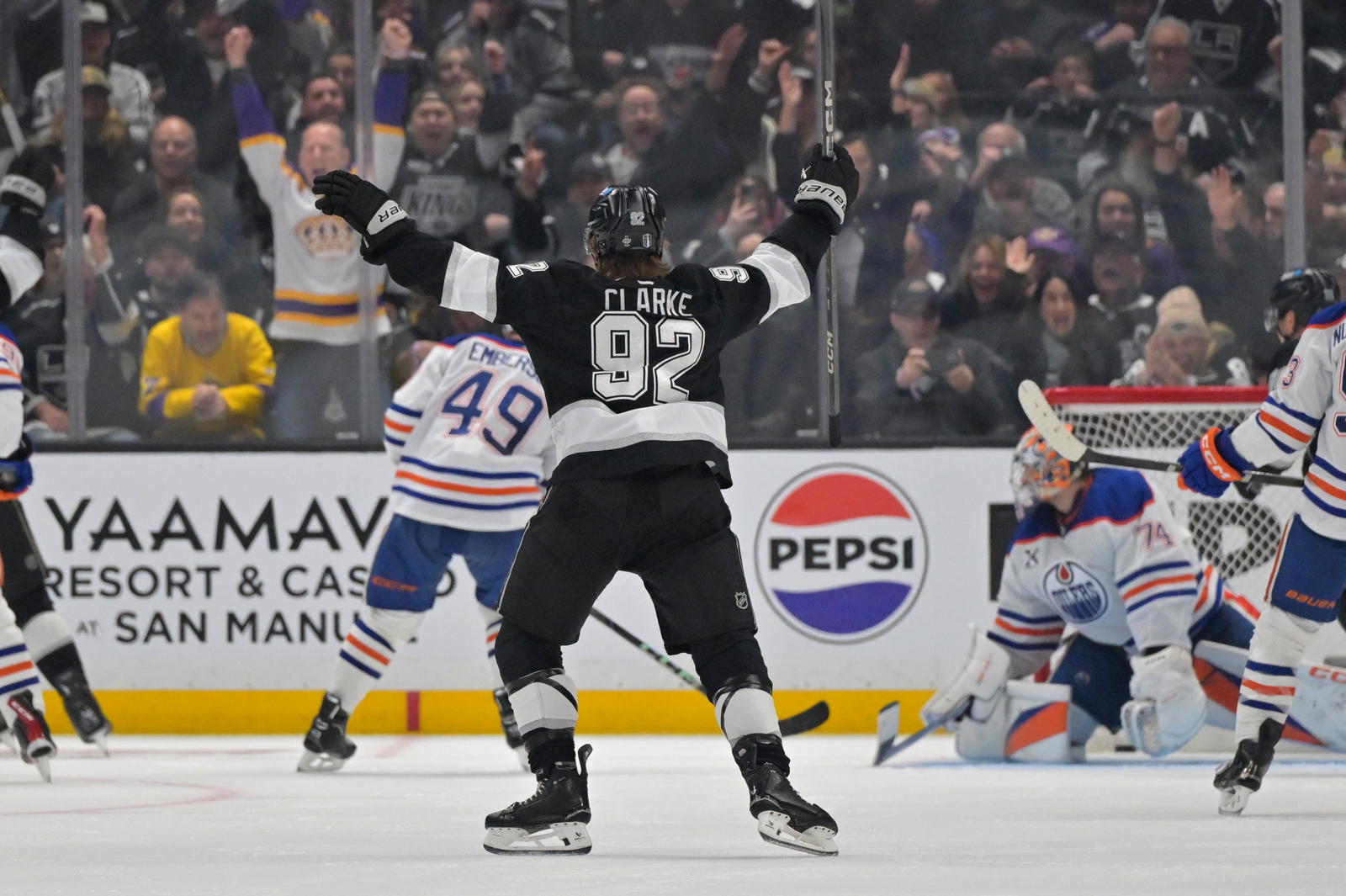 Credit © Jayne Kamin-Oncea-Imagn Images
LOS ANGELES, CA -- Two wins in regulation and a two-nothing series lead is a whole new world for the Los Angeles Kings. While some might think they are dreaming while re-reading that, it is very much true, and it is very much due to a complete reversal of special teams.
When Trent Frederic went off to the penalty box halfway through Game Two, down 2-0, the Kings of the past would have almost certainly flubbed the opportunity to go up 3-0.
But the five forwards who hopped over the boards, designed by a coach willing to put out his best in the best tournament in sports, have been red-hot. But it wasn't the five-man forward unit that drew first blood in Game Two, with two unlikely players getting the credit. A primary assist to Warren Foegele, the ex-Oiler who barely whiffed powerplay time in Edmonton, off a rush to a net-charging Brandt Clarke.
Certainly not on my bingo card.
Let's circle back to Frederick and his penalty: the penalty was taken while guarding a certain Russian player who has caused complete and utter havoc for the Oiler's game plan. Adrian Kempe would rocket a one-timed point shot off the post, which the Kings would corral and extend. But Andrei Kuzmenko, the player acquired for a third-round pick, has been a silent assassin and conductor from an unlikely spot on the ice.
He's playing from behind the net. While not the same feel of 'Gretzky's office', it's certainly doing the job.
His work down low has caused a shift in defending the Kings' powerplay. It's motion between five players, a shift away from the somewhat stagnant yet still effective form of (while in his later years) Drew Doughty, remaining mostly fixed to the point.
In all player motion off of either the left or right side, Kuzmenko gets lost in a good way. He scores the 3-0 goal due to a bank shot off the boards, but while he was in motion from behind the net.
It isn't a standard tactic to guard a player behind the net when down a man; even at even strength, a player has the ability to hunker down, then break off the post to contest. Here, that can be accomplished, but you take the defensive schematic at risk with rapid movement back to the perimeter, gauging the cross crease, the bumper and inner slot as the movement progresses.
All the while, it's Kuzmenko getting 'lost.'
Take away a five-on-three goal in Game One to try to whittle down how the two teams stack up at five-on-four. That's still a 4/9 clip, compared to the o'fer for the Oil. The five-forward unit with Kuzmenko has scored three times in this series, and it's been only two games.
The Oilers will get theirs; that's just an undeniable fact when a team ices Leon Draisatil and Connor McDavid, particularly when they are iced together in a nuclear way. The two were quiet in a game they had to be loud, despite a stellar re-direct from Draisaitl off a high IQ vision play from John Klingberg from the blue line.
I have a hard time seeing the Oilers continue going o'fer the rest of the way, but they just simply haven't drawn the same number of penalties the Kings have been harvesting due to the one-sided favorable depth they are displaying.
Is it by chance that their forward group is thin? Or rather, a defensive corps without their best defensive defenseman and have a gauntlet of quality defensemen who provide less than quality defense? Or did the Oiler Penalty Kill, which had one of the highest net rating playoff percentages of all time during their Game Seven Cup Finals run (a Net PK of 98.6%), shed too many layers off their penalty-killing arm in the offseason?
The stoppages for the Oilers will have to come in a hurry since the Kings have outscored the Oilers 7-5 at even strength and 5-0 on the powerplay. The Oiler PK has practically lost an organ on the kill, with Mattias Ekholm out, and so far, the sample of guys 'stepping up' has been moot against a five-forward unit that has feasted.
The Oilers are now in uncharted territory with the Kings and vice versa. The last time an NHL team has started the playoffs by scoring six goals in the first two games was the Sharks against the Kings before the dramatic reverse sweep in 2014 en route to the Kings' second championship.
Uncharted waters can cause potential grounding, and right now, the depleted Oilers look as if they were brought down to Earth. The nuclear option didn't buckle the Kings despite their clear underlying number advantages: the nuclear line didn't outscore the Kings as they did in Game One. They adjusted, which was probably the reason Jim Hiller went 11-7 in Game Two.
The Oiler defensive unit and penalty kill have been drowning, almost singlehandedly giving the Kings backbreaking goals off of turnovers, turnovers self-inflicted but also from Kings' pressure.
The Oilers will have the last change for two critical games, and I'm curious to see if Kris Knoblauch continues to run his nuclear option with the vast majority of his offensive weaponry deployed on one line. For the Kings, that should look countered in the form of an 11-7 lineup despite not having matchups.
The Oil are very much in this series despite two legitimate black eyes. Being able to go nuclear at home won't always have to see Phillip Danault to counter. It won't see Vladislav Gavrikov or Mikey Anderson. It will come in the form of Joel Edmundson and Brandt Clarke.
How many shifts can the Kings' bottom two or three defensemen (Jordan Spence too) see against the nuclear line before they actually buckle or at a minimum, take a penalty to provide a historically lethal group that was inches away from barging down the door in Game Two?
Home ice has proven favorable for the Kings, but can the Oil navigate these waters with limited offensive options and a Kings' top nine that is currently overpowering them?
It's certainly a thought, and certainly the thoughts the brain trust in Edmonton will be perusing over the midnight Oil.
1
Comments

Powered by RoundtableBuilt on infrastructure designed for real-time media. Learn more at RTB.io.© Roundtable 2026. By using this site you agree to the Terms of Use and Privacy Policy