




Jul 24, 2025 7:28 PM
Updated Jul 24, 2025 8:37 PM
Resting on the coast of the Adriatic Sea, the Republic of Croatia is a beautiful country renowned for its pebbled beaches, natural scenery and parks. It gained notoriety and traction as a tourist destination in recent years, thanks to the popular Game of Thrones series, which used it as a filming location.
What the region is not known for is producing hockey players.
There have been a few exceptions.
THN's Steve Warne and Gregg Kennedy discuss how the Senators got the top two players in the 2020 NHL Draft: Tim Stutzle and Jake SandersonMore Videos
Born in Split, then part of Yugoslavia, Goran Bezina was selected by the Phoenix Coyotes in the eighth round of the 1999 NHL Draft. The defenceman spent the majority of his career in Switzerland, which is the country he represented when playing in international tournaments. Bezina would ultimately play in three NHL games during the 2003-04 season with the Coyotes.
Hailing from Zagreb, Borna Rendulic was an undrafted right winger who played in 15 games across three seasons between the Colorado Avalanche and Vancouver Canucks.
But no Croatian-born player had been drafted and developed within the country until the Ottawa Senators selected Bruno Idžan in the sixth round of this year's NHL Draft (181st overall).
It was a historical moment for the country and sport, but for a country with a population of only four million people, Croatia is accustomed to exceptional sports development successes.
"Considering our size, I think we do punch above our weight," explained Vice Skračić, the Croatian Ambassador to Canada from his country's Chapel Street embassy in Ottawa. "Since independence, we have qualified for six out of the seven FIFA World Cups we have entered. Of those six, in three of them, we finished third or better.
"That's not bad damage for a smaller nation."
Following a brief drought after the country's third-place finish in the 1998 FIFA World Cup, Croatia went on to become the runner-up in the 2018 tournament, before finishing third in 2022.
Team sports have historically been a strength of the small nation. Football, basketball, water polo, and handball are incredibly popular, producing some of the nation's biggest stars, such as Luka Modrić and Ivan Perišić.
In the heart of the Gornji Grad–Medveščak region of Zagreb, lies the infamous Mirogoj Cemetery, one of the most beautiful cemeteries in Europe. Within the confines of its iconic arcades and walls resides a peaceful and popular tourist site. It is the resting place for people of all religions, and where the graves of many of Croatia's most prominent and historical figures reside.
The tombs of poets, writers, politicians and athletes can all be visited, and one of the most iconic belongs to Dražen Petrović. To this day, candles coloured to match those on the Croatian flag and flowers are placed on the base of a marbled slab adorned by a dome and four vertical pillars.
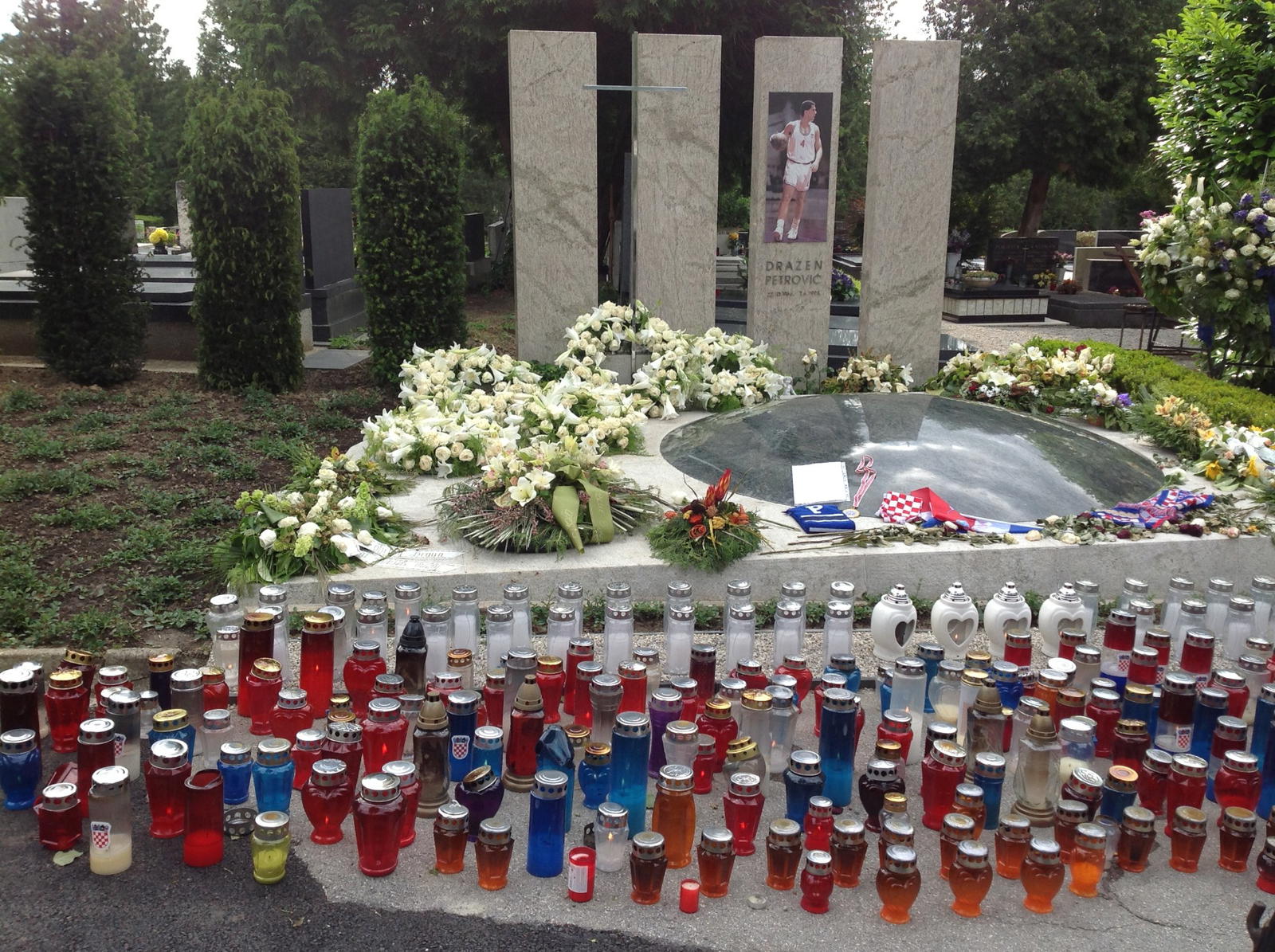 The tomb of Croatian NBA star Dražen Petrović at the Mirogoj Cemetery in Zagreb.
The shooting guard starred for the New Jersey Nets in the early 90s before his life tragically ended at the age of 28 following a car accident. Petrović is widely regarded as one of the most influential and incomparable European talents to have ever graced the NBA, making him a forebearer of the modern NBA.
Amazingly, the country has also produced its share of unconventional winter athletes.
Slalom racer Janica Kostelić is a four-time Olympic gold medalist and former world champion, while the 2024/25 FIS Alpine Ski World Cup Slalom Champion is Croatian Zrinka Ljutić.
Nobody is burdening Bruno Idžan with the expectation that he will develop into one of the best players in the world, but his development path and unlikely story are worthy of telling.
Idžan grew up in Novi Zagreb, which translates to 'New Zagreb', a part of the city located south of the Sava River.
Idžan began skating around the age of three or four. At that time, Zagreb's professional hockey team, KHL Medveščak Zagreb - whose KHL acronym represents the Croatian words 'Klub hokeja na ledu', which translates to 'Croatian hockey club' - played within the Austrian Hockey League.
The organization would eventually join the Kontinental Hockey League in 2013, and its roster featured a few names that may still be familiar in Ottawa. The roster featured Carp's Kurtis Foster, former Binghamton Senators Hugh Jessiman and Barry Brust, and one-third of the return from the infamous Dany Heatley trade to San Jose, Jonathan Cheechoo. One of their teammates, Marko Sakic, would go on to play a role in Idžan's development as his U18 and U20 coach.
Sakic had heard stories of Idžan's talent, but only had the opportunity to watch the player consistently when he began coaching Bruno at the age of 15.
"When I saw him on the ice, I knew that he was different," Sakic remembered while describing the first time he watched Bruno play. "That shot is different. That release and that skating, everything was different than the other kids on the ice.
"You could see it right away on the ice in that group, where I saw him for the first time. He was different. Of course, in that moment, I didn't imagine that he would be the first drafted Croatian, but I saw a lot of potential and that he could score goals.
"When you can score goals, everything is possible. He has the ability to score, so that's the most important thing. As a coach, you see that (offensive) talent that he has and that separation from his (peers), but I need to say his work ethic is exceptional. He asks questions, and he wants to develop. He wants to become better. You could see that from a young age."
 Idžan visits with The Hockey News Ottawa's Graeme Nichols at Sens Development Camp earlier this month.
When it came to self-improvement, the challenge Idžan encountered was the sport's infrastructure.
Having a KHL franchise helped spur interest and participation in Croatian hockey, but financial difficulties eventually forced Medveščak to rejoin Austria's Erste Bank Eishockey Liga (EBEL) for the start of the 2017-18 season.
"At that time, the whole quality after that just went down," Idžan recalled when describing his formative years playing hockey. "We had one, sometimes two functioning hockey rinks in the whole country, so it was a pretty bad situation."
When Medveščak was playing in the KHL, it represented an opportunity to grow the sport nationally.
"In terms of infrastructure, arenas and rinks, we have three
in the whole country," stated Marko Sakic, the head coach of Croatia's U18 and U20 programs. "That's it, just three rinks: two in Zagreb, and one in Sisak."
One of those rinks in Zagreb is open-air.
"It only works like two or three months of the year because it is seasonal," outlined Sakic. "There are two other rinks, and one is very old and needs a major reconstruction. (The sport) is not very big. It was popular for 10 years when Medveščak was very popular playing in the Austrian League and in the KHL. At that time, hockey was very popular, but nothing happened.
"We didn't build any new rinks, or we didn't (try to grow) our sport in other cities. It was not in anyone's plans. Nobody was thinking about future growth. That was a good opportunity to build rinks in other cities, grow hockey and have eight or ten teams to get our own national league going."
The lack of infrastructure would eventually push Idžan to look outside the country for opportunity.
"I was kind of always the best in my age group, and maybe even more (when playing against older competition) in Croatia," Idžan recalled. "I wanted to do something more. I loved the sport, obviously. I wanted to see what my limits were."
The issue Idžan faced is similar to the problem many Croatian kids still face today; if they have aspirations of improving and playing hockey at a higher level, they need to play more games against better competition.
There are presently four youth teams in the entire country - three in Zagreb and one in Sisak.
"It is tough to develop under these circumstances," Sakic emphasized. "The kids also don't have a lot of (on-ice) practice. We do a lot of stuff off-ice because the kids are on the ice only two or three times a week.
"They don't play enough games. It's pretty tough. You need to be very talented and work very hard off the ice.
"It's impossible (to develop), to be honest with you, if you don't go abroad."
To allow their son to chase his dreams, the Idžan family selflessly committed themselves to affording him an opportunity. Bruno's parents made the hour-and-a-half trek from Zagreb to Ljubljana, Slovenia and back every day so that he could play for HK Slavija.
"It was a pretty small (club), but I was driving back and forth there for three years," Idžan said when talking about his path. "I played pretty well in Slovenia, and then there was the next step in Sweden.
"I got an invite to a smaller club, which was like a second Junior League, let's say, then I played well there, got invited to a better club."
During that 2021-22 season, Idžan played well for the Viggbyholms IK division 2 team, tallying three goals and seven points in 13 games. He would go on to play 35 games for their J18 program, where he exploded for 50 goals and 81 points.
That production drew the attention of the Swedish Hockey League's HV71, who slid Idžan into their J20 and J18 programs for the following season, where he continued to put up solid numbers in regional play.
The following season, however, Idžan's performance waned between HV71 and the Malmö Redhawks.
That offseason represented a pivotal crossroads-type moment for Idžan, and he sat down with Sakic and his agent, Aljoša Pilko, to discuss how he should proceed.
"That summer, we were sitting and speaking about what he should do," Sakic described. "He ended up staying at home in Sisak, in the Alps Hockey League (AlpsHL). (The risk was that) no player from the Alps will be drafted, but for Bruno, it was exactly what he needed, as he was not satisfied with his performance last year in Sweden.
"It was a tough year. It's normal (for players) to have ups and downs. We have all gone through it, but he decided to stay at home. That was a great decision to stay at home."
It was a decision that paid immediate dividends.
"(Returning to Croatia) was awesome because I had an opportunity to play at home," Idžan said while clarifying how his time with Sisak benefited him. "I lived at home. It was that home factor that developed my self-confidence."
Bruno started the 2024-25 season tallying 16 goals in his first 10 games, before ultimately finishing with 21 goals and nine assists in 19 games with KHL Sisak. His 1.58 points per game was the AlpHL's fifth-highest rate, earning him attention from the USHL's Lincoln Stars.
"I just felt really good there," Idžan stated. Playing with my childhood friends on the same club was awesome. I got that invite from (Lincoln), and it was just like, yeah, I earned this. I'm going to take the shot and see what happens."
Impressed with his production, Idžan earned an invite to join the Stars. He would finish his 2024-25 season playing 36 games in the top junior league in the United States, recording 22 goals and 44 points. Only 10 players in the USHL averaged more than a point per game while playing in more than 30 games, with only one outproducing Idžan's 1.22 points per game.
His performance put him on the NHL scouting radar, but there were no assurances that he would be selected at the 2025 NHL Draft.
"I was hoping that I would go," Idžan said through a smile. "Of course, I was ready not to be selected as well. I knew there was a chance not to be, but the hope was there."
Idžan never experienced any in-person interviews, but he did participate in several Zoom calls with NHL organizations. One of those was with the Ottawa Senators, which included several of their amateur scouts.
"There were three or four amateur scouts on Zoom, and we talked a little bit," said Idžan. "They were not telling me, 'We'll take you.' I thought it was a pretty good interview, so I felt good afterwards, but I was not sure Ottawa would take me."
The Senators would ultimately select Idžan, but after development camp ended, the prospect headed to Madison, Wisconsin, to get a head start on training for his freshman season at the University of Wisconsin.
One of the more interesting storylines to follow from a Senators' prospect perspective is how the University of Wisconsin is now home to several of the organization's prospects. Blake Montgomery and 2025 first-round pick Logan Hensler will be familiar faces to Idžan, but 2022 draftee Tyson Dyck will also join him as WisconSens.
Like most prospects, Idžan wants to spend the next several years improving his defensive play and fundamentals.
"The most obvious (place to improve) is the defensive part of the game," Idžan admitted. "It is huge for me. It is a step to reach the next level that I need while improving my fundamentals like puck handling and skating.
"Maybe I have the wrong technique, so I need to improve, but these are things I can improve with time."
Idžan's developmental story will be one to watch, as he possesses some offensive instincts not commonly found in the Senators' pipeline. Although the organization has some skill and size on the blue line, there is not a ton of skill within its forward prospect group. If he can continue to showcase his skill while improving in the other areas of his game, he will have a chance to play professionally.
What works in his favour are his roots. He comes from what his former coach, Marko Sakic, describes as a remarkable family.
"The whole family is very humble and very hard working,
"(Bruno) will keep doing what he does best, and he will keep battling. He had many challenges in Sweden and played abroad, leaving home at a young age. He is ready in that aspect because he has already experienced it."
Getting drafted was just one step in Idžan's journey, and he recognizes that there is still a long way to go to fulfill his hockey goals. Nevertheless, there is still time to appreciate the significance of the moment.
"I had so much joy and feel proud to do it, not just for myself, but for my country as the first Croatian to be selected," he said. "It's pretty cool. I wish that (a Croatian was drafted) when I was younger.
"For somebody who started in the same shoes as the kids in Croatia right now, where there's not a lot of hockey or opportunities to play, and just to see that it's possible at my age of 19 now. From playing hockey in Croatia until I was 13 to being drafted in the NHL, I think it would be nice for kids to see it.
"I hope it's cool for kids right now."
It is incredibly cool to instill hope in a younger generation of Croatian athletes who may have turned to another sport because they lacked confidence in their own hockey future.
"I'm sure there are kids in Croatia who are following his success, and it will spur them to do the same," Vice Skračić proudly beamed. "This is why it's important to see how he develops and his approach to the game.
"From what I can see, he's a very mature young man. It is the way he looks at it, the way he is talking about it, and his attitude towards the sport."
Idžan's selection does not have to be that watershed moment for Croatian hockey. Nonetheless, if his story inspires more Croatians to try the sport, that will drive demand for more and improved infrastructure, which will inevitably fuel growth and ideally, future success stories.
"It's awfully important," stressed Skračić. "We only have two arenas where you can play hockey all year round.
"If you don't have the infrastructure in place, it's very hard to develop (athletes), and it's finding your way into the priorities. Croatia is undergoing significant construction, with numerous projects underway, including sports centers and other developments, not just in major cities, but also in outlying areas. A lot of that is done with the help of EU funds, but infrastructure is critical to grow the sport."
Idžan does not feel the pressure to grow the game, however.
"Not really," the prospect acknowledged. "I feel like this is just like a bonus. It's not really something that people expect from you. They are just happy for you. They are happy to see their country represented in that way. So, I don't feel pressure. I feel the pride of being Croatian more than anything."
By Graeme Nichols
The Hockey News Ottawa
Banner image credit: Ottawa Senators
This article originally appeared at The Hockey News-Ottawa
More Sens Headlines:
Former Ottawa Senator Returns To NHL After Three-Year KHL Stint
Sens Captain Brady Tkachuk Celebrates Hard at Brother Matthew's Wedding
Can The Senators Count On Dylan Cozens To Consistently Produce?
Senators Re-Sign 2021 First-Round Pick To One-Year Deal
An Early Glance At The Senators’ 2026 Free Agent Class
Why Mason McTavish Isn’t Coming Home To The Senators
2
Comments

Powered by RoundtableBuilt on infrastructure designed for real-time media. Learn more at RTB.io.© Roundtable 2026. By using this site you agree to the Terms of Use and Privacy Policy