



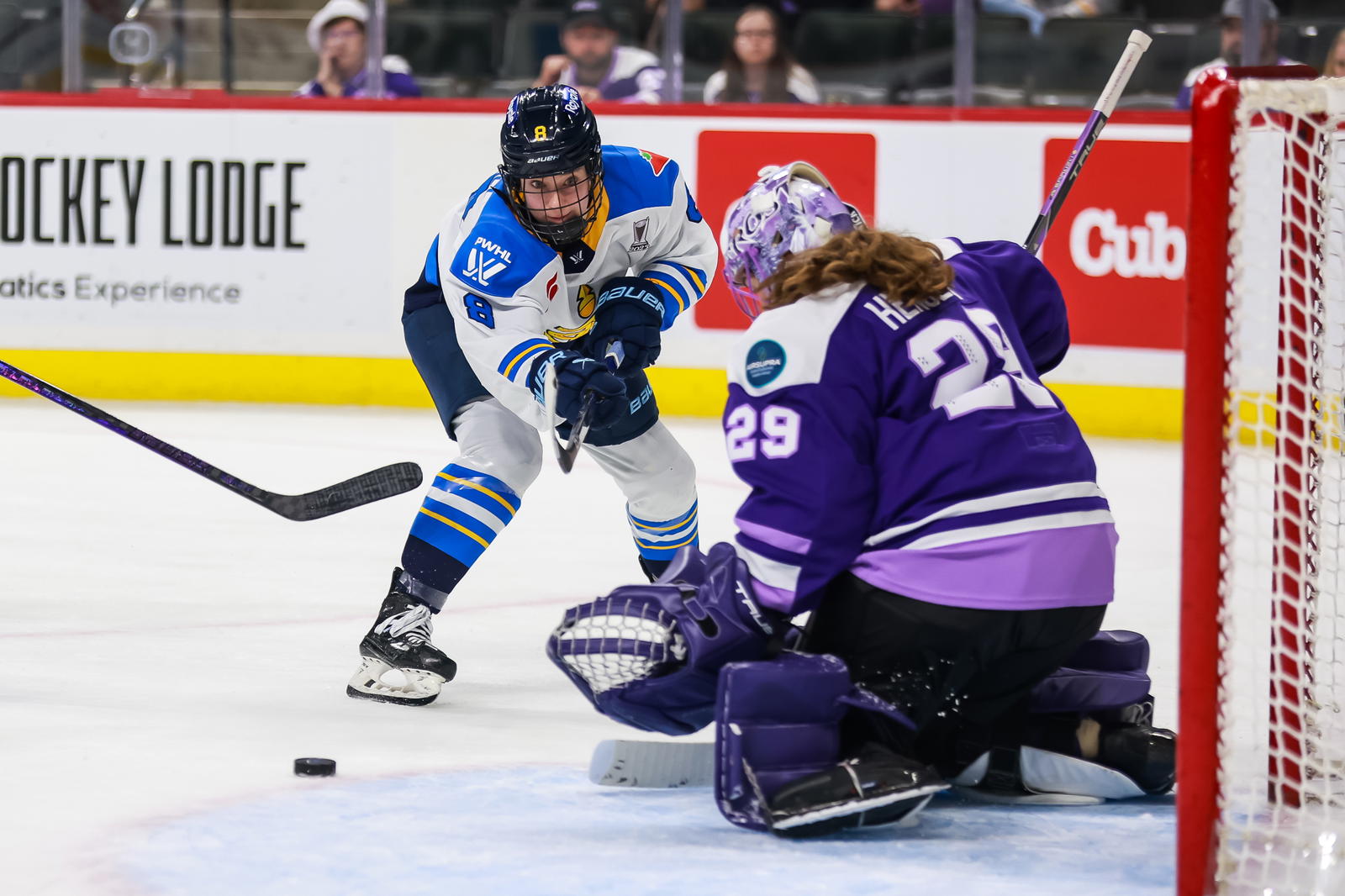
For the second straight season, the Toronto Sceptres suffered an opening round playoff loss at the hands of the underdog Minnesota Frost. Toronto finished first in year one, and second in year two during the PWHL regular season to secure home ice advantage, but in both campaigns, the advantage was all Minnesota's.
For long suffering Toronto hockey fans, it was the opening lines of another chapter in unexpected and early playoff exits. Toronto exited in game four, falling in overtime to end their year. When examining what went wrong, there are a number of variables that factor in. Not to be overlooked was the injury and recovery of Natalie Spooner; but to put blame on the PWHL's 2024 MVP would be misdirection.
Despite their regular season strength, Toronto certainly had issues this season.
Inconsistent Goaltending Hurts Toronto
There are six people on the ice at any one time, so team defence is always the first symptom to look at. In Toronto's case however, there were clear moments when inconsistent goaltending hindered their hopes. Starter Kristen Campbell saw her numbers dip from a 2.25 GAA and .910 save percentage in the regular season to a 4.74 GAA and .813 save percentage in the playoffs. Those numbers collapse further when you remove a solid game one. That includes a .708 save percentage in a devastating game three where Campbell allowed seven goals on 24 shots, and an equally leaky game two where she relinquished five goals on 25 shots. It wasn't that Toronto hung Campbell out to dry. It was simply that shots were going in that had no business finding the back of the net. The injury to Raygan Kirk exasperated the issue, and while CJ Jackson gave a valiant effort in game four, it was a near no-win situation throwing in a goaltender with only one game played in the last two years, and only seven over the last three years, expecting them to steal a game.
The real interest in this discussion moving into the offseason will be if Toronto decides to move forward with Kirk as their starter in year three, exposing Kristen Campbell to expansion, or if they attempt to run it back for a third attempt in Campbell's final season of her three year contract. Exposing a player like Campbell would free up significant money in Toronto to target free agents, and give internal raises to retain key performers.
Nurse And The Stars Didn't Shine
Injuries certainly played a factor in Toronto's season with Natalie Spooner and Sarah Nurse missing significant time. Spooner never quite got back to form, which is understandable. Nurse just struggled. Following her return from injury in March, Nurse had only a goal and an assist in six games. Her only goal at Worlds, which bisected this return, came as the final tally in a lopsided 8-1 win over Finland. 11 Canadian players scored two or more goals in the tournament, a list that did not include Nurse. In the playoffs, her impact dwindled further as Nurse collected only one assist in four games. It's a similar disappearance to last year's loss when Nurse had one assist in five games after recording 23 points in 24 regular season games. Perhaps more concerning, despite above average advanced possession numbers for Nurse, was the fact she dropped to a team worst -10 on the season. It's a 24 goal differential from top to bottom in Toronto as forward Hannah Miller finished +14. Nurse missed nine games due to injury, making the number even more stark.
Unable To Match Minnesota's Tenacity
Minnesota played hard and fast playoff hockey. Toronto struggled to match the impact of Brooke McQuigge, Britta Curl-Salemme and others physically, and the speed of Taylor Heise and Kendall Coyne Schofield. Minnesota was hard on pucks, got bodies to the net, and rarely passed an opportunity to make contact. From their top line, to the depth of Dominique Petrie, Katy Knoll and Liz Schepers, Minnesota didn't take a shift off, and even when there was little flash, there was a lot of pace, and you could see the competitiveness of their roster. The other aspect of Minnesota's game that pushed them over the top was their ability to generate and jumpstart their offense from the blueline. Lee Stecklein and Sophie Jaques both outscored any player on Toronto's roster with six points each, while Mellissa Channell-Watkins also tied Toronto's leader with four. And that's not even mentioning the impact of Claire Thompson for Minnesota. Goaltending in the series was a wash, as Minnesota's crease was average, but in the simplest terms, Minnesota looked like a team willing to do the little things to win.
Offseason Changes Are Coming
One major in-season change was made this year with Toronto sending Jocelyne Larocque and Victoria Bach to Ottawa for Savannah Harmon and Hayley Scamurra. They also sent Kaitlin Willoughby to Montreal for Anna Kjellbin. Following Toronto's four player trade, Larocque flourished in Ottawa playing some of the best hockey we've seen her play in years. And sadly for Toronto, the type of hockey Larocque is bringing to Ottawa, is exactly what the Sceptres lacked in round one. She's competing and winning puck battles, in the face of opponents, and making simple plays to support her teammates, rather than trying to do it herself. It's a stark contrast to the Larocque who started the season in Toronto. Perhaps it was more of a system mismatch for Larocque's style rather than a degradation of Larocque's game itself. Similarly, Montreal has leaned heavily on Willoughby to play the same fast, dogged-in-pursuit-of-the-puck styled game that Minnesota used to beat Toronto.
More change is destined to come this offseason as Toronto will be one of the hardest hit teams in expansion. Win or lose, Toronto's roster boasts some of the best forward depth in the league, and Vancouver and Seattle will be waiting to pluck a handful of those players from the Sceptres. Toronto will have an endless lineup of players hoping to head home to the city, and get a chance to show Team Canada's brass what they can do, but unless Toronto exposes their top paid players, it will come at a personal cost. In the case of Daryl Watts, she's one of the league's lowest paid players, a deal she accepted to get to Toronto, when her play dictates she should be one of the league's highest paid players. It will be the same for any other new player headed to Toronto unless the let others walk, or strategically expose a player like Kristen Campbell, or one of their other original six signed players to free up money to fill their holes through free agency.
Conversely, Toronto might benefit from looking at the style of depth players other teams have found success with this season and bring in a handful of players on league minimum salaries who won't flash as much skill down the lineup, but will bring intangibles to make the Sceptres a more difficult team to play against, particularly in playoff situations.
With their season ending in round one for the second straight season, Toronto management and fans will run over the what ifs and analyze what went wrong for the foreseeable future. The result of that inquiry could, and should, result in offseason change for the Sceptres.
