


City of Cambridge Archives


Sep 11, 2025 10:44 PM
Updated Sep 14, 2025 2:35 AM
The Hilborn Company of Ayr had many competitors in the early days of the made-in-Canada hockey stick business.
One noteworthy rival was in the nearby town of Preston, Ontario, which is now part of the city of Cambridge. That’s where Edward Burgess 'E.B.' Salyerds, the descendant of a Cambridge pioneer, operated a brush factory and later began making hockey sticks that rivalled Hilborn’s in popularity.
Preston was first known to its European settlers as Cambridge Mills, which is where the current city’s name originates. It was founded by Salyerds’ great-grandfather, John Erb, who was among a group of Mennonites from Pennsylvania who had purchased land in the Haldimand Tract from a speculator who had arranged to buy it from the Indigenous people who already lived there.
John Erb’s properties included the confluence of what would later be named the Grand and the Speed Rivers, and he built a sawmill on the Speed in 1806, followed by a flour mill in 1807. (1) The flour mill still runs today and is the oldest continuously operating business in Waterloo Region, although it has long since passed out of the Erb family’s ownership. Cambridge Mills was renamed Preston in the 1830s and was incorporated as a village in 1852.
E.B. Salyerds was born in 1862 in Preston. His father was John Salyerds, whose parents were Isaac Salyerds, another immigrant from Pennsylvania, and the former Susannah Erb, who was a daughter of John Erb. Isaac, like his father-in-law, had an entrepreneurial spirit and operated a tavern and a tannery near the Grand River and two large farms nearby. John Salyerds worked as a merchant.

E.B. Salyerds first appears in our story in 1885 as the proprietor of the Preston Brush Works, located at the end of Water Street (now Chopin Drive) where it intersected with Hamilton Street.
It has been written that Salyerds was in business for himself as early as 1876, but that is improbable since the brush factory was a very sizeable operation, and he would only have been 14 years old at that time. (He also had no profession listed in the 1881 Canadian Census.)
Whenever it was that he established himself, what is inarguable is that he developed an interest in the new sport of hockey and in manufacturing hockey sticks at his plant, probably in the early or mid-1890s after hockey became established in Preston.
It has been claimed that Salyerds was producing hockey sticks by 1887, but this is very unlikely since hockey, migrating west from Quebec and eastern Ontario, had yet to be established in the southern and western parts of the province; the game wasn’t introduced to Toronto until 1888, and Hamilton’s first exposure to hockey was in 1890. (2)
It’s difficult to imagine that the sport would have leapfrogged the two largest cities in the province to reach Preston first. In any case, Salyerds was firmly established as a stick manufacturer by 1897. That year, he proclaimed in an advertisement for the brush factory that his sticks, made of rock elm, were “the best in the market.” (3)
His best-known stick was one that he called the Salyerds Special, and a Preston industrial profile in 1908 said that it was an immediate hit after he made it available for sale.
“It wasn’t long before players of this sport throughout the Dominion began to realize that here was the stick they had been waiting for and wishing for,” the profile said. “Today Mr. Salyerds owns one of the handsomest factories in Preston. It is located on the corner of Hamilton and Water Streets, is built of brick, 2 stories in height and in point of equipment and sanitary conditions attending the manufacture of the brushes and sticks, could not be excelled anywhere in Canada.” (4)
The phrase “throughout the Dominion” was not mere marketing hype. Salyerds enjoyed wide distribution with his products; newspaper archives prove that they were being sold in Saskatoon and Edmonton by 1910 if not before, and in Vancouver in 1911, just prior to the introduction of artificial ice in British Columbia and the establishment of professional hockey on Canada’s West Coast. (5)
“What you want in the hockey stick is the Salyerd (sic) Special,” a Saskatoon hardware store claimed in a newspaper advertisement. “If you once see one you will want one.” (6)
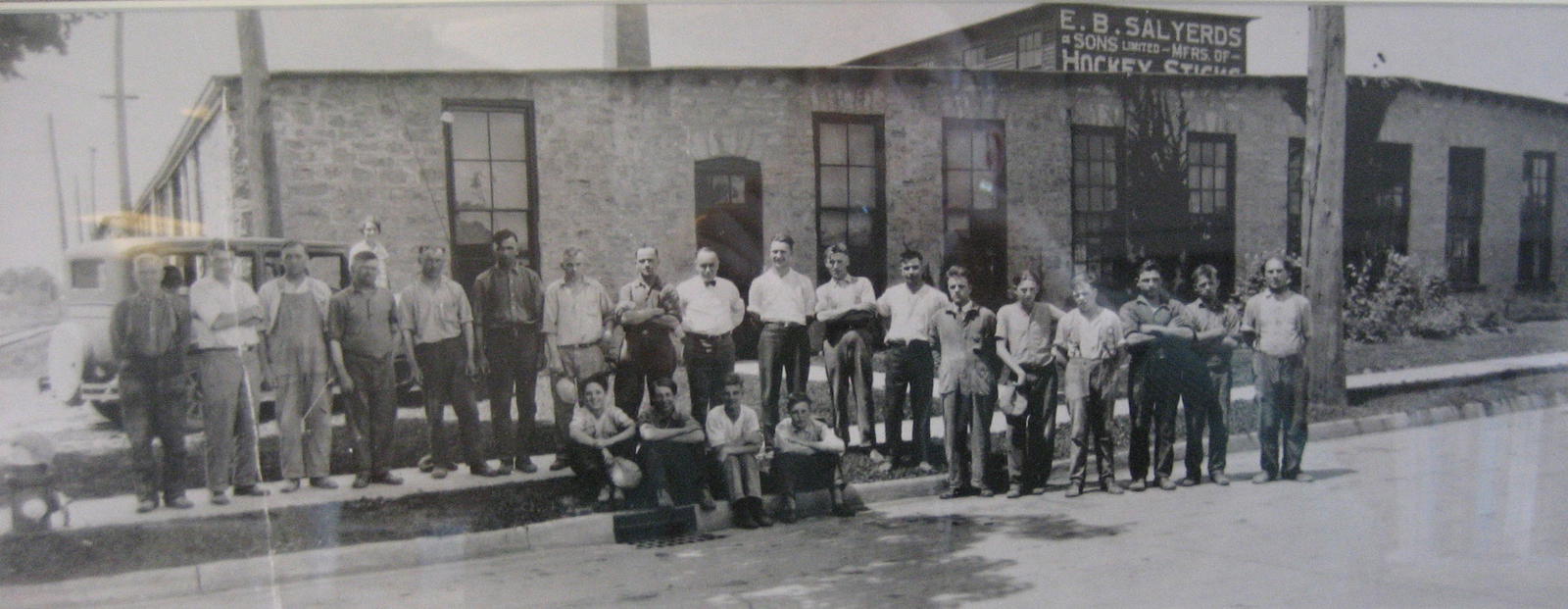 E.B. Salyerds and Sons hockey stick in factory in Preston, Ontario (now part of Cambridge, Ontario). E.B. Salyerds is believed to be the gentleman wearing a white shirt and black bow tie, standing roughly in the middle. (Courtesy of the City of Cambridge Archives)
E.B. Salyerds, like William Hilborn, took a deeply personal interest in his work. He served as the treasurer of Preston’s hockey team and watched his oldest son, Edward Charles 'E.C.' Salyerds, line up with the Preston juniors in 1906. He also registered a patent for his own hockey stick in 1909. Both of his sons came to work with him at his factory – E.C., born in May 1887, and Courtland, born in December 1888. Eventually, the company would be known as E. B. Salyerds and Sons Ltd.
But there were struggles along the way.
The brush works was gutted by a fire in July 1902. (7) He rebuilt at the same location but a second fire, in October 1921, destroyed his plant at a cost of about $30,000, along with $5,000 worth of nearly completed hockey sticks. (8)
Salyerds bounced back both times – within days of the latter fire, he was planning an immediate return to work after leasing an empty factory building where woodworking machinery had previously been manufactured. (9) This turned out to be a very good location; unlike the brush works, the Salyerds’ new home on Guelph Street (now Dolph Street) was situated next to a branch line of the Grand Trunk Railway, later the Canadian National Railways. Previously, their sticks had to be taken by wagon or truck from the brush works to the rail line, but transportation was far more convenient with the move to Guelph Street.
Preston became a noted hockey center during the Salyerds’ reign in the hockey stick business, with its junior team advancing to the Ontario Hockey Association playoff final in 1910 and its intermediate team winning the OHA title in 1911 and repeating in 1912. (10) In the 1930s, the Preston Rivulettes women’s hockey team would make history by winning all but two of an estimated 350 games on their way to capturing 10 consecutive Ontario and Eastern Canadian championships, also capturing six Canadian titles during the same time frame. (11) We can’t know for certain, but the Salyerds most likely supplied the sticks for at least some of these accomplished clubs.
The business faced financial difficulties in addition to the fires the Salyerds endured, with an insolvency and a liquidation taking place during a period of time in the early 1910s when new investors were involved, among them another industrialist from Preston named Percy Hilborn. He happened to be the nephew of William Hilborn Sr. and therefore the first cousin of Albert Hilborn, the operator of the hockey stick factory in nearby Ayr. His interest did not last long, though, and familial competition between the Hilborn cousins was short-lived. The Salyerds were back in full control of the Preston plant by 1915.
Between fires, the Salyerds made a fateful decision when they oversaw the opening of a new factory in nearby Hespeler in March 1920. The new business was reportedly to be called the Dominion Wood Specialty Company.
“The new venture will be under the management of Edward C. Salyerds, who has a thorough knowledge of the manufacture of hockey sticks, which will be the firm’s main product,” said a Kitchener newspaper article. Somewhat prophetically, the article added, “The new concern is starting in a small way, but promises to develop into a large concern.”
It is noteworthy that the factory was located in what the article called “the Hall-Zyrd (sic) annex” in Hespeler, but there was no mention of who actually owned the operation. (12) It’s possible that the owners were entrepreneurs Z.A. Hall and Oscar Zryd; we’ll be meeting them later in our overall story.
The Salyerds’ ambitions would carry them far beyond Preston and Hespeler, with the result that they were probably the first hockey stick manufacturers in Canada to achieve true cross-border success. While other stick companies had merely sold their products in the United States, E.B. and his second son, Courtland Salyerds, moved in 1927 to Avoca, New York, a town south of the Finger Lakes region, with the intention of making sticks there. The Salyerds had family ties in New York state; E.B.’s uncle, Isaac W. Salyerds, had settled in the Rochester area many years earlier and was a prominent citizen there.
E.B. and Courtland first leased part of a building, then bought a former spool factory called the Avoca Manufacturing Company the following year. A Rochester newspaper said when the Salyerds moved to town that their new hockey stick operation was reportedly “the only manufacturing plant of its kind in the United States.” And at the time of the spool factory purchase in 1928, the newspaper reported that the Salyerds owned “the oldest and largest hockey stick factory in Canada.” (13) An article in the Kitchener newspaper claimed the purchase would make E.B. Salyerds “the largest manufacturer of hockey sticks in the world.” (14)
But he would not keep that distinction.
The family sold their 23,000-square-foot Preston plant to the Seagram family of Waterloo just over a year later, in November 1929, with the transaction being announced in early December. (15) It was suggested then that although the business had been very successful, the family simply did not have the necessary capital to continue.
One cannot help but wonder if they would have had the resources to continue in Preston had they not expanded to Avoca and possibly overextended themselves, but that can only be speculation. It’s also not clear why they would sell the factory in their hometown in favor of the newer operation in Avoca, but if the Rochester article was correct in that they had no competition anywhere in the United States, they might have seen more potential for growth there than would have been available in a rather crowded market in southern Ontario.
E.C. Salyerds had not moved to Avoca with his father and brother and, after the sale to the Seagrams, was kept on at the Preston factory while also serving as an alderman on the town council. He remained the factory’s manager until January 1932, when it was announced that the business would move to Hespeler – to the factory that he himself had opened a dozen years earlier. (16)
Although the Preston plant closed down, the building did not suffer the fate of the Hilborn building in Ayr and remains an active industrial operation today. It was the home of a metal stamping firm for many years, and it is now a plastics reprocessing center.
E.B. and Courtland Salyerds had established themselves in Avoca and had gambled that they would have long-lasting success there, but they could not have predicted the Great Depression, which unfortunately began immediately after they sold the family’s Preston operation.
Edward B. Salyerds, having already weathered two fires and a liquidation during his career, was at least spared the indignity of watching the Avoca Manufacturing Company collapse; he died in Avoca in June 1935. Courtland remained in charge until the late 1930s, when he sold out. The factory itself shut down in 1943 after multiple subsequent ownership changes. (17) Courtland Salyerds remained in New York state and died in 1976.
Incidentally, Edward C. Salyerds briefly got back into the hockey stick business by setting up a manufacturing operation in an old furniture plant in Hepworth, Ontario, near Owen Sound, in 1940. (18) This enterprise also failed within a couple of years, and that factory eventually vanished from the landscape. Edward then returned to Preston, where he spent the rest of his life. He died in 1961.
E.B. Salyerds and Sons had made a tremendous impact over five decades in the manufacturing of sticks, especially in the Canadian market that they first established themselves in, but their time in the industry was at an end. Roustan Sports Ltd. remembers them today and are proud to carry on their legacy.
Jonathon Jackson is a hockey historian based in Guelph, Ontario.
Follow along as we post new chapters of Hockey's Oldest Business – Since 1847 on TheHockeyNews.com.
Read the previous chapter: Chapter 1 – Ayr
Read the next chapter: Chapter 3 – St. Marys
(1) John Erb’s brother Abraham later established his own saw and flour mills several miles to the northwest in what eventually became the city of Waterloo, and what is now King Street was initially a trail that was blazed to connect their operations. See: Ernie Ronnenberg, “Erb brothers founded two Waterloo county communities,” Kitchener-Waterloo Record, January 23, 1975; Elizabeth Bloomfield, Waterloo Township Through Two Centuries, 1995.
(2) “Hockey: Two Teams in Toronto,” The Globe, January 23, 1888; “Hockey,” Hamilton Spectator, February 7, 1890.
(3) Farmers’ and Business Directory for the Counties of Halton, Waterloo, and Wellington, 1899.
(4) C.M. Nichols and John H. Dyas, “Industrial Preston,” Preston Progress, 1908.
(5) “Sports and Pastimes” and Martin, Finlayson & Mather Limited advertisement, B.C. Saturday Sunset, December 16, 1911.
(6) M. Isbister & Son Hardware advertisement, Saskatoon Daily Phoenix, November 26, 1910.
(7) “Fire in Brush Works,” Hamilton Spectator, July 16, 1902.
(8) “Fire Completely Destroyed Hockey Stick Factory,” Hamilton Spectator, October 14, 1921.
(9) “To Use Idle Plant,” Brantford Expositor, October 18, 1921.
(10) W.A. Hewitt, “Preston Intermediate Team Champions of O.H.A.,” Toronto Daily Star, March 8, 1911; “Preston Champions for Second Consecutive Year,” Toronto Daily Star, February 27, 1912.
(11) Cambridge Sports Hall of Fame inductees, 1997.
(12) “New Industry,” Kitchener News Record, March 15, 1920.
(13) “Ice Hockey Brings Industry to Village; To Form Teams,” Rochester Democrat and Chronicle, November 27, 1927; “Canada Firm Purchases Spool Factory in Avoca,” Rochester Democrat and Chronicle, October 12, 1928.
(14) James Gingerich, “Preston Maker Of Hockey Sticks Has Bought U.S. Plant,” Kitchener Daily Record, October 15, 1928.
(15) “Salyerds Hockey Stick Plant Sold to the Seagrams,” Galt Evening Reporter, December 3, 1929.
(16) “Salyerds Plant Sale to Seagram Confirmed Today,” Kitchener Daily Record, December 4, 1929; “Salyerds Co. May Move To Hespeler,” Kitchener Daily Record, January 11, 1932.
(17) “Avoca Company Changes Hands,” Elmira (NY) Star-Gazette, March 1, 1939; Edward B. Denerstein, Auctioneer, advertisement, Elmira Star-Gazette, August 16, 1943.
(18) “Hepworth is Anticipating a Good Year,” Owen Sound Daily Sun-Times, January 18, 1941.
2
Comments

Powered by RoundtableBuilt on infrastructure designed for real-time media. Learn more at RTB.io.© Roundtable 2026. By using this site you agree to the Terms of Use and Privacy Policy