




Aug 11, 2025 2:00 PM
The Hockey News has released its archive to all THN subscribers: 76 years of history, stories, and features.
Also, go to thn.com/free to subscribe.
Blood Brothers - Dec. 4, 2017 – Vol. 71, Issue 08 -Jason Buckland
THE PUCK SNAPPED OFF the stick, rose from the ice, and struck hard under the visor. As he crumpled in a heap, swallowed by a pain unlike any he had ever known, the young phenom thought… what, exactly?
This, even Zach Werenski isn’t sure.
It was Game 3 of the Columbus Blue Jackets’ first-round series against the Pittsburgh Penguins last spring, and Werenski had reached to challenge a Phil Kessel shot from the slot. As Werenski’s blade met Kessel’s at the point of release, the puck leapt upward and rocketed along the shaft of Werenski’s stick, its forward momentum halted only by his right orbital bone and eye socket.
For Werenski, darkness. His world went black, his ears grew deaf with ringing. There was no shock, no brief reprieve from agony. Only pain, immediate and crippling, as the ice began to pool red beneath him.
“The blood,” said Werenski’s defense partner Seth Jones, “was coming out quick.”
Werenski staggered to his feet. He had been hurt before in sports, felled once in elementary school by a wrist he broke playing football, but he’d felt nothing like this before. He skated in a panic toward the bench. Trainer Mike Vogt sped to meet him with a towel for the blood that would not stop gushing from his face. A harried Werenski squinted up at Vogt. “What do I do?” he asked.
At the very moment Werenski was able to find a door to leave the ice, Columbus, suddenly down a man and afforded no whistle to stop the action, surrendered the tying goal. The Blue Jackets later lost the game in overtime, and the Penguins took a 3-0 series lead.
Werenski’s horrific injury – which left him with a broken orbital bone, several fractures around his eye socket and serious sinus damage – would eventually mark the end of his season, an attempt to return to the game behind a special mask cut short by swelling around his eye that wouldn’t cease. Indeed, Columbus didn’t last much longer, losing the series to the eventual Stanley Cup champs a few nights later.
And yet, for a team fighting to gain a leaguewide reverence that its famously boisterous coach feels it so recently had none of, the night may have signalled much more for Columbus.
When Werenski returned to that game six months ago, he did so alongside Columbus’ other great hope for the future, who makes up the other half of what may be one of the NHL’s best blue- line duos. Like Werenski, Jones couldn’t stop the Penguins. But in their two young defensemen, Columbus has uncovered not one but two franchise linchpins that could finally spell bright days ahead in the Ohio capital. The hope is Jones, 23, and Werenski, 20, will lead this oncemoribund franchise to league prominence, perhaps sooner than you think. “Our mantra last year was just to earn respect in the league, because we had zero of it,” said coach John Tortorella. “I think we’ve found our way a little bit.

ONE OF THE MAIN REASONS OUR RELATIONSHIP ON THE ICE WAS SO GOOD IS BECAUSE OUR RELATIONSHIP OFF THE ICE WAS REALLY GOOD– ZACH WERENSKI
THE TRAJECTORY OF an NHL franchise can hinge on any number of moments, though the Blue Jackets might be able to trace their rising stock to a precise date nearly two years ago.
On Jan. 6, 2016, Columbus acquired Jones from Nashville in a trade for star center, Ryan Johansen. The subtext was easy to spot: Johansen was a stud, an All-Star Game representative in 2015 and the Blue Jackets’ top scorer over the previous two seasons combined. Yet Columbus remained, in some ways, a tomato can. The Blue Jackets missed the playoffs in 2014- 15 for the fifth time in six seasons – and the 12th time in the 14-season history of the franchise up to that point. A change in philosophy was needed, and in Jones, the much-hyped defenseman drafted fourth overall by the Nashville Predators in 2013, Columbus was committing to something else entirely. “To be one of those top organizations in the league that we all strive to be, you need to build through the middle,” said Tortorella, who arrived behind the Columbus bench some 10 weeks before the team obtained Jones. “That’s goaltenders, and you have to have a defense.”
In net, Columbus has a goalie who’s about as good as it gets in Sergei Bobrovsky, the reigning (and two-time) Vezina Trophy winner. But what it uncovered in Jones was the second step toward a new future, a commitment to a style of play that Tortorella and the team’s management considered the most efficient, most economical way to climb out of the basement.
The first step came a little more than six months before Jones landed in Ohio. On June 26, 2015, the Blue Jackets drafted Werenski, a University of Michigan star from nearby Grosse Pointe, at eighth overall. The hope was that after some more time at Michigan and a little seasoning in the AHL he’d one day anchor a young, versatile two-way defense corps.
Werenski had other ideas for how long Columbus would have to wait. He spent one final season in college and then jumped straight into the heat of the AHL playoff race, leading the Blue Jackets’ minor-league affiliate to the Calder Cup. Tortorella watched him play throughout that post-season run and believed Werenski, then still only 18, was ready for the big-time.
In his first five games in the NHL last season, Werenski had five points, including two goals. Tortorella quickly paired Werenski alongside Jones, whom the coach also pressed into duty as an off-ice mentor to the teenage rookie.

It was an intriguing arrangement. Jones was still only 21 at the time, placed in the unlikely role of veteran leader. For Tortorella, though, it just made sense: what better way to make a young star (Jones) flourish than by having him take an even younger star (Werenski) under his wing?
The duo’s swift rise brought envy from the entire league. And yet it was in each other that Jones and Werenski found their biggest fan. Jones couldn’t help himself during one game last season, late in the third period against Washington, when he watched Werenski skate down the left side from the point and rip a puck through traffic to tie the score. “That,” Jones said, “was eye-opening. It couldn’t have been a much more perfect shot.”
Werenski, for his part, could only marvel at a play by his blueline partner against Boston last season, when Columbus was riding a 12-game win streak it would eventually run to 16. The rookie looked on as winger Scott Hartnell peeked around the net and put the puck right onto the tape of Jones, who blasted it home as the arena’s roof nearly exploded. “He let an absolute missile go,” said Werenski with wonder. “He’s got a bomb of a one-timer.”
They gush about one another, these two, and Columbus management will surely relish that Jones and Werenski also count themselves as friends away from the rink. “One of the main reasons our relationship on the ice was so good,” Werenski said, “is because our relationship off the ice was really good.”
If chemistry in sports is nearly unquantifiable, it can at least be felt, and when it is present it is undeniable. Jones and Werenski have in themselves two very similar players – big, offensively gifted defensemen who take a certain pride in shutting down an opposing team’s attack. Yet more than that, they also displayed an unusual cohesion for first-year teammates.
One play late last season in Ottawa sticks out. About two minutes into the first period, Jones gathered the puck along the right boards deep in his own end. In an instant, he found Werenski rifling up the ice, carving ahead with the puck in transition. Werenski drew three Senators toward him, only to discover Brandon Saad streaking near the blueline. Saad took the pass, ripped the puck into the net, and from the rear of the play Jones and Werenski could only look at each other and laugh, their role in turning a threat at one end M into a chance at the other best recognized without verbal acknowledgement. “We just read off each other on the ice,” Jones said. “There was kind of that instant chemistry between us.”
Columbus returned to the playoffs last year in no small part because of the output from Jones and Werenski. Jones had a career-high 42 points and was named to his first All-Star Game. Werenski, part of a sensational fraternity of NHL rookies last season, had 47 points of his own, breaking Rich Nash’s franchise rookie record, no matter that Nash tallied his own statistics as a hard-charging forward, not a defenseman.
In any other year, save for the frontrunners Tortorella cheerfully referred to as “that kid in Toronto” (Auston Matthews) and “that kid in Winnipeg” (Patrik Laine), Werenski would’ve been named rookie of the year, too.
MANY IN COLUMBUS are still scarred by the gruesome injury that felled Werenski and stopped short his first taste of playoff hockey in the NHL. “I try to forget it because it was just awful,” said Blue Jackets captain Nick Foligno. When Werenski returned to that game against Pittsburgh after being stitched up, his face was so puffy and misshapen Foligno could only offer that it looked like Werenski had been “stung by a bumblebee – or 20,000 of them.”
Werenski must wear the real scar left by that puck, though its mark may not only be cosmetic. A smack like that, and his subsequent insistence to rejoin his team on the ice, has a funny way of endearing yourself to an NHL dressing room. “He gained so much respect for the way that he handled it,” Foligno said. “I think Zach will be a better player for it.” (Moments before Werenski shared a stomachchurning photo of his face on Twitter after the game, Tortorella remarked best on the incident, volunteering that the rookie had “balls as big as the building.”)
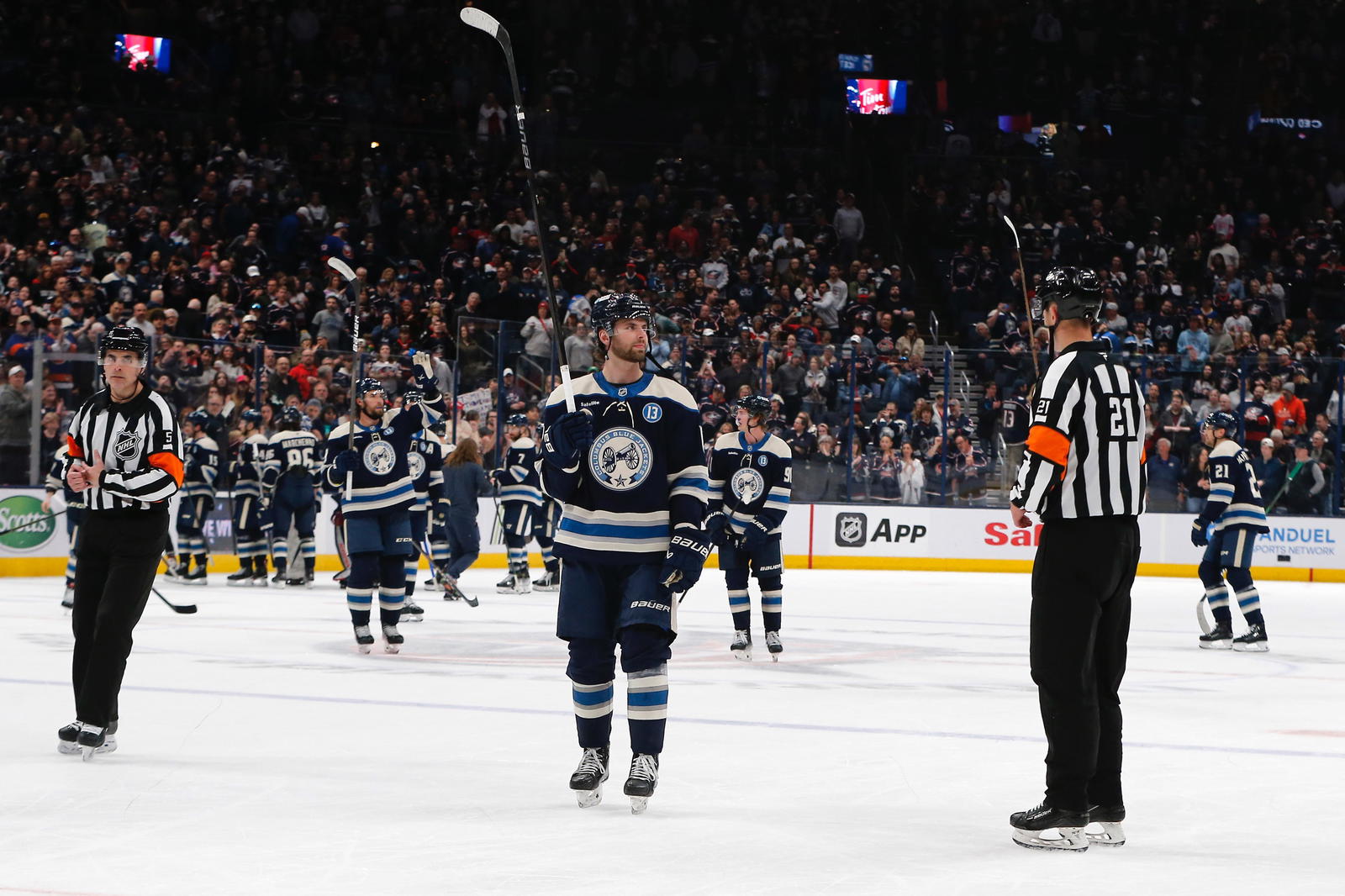
In the ranks of young Columbus leadership, then, Werenski will join Jones, his partner on defense. “When (Jones) speaks, guys listen,” Foligno said. “That’s not easy to do (as a young player), but he backs it up with his play. Guys will follow a guy like that.”
The Blue Jackets have their relative geezers – winger Cam Atkinson is 28, Foligno is 29, defenseman Jack Johnson is 30 – but if this franchise is to build on the respect that its coach believes it has finally earned, it’ll be on the shoulders of its most youthful players. Last season, only Winnipeg had a younger average age than Columbus. The stars among the Jackets’ young core – Jones, Werenski and 23-year-old center Alexander Wennberg – all must prove they can cut it in the playoffs for the team to truly contend.
In Columbus, Jones and Werenski are known as something of a laid-back duo, not quiet, per se, but certainly not as fiery as their notoriously brooding coach. Yet opponents would be best not to mistake that attitude as complacency.
Jones was asked if he felt a certain kinship to his former teammates in Nashville, who roared to the Stanley Cup final last season without him. Did he feel jealous? Perhaps he could be forgiven if he was even rooting for the Predators, the team he’d spent his earliest and most impressionable days with in this league. But the suggestion was batted away, like a charging forward in his end. “I’m not going to choose favorites in the Cup final,” Jones said, “unless I’m in it.”



1
Comments

Powered by RoundtableAn AI/DeFi-powered Enterprise Media Operating System. Learn more at Roundtable.io.© Roundtable 2026. By using this site you agree to the Terms of Use and Privacy Policy