


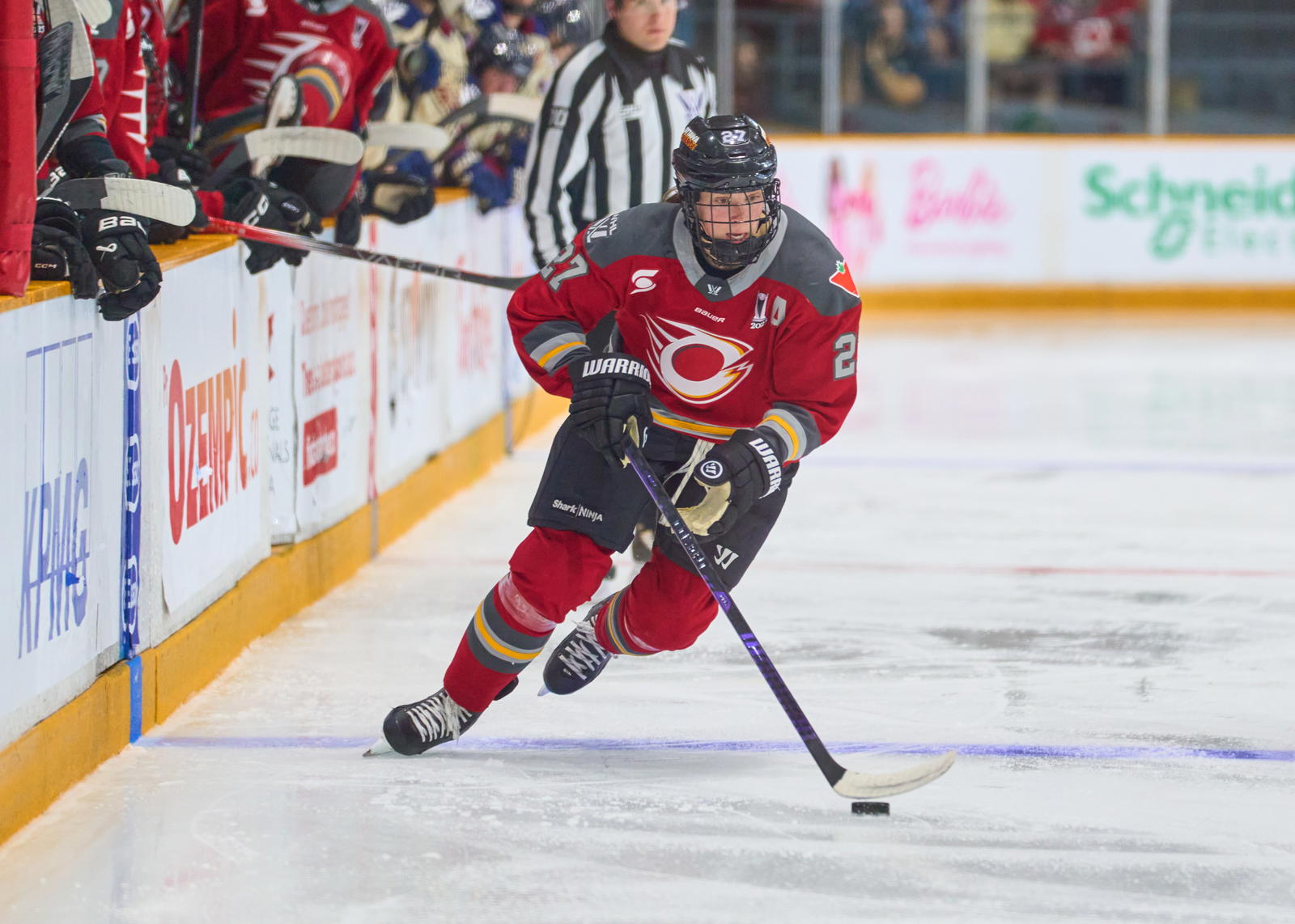
 Shiann Darkangelo rushes the puck for the Ottawa Charge in game four - Photo @ Ellen Bond
The Ottawa Charge booked their first-ever trip to the Walter Cup final with a 3-1 series win over the league-leading Montreal Victoire. Now they face the defending champion Minnesota Frost, a team with firepower, experience, and expectations. But don’t expect the Charge to lean on that narrative.
“I guess you could go with that mentality,” said goaltender Gwyneth Philips. “But this league is so close. Is there really an underdog? I don’t think that’s what we need to push ourselves right now. I think we really trust each other, and that’s what’s fuelling us.”
The best-of-five series gets underway Tuesday night in Ottawa.
Both teams had their share of ups and downs this season, but each found its stride when it mattered. Here's how they match up heading into the Walter Cup final.
Goaltending
Emerance Maschmeyer entered the season as Ottawa’s clear-cut starter, a role she’s held since the team first hit the ice. She was in the thick of the MVP conversation before a lower-body injury sidelined her on March 11. In her place, rookie Gwyneth Philips has stepped in and looked anything but inexperienced. She posted an 8-5-1-0 record in the regular season, with a .919 save percentage, a 2.11 goals-against average, and two shutouts. That momentum has carried into the playoffs, where she’s started all four games, going 3-0-1 with a 1.14 goals-against average, a .956 save percentage, and one shutout. She’s been lights out, giving the Charge stability and confidence throughout their playoff run.
Minnesota has leaned on a tandem approach all season, with Maddie Rooney (8-7-1-2) and Nicole Hensley (7-3-1-0) splitting the regular-season workload. They’ve continued that rotation in the playoffs, but not by design. Goaltending was a question mark in their semifinal series against Toronto, where both netminders had moments of inconsistency. Hensley fared slightly better, finishing the series with a 1-1-0 record, a 2.68 goals-against average, and a .909 save percentage. In the end, Minnesota’s strength came from outscoring rather than out-saving.
Edge: Ottawa
Defence
Ottawa made it clear heading into the offseason that upgrading the back end was a priority, and it’s paying off. Anchored by Ashton Bell and Jocelyne Larocque, Ottawa’s defence played a key role in shutting down Montreal’s top stars. Marie-Philip Poulin and Laura Stacey were held to just three points combined, marking a major win for Ottawa’s blueline. This group isn’t flashy offensively, with Aneta Tejralová leading the way with two points, but they defend hard, block shots, and move the puck out of their zone with tremendous skill. The team remains without veteran Jincy Roese, who’s been sidelined with an upper-body injury since the end of the regular season.
Minnesota brings a more offensive look to the blueline. Lee Stecklein and Sophie Jaques have both posted six points through the playoffs, with Jaques scoring a game-winner. The Frost’s defence is active and involved, generating 38 shots on goal in their series against Toronto. They’re a threat from the point and help drive the team’s offence.
Edge: Minnesota
Forwards
Ottawa’s forward group has evolved into a more balanced unit this season, and it’s showing in the playoffs. Nine of their 13 forwards registered at least a point in the semifinal against Montreal, with strong contributions from depth players like Shiann Darkangelo, who continues to be a reliable two-way presence and has been excellent in the faceoff circle (61.3%). Ottawa’s strength down the middle has been a key storyline, led by Gabbie Hughes, who’s been steady on draws and dependable in high-pressure situations. Her line with Emily Clark and Manon McMahon was often tasked with shutting down Montreal’s top trio, most notably Marie-Philip Poulin, and did so with impressive consistency.
Minnesota boasts a similarly well-rounded attack. Their top line of Kendall Coyne Schofield, Taylor Heise, and Michaela Cava has been dangerous all playoffs, but the Frost also get consistent contributions from players like Kelly Pannek, Brooke McQuigge, and Liz Schepers. Like Ottawa, they come at you in waves and don’t rely solely on star power, making them very difficult to defend against, as made clear by their 33 points in the opening round against Toronto.
Edge: Draw
Special Teams
This has been a weak spot for Ottawa all season. After finishing first on the power play last year (25%), they dropped to last in the league this season at 14.9%. The playoffs haven’t been much better, as they’ve gone just 1-for-9 on the power play, with their lone goal coming from Brianne Jenner in Game 1 versus Montreal. Since then, they’ve failed to convert, putting them at 11.1%, last among playoff teams.
Their penalty kill, which ranked fifth in the regular season (80.2%), has been more reliable in the postseason. They haven’t allowed a power play goal since the opening game of their series against Montreal, and they currently sit second among playoff teams with a 77.8% success rate.
Minnesota, on the other hand, has been lethal on the power play. They scored in three of their four games against Toronto and finished the series with a league-best 55.6%. That number is likely inflated by Toronto’s goaltending struggles, but it’s still a sign of how dangerous their top units can be. Eleven different players registered at least one power play point in that series.
The penalty kill, however, could be Minnesota’s weak point. They allowed three goals on nine opportunities against Toronto, finishing the series at just 66.7%.
Edge: Minnesota
Final Word
On paper, the edge leans toward Minnesota. They have the experience, the firepower, and a special teams unit that can take over a game. It’s easy to see why many consider them to be the favourites to repeat as Walter Cup champions.
But to counter that, Ottawa has something harder to measure which you won’t see in the stats. This is a team that believes in each other. A team that’s found its identity at exactly the right time, backed by stellar goaltending, a full-team commitment to defence, and depth scoring.
“I’m really proud of how our group is really focused on ourselves and developed our game,” said forward Emily Clark. “I just feel like maybe there’s been some inconsistencies or some ups and downs, but I really feel like we continued to just build and now we’re playing our best hockey at the right time.”
And in a league this close, that belief can be the difference.
