


Aug 8, 2025 4:04 PM
The Utah Mammoth are here in the NHL prospect pool overview series.
Tony Ferrari digs into Utah’s strengths and weaknesses, latest draft class, positional depth chart, next player in line for an NHL opportunity and more. A player who no longer holds rookie eligibility in the NHL is considered graduated and no longer a prospect for these exercises, with few exceptions.
Initial Thoughts
New year, new name. The Utah Hockey Club run lasted just one season before the team was officially named the Utah Mammoth, a fitting name for a team that loves to draft big, hulking players. The team took some significant steps last season, leaning on its youth led by Logan Cooley and Dylan Guenther, along with some young veterans like Clayton Keller and Mikhail Sergachev. The Mammoth will look to take an even bigger step this season as they build off a solid first season in Utah.
Shortly after last season ended, top prospects Dmitri Simashev and Daniil But signed their entry-level contracts with the intent of coming to North America for the upcoming season. The Russians are tied together in Utah lore as they were selected with the 6th and 12th picks in the 2023 NHL draft. They are now looked at as the faces of Utah’s strategy of drafting big, hulking players and building up a pipeline of beef to supplement some of the young skill they have. The nice thing about Simashev and But is that they are high-quality players who could potentially play in the top four of the defense or top six of the forward core, respectively.
Simashev is a 6-foot-5 blueliner with a picturesque stride who welcomes physicality. His mobility allows him to close gaps quickly and force attackers into the corners, and his size gives him the advantage in just about every puck battle. Simashev possesses some underrated puck-handling and passing abilities, which are particularly evident when avoiding pressure from forecheckers or executing a clean breakout.
When it comes to But, the tantalizing aspects of his game come from the fact that, despite his 6-foot-6 frame, he has the mobility and puck handling of a 5-foot-10 forward who has to weave his way through the game. But is a very strong shooter with a developing playmaking game. He seems to embrace both his physical advantages and his desire to play a shifty, skillful game with the puck on his stick. But could be a very good top-six winger who complements the skill already present.
 Tij Iginla (Christopher Hanewinckel-Imagn Images)
When Mammoth made Tij Iginla the first pick in Utah’s existence, they strayed from their usual desire for massive players to go with a 6-foot winger who plays with the heart of a lion. Iginla is uber competitive, and he has a skill set that matches his relentless nature. Equal parts finisher and playmaker, Iginla is a player with the potential to put up some very solid numbers. He only played 21 games last season due to injury, but when he was at his best and looked fully healthy, Iginla was a nuisance for opposing teams. His motor never dies out, and that’s the key to his game.
Cole Beaudoin plays a heavy, straightforward game. He goes into board battles with a high success rate of coming out of them with the puck, peeling off the wall and into the middle of the ice. Beaudoin attacks downhill, looking to put defenders on their heels. His defensive game is solid, using his size and strength to apply pressure and force players to the outside where he can finish along the boards. Beaudoin is a strong two-way forward who could be a depth scorer who plays a heavy game on an NHL team’s third line.
Yet another massive blueliner, Maveric Lamoureux, played 15 NHL games last season with some success, but he really showcased his potential at the AHL level. Lamoureux stands 6-foot-7 and uses his length extremely well at both ends of the ice. He engulfs attackers as they enter the zone and seals them off along the boards. In the offensive zone, he has shown the ability to use his wingspan to help protect the puck before passing it off to a teammate. Lamoureux could get a bigger NHL role this season as the Mammoth look to build up their blueline.
 Maveric Lamoureux (Steve Roberts-Imagn Images)
Artyom Duda took a weird path to get to this point, but after a good rookie season in the AHL, his year spent in Canadian college is all but forgotten. Duda has matured since his days in Russia, using his teammates more effectively in the offensive zone and deferring a bit more. His defensive game is best when he’s playing positional hockey and staying between the puck and the net. Duda should be an important piece on the Tucson Roadrunners’ blueline in the AHL.
22-year-old German defender, Maksymilian Szuber, has two AHL seasons under his belt now, and he’s looked quite good. He’s not an incredibly flashy defender, reserving his efforts for the defensive side of the game while maintaining some steady passing ability to ensure that he’s able to break the puck out. Szuber keeps things simple and doesn’t stray from that.
In net, the Mammoth have Michael Hrabal, who has been one of the top prospects in his age group the last few years. His sophomore season at UMass was fantastic, posting a .924 save percentage at the NCAA level while performing at a high level internationally as well for Czechia. His size and athleticism are key factors in his ability to stop pucks. As with most goalies, he’s likely going to need to jump to the AHL after his NCAA career, but there’s plenty of promise in his game.
U-23 Players Likely To Be On NHL Roster This Season
Logan Cooley (C/W), Dylan Guenther (LW/RW), Daniil But (LW), Dmitri Simashev (D)
 Logan Cooley and Dylan Guenther (Stan Szeto-Imagn Images)
2025 NHL Draft Class
Round 1, 4th overall - Caleb Desnoyers, C, Moncton (QMJHL)
Round 2, 46th overall - Max Psenicka, D, Portland (WHL)
Round 3, 78th overall - Stepan Hoch, LW, Ceske Budejovice (Czech Jr)
Round 4, 110th overall - Yegor Borikov, RW, Dynamo (KHL)
Round 5,142nd overall - Ivan Tkach-Tkachenko, G, Ufa Tolpar (Russia)
Round 6, 174th overall - Ludvig Johnson, D, Zug (Swiss.)
Round 6, 182nd overall - Reko Alanko, D, Jokerit (Finland)
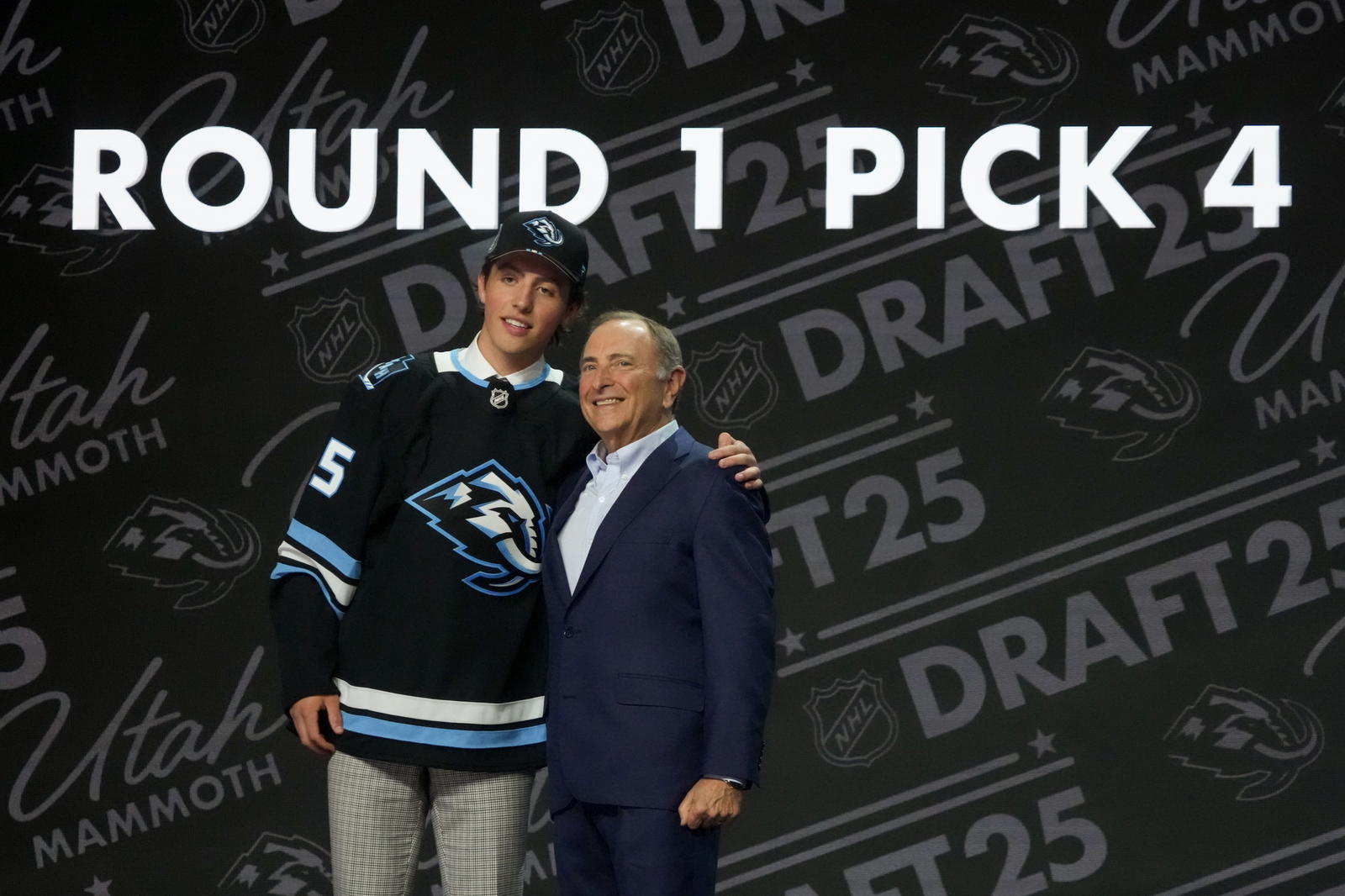 Caleb Desnoyers (Kirby Lee-Imagn Images)
The Caleb Desnoyers hype train was going full steam all season long. Desnoyers is a tactician with the puck, feathering passes through traffic with ease and connecting play at a high level. He’s an opportunistic forward who positions himself well in all three zones. He’s not the transition driver, but he’s a capable bumper and outlet if the opposing team closes on the puck carrier. Defensively, Desnoyer always finds himself in passing lanes and breaking up plays, turning it around quickly. Desnoyers needs to play a bit more high-paced hockey, but the building blocks for a methodical top-six center are all there.
The Mammoth went back to drafting massive defenders in the second round, selecting Max Psenicka. The Czech blueliner is a hard-working, physical defender who is always looking to get into the face of attackers. He skates well for his size and thrives along the walls because he can skate out of pressure when he gets the puck on his stick. Psenicka flashes some nice puck-moving, but he will need to refine some of his game to ensure that he can play a bigger role at the pro level and not be relegated to third-pairing duties.
Seldom ranked in the top 100, Stepan Hoch was a bit of a surprise pick in round three, but the Mammoth valued his two-way play and positional versatility. The 6-foot-4 forward is an effective play reader who sits back to stalk the opposing team before jumping at the chance to break up play in the neutral zone or in his end. Offensively, Hoch is a player who won't be a dynamic presence, but he understands how to play tactical hockey with short, purposeful passes up ice. Hoch is a smart player who plays positional offensive hockey, looking to pop into pockets or break through seams to work the puck around the ice.
In the fourth round, Utah drafted overage forward Yegor Borikov. The 19-year-old has a heavy shot and isn’t afraid to use it from just about anywhere in the offensive zone. When engaged, he’s a fluid skater who gets around the ice and sets himself up to be the finisher on his line. His effort lacks at times, and he doesn’t stay engaged through the entirety of a game, which is the big drawback at the moment.
Utah added a netminder in round five, taking Ivan Tkach-Tkachenko. He has good size at 6-foot-3 and relies on his athleticism quite a bit. He likes to cut down the angle on shooters, which can leave him vulnerable to lateral passes, and he can be a bit scrambled when trying to recover, but he does a very good job of moving quickly and regaining positioning. He’s a nice bet in the latter half of the draft because with some refinement, it could pay off.
Ludvig Johnson has long been a favorite of mine, going back to his draft year a year ago. He’s been on every overage list I’ve put out this year, and he was a hidden gem I highlighted last year. Although he’s not the biggest defender, Johnson was a very steady presence at both ends of the ice thanks to his skating and play-reading ability. Johnson looked quite good at the Swiss pro level this past season. When he played at the U-20 level, he looked in control of the game. This is a bet on development, and getting him to the AHL in a year or so will help refine some of the areas of his game that will need to be adjusted to North America, like his physicality.
The Mammoth’s final pick of the draft was Reko Alanko, a Finnish defender who towers over his opponents and brings a heavy defensive game. Playing primarily at the U-18 level in Finland, Alanko was a defensive stud, crushing attackers as they entered the zone and then making quick, smart plays with the puck. He is very raw with the puck on his stick, but some skill pops up from time to time. He’s a really interesting late-round swing on a player with size and a base to build off of at both ends of the ice.
Strengths
Utah doesn’t have a clear strength at any given position. Left wing is a deep spot with a few notable prospects like Iginla and But, but it starts to drop off after that. Center looks promising with Cooley already on the roster, as well as the newly drafted Desnoyers joining Beaudoin and Allard in the pipeline. The biggest area of strength might be left-shot defense, a position that might not be the flashiest or the most highly skilled, but it’s filled with potential role players behind the top guys.
Simashev is the top dog, but Szuber and Duda were very solid in the AHL last year, both showing their two-way ability. Veeti Vaisanen has the potential to grow into a solid defenseman, even if he had a bit of an up-and-down year in Medicine Hat. Johnson was a sneaky good add in the draft this year, as he was one of my top-ranked overage prospects. Gregor Biber and Ales Cech are interesting swings on talent deeper in the pipeline.
Weaknesses
The Mammoth have a very good prospect pipeline with some high-end prospects and plenty of depth to go around. The one area that seems to be a bit of a weakness is the right wing. They have a couple of mid-low-level prospects, but they don’t have any potential impact players, and the depth on the right side is mediocre at best. For a team with plenty of youth throughout the system, they don’t seem to have much down the right side up front.
Hidden Gem: Gregor Biber, D
Don’t let his underwhelming point totals fool you, Gregor Biber was an impactful defender in the SHL this past season with Rogle. His defensive game is steady with excellent size and reach, combined with very solid mobility and a physical edge. He plays a smart game in his end, closing on play quickly, overwhelming attackers and then making the simple play with the puck. As an 18-year-old, he adapted to the pro game quite well, and if he continues on this trajectory, he could be a very valuable defensive asset for the Mammoth down the road as a third-pair, reliable shutdown defender with penalty kill utility.
 Daniil But ( Christopher Hanewinckel-Imagn Images)
Next Man Up: Daniil But, LW/Dmitri Simashev, D
It’s no sure thing that either But or Simashev end up in the NHL to start the season, but it won’t be shocking to see either or both of them getting some NHL games later in the season. Both But and Simashev are hulking players who bring a lot to the game at their respective positions. But is a skilled winger who has the hands of a player much smaller. He can get himself into open ice by maneuvering the puck through defenders with both his skating and skill. He can make a pass or get a shot off from any hand position, keeping defenders and goalies on their toes.
With Simashev, there is a shutdown defender who moves extremely well and closes on attackers quickly. He flashes some advanced puck handling at times and even has some nice offensive habits when attacking off the blueline. He wasn’t a big point producer, but it wouldn’t be shocking to see him become a 30-point blueliner at some point with some added confidence and more involved teammates in the offensive zone.
Prospect Depth Chart Notables
LW: Tij Iginla, Daniil But, Noel Nordh, Julian Lutz, Ilya Fedotov, Sam Lipkin
C: Caleb Desnoyers, Cole Beaudoin, Owen Allard, Tanner Ludtke, Gabe Smith, Vojtech Hradec
RW: Vadim Moroz, Miko Matikka, Yegor Borikov
LD: Dmitri Simashev, Artyom Duda, Veeti Vaisanen, Ludvig Johnson, Maksymilian Szuber, Ales Cech, Gregor Biber
RD: Maveric Lamoureux, Max Psenicka, Tomas Lavoie
G: Michal Hrabal, Melker Thelin, Ivan Tkach-Tkachenko, Carsen Musser, Anson Thornton
For a deeper dive into the prospect pool with player rankings, check out the Yearbook and Future Watch editions of the Hockey News print edition!
Comments

Powered by RoundtableBuilt on infrastructure designed for real-time media. Learn more at RTB.io.© Roundtable 2026. By using this site you agree to the Terms of Use and Privacy Policy